Territorial Pissings: Nirvana and the Politics of Marking Ground
 POP Ideas · Music & Language
Territorial Pissings: Nirvana and the Politics of Marking Ground
A possible political reading of Kurt Cobain’s rage — territory, gender, alienation, and the search for a way out of the map.
There is a phrase that often opens well-intentioned, almost obligatory speeches: “love one another.” It sounds good, marketable, comfortable. However, it only takes a war, a border, a crisis, or a real dispute for everything to change instantly. Suddenly, the world orders itself into much more primitive phrases: “this is mine,” “this is yours,” and “do not cross this line.”
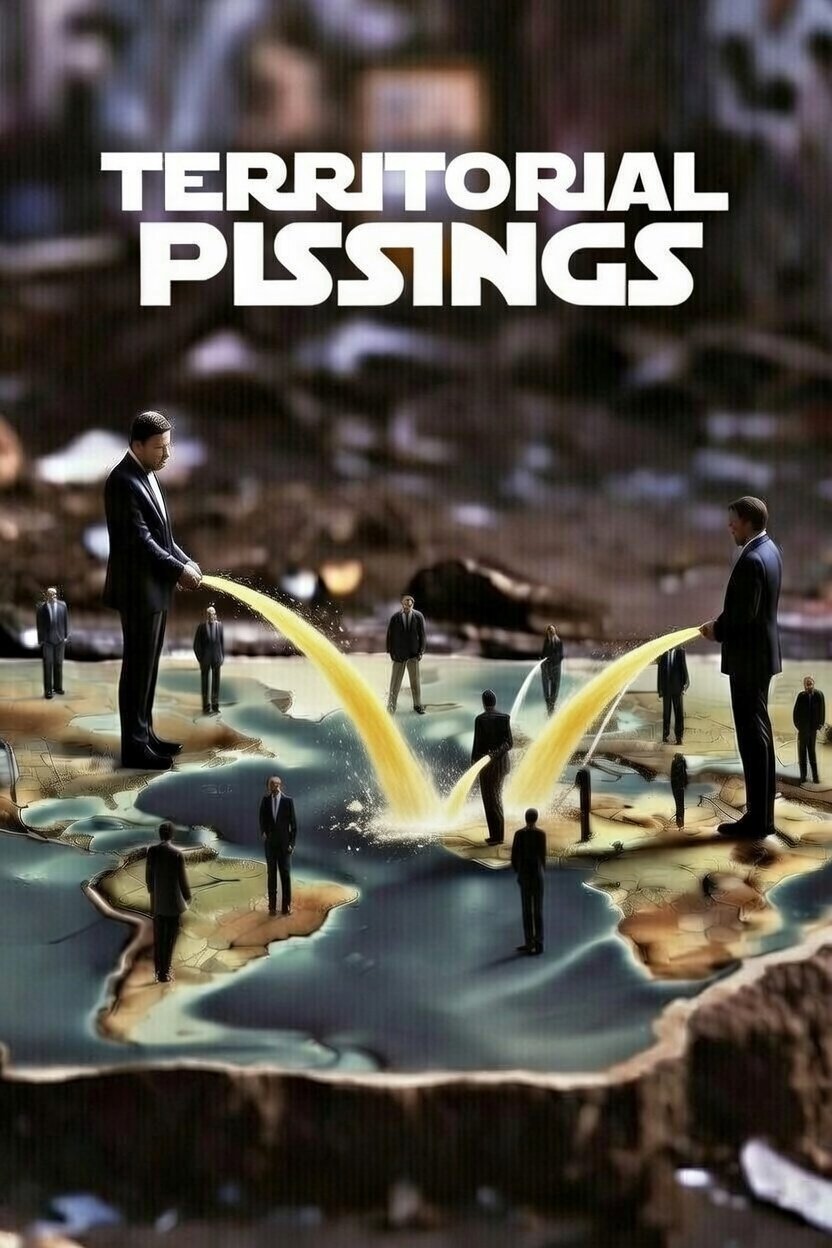
Why does this happen? It is not due to a divine truth or a natural reason. Instead, it is often because of something as basic and absurd as a mark — as if someone, at some point in history, urinated on a territory and decided that from then on, it belonged to them. Consequently, this has been the historical reality in almost every corner of the globe. Although our rhetoric changes, the underlying logic remains the same.
“Territorial Pissings” by Nirvana is not just a song of rage. On the contrary, it is a brutal X-ray of this logic. Its brilliance lies not in stating a closed truth, but in writing from a deliberate ambiguity that allows for several layers of reading simultaneously.
🔎 Metaphors and ideas to notice
This is one possible interpretation. POP Ideas reads songs as case studies in how language creates meaning.
The Ambiguity of Method and Instinct
Kurt Cobain is often reduced to an icon of apathy or chaos. Nevertheless, his writing possesses surgical precision: he does not provide “pre-chewed” messages, instead he constructs containers of meaning. While the audience argues about the song’s “true” meaning, he escapes through the middle — every key word opens a political, physical, and cultural field.
The word “territorial” takes us directly to ethology, the study of animal behavior. A dog does not urinate out of physiological necessity; it urinates to mark — it is saying, “this is mine.” Cobain takes this logic and transfers it to the human plane. Whether it is a man marking his home, his partner, his country, or his ideas, the impulse is identical. The territory is not the land; it is the obsession with control.
In this context, we can see how the song challenges the very idea of private property. By comparing human behavior to animal instincts, Cobain strips away the “civilized” veneer of our legal systems. If property is just a “pissing,” then its legitimacy is purely based on strength and visibility, not on any higher moral ground.
The Gendered Power of the Mark
In English, there is a significant difference between “urinating” and “pissing.” Urinating is clinical, neutral, and private. Pissing, however, is aggressive, loud, and directed outward. Culturally, women are often taught to “urinate,” while “pissing” is coded as masculine — an exhibition of dominance and a display of power. By titling the song “Territorial Pissings,” Cobain applies a specific gender to the conflict.
He is not talking about abstract humanity. Instead, he addresses a specifically masculine and violent way of relating to the world. Therefore, the “pissing” becomes a metaphor for the aggressive colonization of spaces, both physical and ideological. This gendered reading is crucial because it connects the personal with the political, showing how patriarchy and territoriality are inextricably linked.
Key Lines and Political Readings
| Original Lyrics | Key Analysis / Interpretation |
|---|---|
| “When I’m there” | Inevitable system: the “there” represents the inside of the established power structure. You don’t just arrive; you find yourself already within its borders. |
| “Never met a wise man, if so it’s a woman” | Disruption of patriarchy: a critique of the male-dominated “wisdom” that justifies territory and war. True insight exists outside the “marked” center. |
| “Just because you’re paranoid don’t mean they’re not after you” | Political realism: paranoia does not invalidate persecution. For the “alien,” the threat of the system is often a material reality. |
The Concept of the Alien and Alienation
The word “alien” is the most powerful core of the song. It functions on at least three simultaneous levels: first, it refers to the “weirdo” — the one who doesn’t belong. Second, it points to the political foreigner — the “illegal” who crosses a border someone else marked. Finally, it mirrors Marxist alienation: the subject separated from themselves within the system.
Cobain embodies all three. He was an outsider in rock culture, an “illegal” in the conservative value system of the time, and ultimately alienated from his own fame. Consequently, when he screams about being an alien, he is describing the friction of a body that refuses to be “marked” by the territory it inhabits.
Furthermore, the term “alien” highlights the absurdity of borders. If someone is an “alien” just because they crossed a line, then the line itself is the source of the conflict. Cobain identifies with this displaced figure, choosing to embrace the “alien” status rather than fight for a piece of marked territory.
Finding a Way Out of the Map
In the bridge, we hear the haunting repetition: “Gotta find a way, a better way, I’d better wait.” This is profoundly human and very “Cobain” because it lacks heroic epicness: first, there is the necessity of a path. Then, the desire for a better one. Finally, there is the hesitation — a deep awareness of the risks involved in dissent.
There is no revolutionary epic here. Instead, there is doubt, calculation, and the fatigue of being an outsider. Cobain does not romanticize the escape: he knows that leaving the marked territory carries a high cost, and it is not always possible to do so immediately. The “alien” is not a martyr; the alien is a survivor trying to navigate a world of traps.
The word “way” is also a double entendre — it can mean a physical path or a method of existence. By searching for a “better way,” Cobain is looking for a method of living that doesn’t involve marking or being marked: a search for a space without owners, a crack in the map where one can simply exist without the pressure of territoriality.
Marx and the Clearing of Estates
The line “Cultures weren’t opinions” condenses a brutal historical critique. There was a time when you were born into a culture, and that was it — no choice, no reflection, no critical distance. Culture was not a stance; it was an established, unquestionable truth. While modernity introduced “opinion,” that transition was far from peaceful: it was built on displacement.
This brings us to the Marxist concept of the “clearing of estates.” The formation of the first states was not a philosophical debate — it was simple: advance, mark, kill, expel, and afterward, legalize. First comes the violence (the “pissing”), and then comes the law (the “territory”). The law does not create the territory; it merely legitimizes it after the fact.
“Territorial Pissings” echoes this history of despoilment. It reminds us that every “civilized” border started with an act of primitive aggression that was later dressed up in legal language.
More Nirvana Readings on POP Ideas
Keep exploring other POP Ideas articles on ambiguity, identity, and power in Kurt Cobain’s writing.
- Something in the Way → consumption, addiction and moral permission.
Read the analysis - Dumb → emotional numbness and glue as a metaphor for escape.
Read the analysis - About a Girl → semantic ambiguity and the difficulty of defining a relationship.
Read the analysis
Conclusion: The Radical Act of Finding a Way
Ultimately, “Territorial Pissings” is not a song about teenage angst. It is a raw indictment of how language, the body, and power are organized around the idea of ownership. Cobain doesn’t propose easy solutions or offer slogans — instead, he does something much more uncomfortable: he exposes the mechanism of the system while it is still running.
While the public continues to debate what he “meant,” the singer had already found the only thing that mattered to him: an exit. In a world obsessed with marking, claiming, and owning, sometimes simply finding a “way” is the most radical act of all.