Blog

  • “Underneath the Bridge, Tarp Has Sprung a Leak”: Meaning of the Metaphor in Nirvana

    “Underneath the Bridge, Tarp Has Sprung a Leak”: Meaning of the Metaphor in Nirvana

    POP Ideas POP Ideas · Música, Lenguaje y Cultura

    “Underneath the Bridge, Tarp Has Sprung a Leak”: significado de la metáfora en Nirvana

    Una posible lectura desde la teoría de la metáfora conceptual de Lakoff y Turner.

    La frase de inicio de “Something in the Way”, “Underneath the bridge, tarp has sprung a leak”, es un cúmulo de metáforas en sí misma. La teoría de la metáfora conceptual, desarrollada por George Lakoff y Mark Turner en More Than Cool Reason: A Field Guide to Poetic Metaphor, puede ayudarnos a entenderla. Según los autores, el lenguaje poético no inventa sensaciones de la nada, sino que toma nuestro conocimiento cotidiano del mundo físico y lo proyecta sobre estados emocionales abstractos.

    Underneath the bridge, tarp has sprung a leak

    “Debajo del puente, la lona empezó a tener una gotera”

    🔎 Las metáforas en juego

    • Estar debajo del puente → el control está arriba, ser controlado es estar abajo.
    • La lona (tarp) → un espacio delimitado, un límite entre lo protegido y lo hostil.
    • La gotera (sprung a leak) → la vida como un fluido que se escapa del cuerpo.

    Esta es una posible lectura, apoyada en la teoría de la metáfora conceptual de Lakoff y Turner. No pretende cerrar el significado de la canción, sino mostrar cómo funcionan sus imágenes.

    Estar abajo, no tener el control

    Lakoff y Turner explican que entendemos situaciones abstractas a través de “esquemas de imagen” (image-schemas): orientaciones humanas básicas como arriba-abajo, centro-periferia, delante-detrás. Una de las metáforas estructurales más básicas de nuestro sistema conceptual es EL CONTROL ESTÁ ARRIBA, SER CONTROLADO ES ESTAR ABAJO. A eso se suma otra: LOS ESTADOS SON UBICACIONES.

    Al situar al sujeto “debajo” de un puente, la letra transmite de inmediato un estado de subordinación, marginalidad o abatimiento. No está en la cima de nada ni tiene el control: está aplastado por el peso y la estructura de lo que lo rodea.

    La lona como límite

    Comprendemos el mundo también a través de “espacios delimitados” (bounded spaces): un adentro y un afuera, como una casa, un garaje o el propio cuerpo. La lona (tarp) funciona como esa barrera física — un límite pensado para proteger un interior de la hostilidad del exterior, el frío, la lluvia. Ese límite físico se proyecta sobre un límite psicológico: la última capa de protección de la mente o de la vida de alguien.

    La fuga: cuando la vida se escapa

    Esta es, quizás, la imagen más poderosa, y se apoya en otra metáfora fundamental que analizan los autores: LA VIDA ES UN FLUIDO EN EL CUERPO, donde perder ese fluido equivale a perder vitalidad — o a la muerte.

    Lakoff y Turner analizan un verso muy similar de W. H. Auden: “And the crack in the tea-cup opens / A lane to the land of the dead” (“Y la grieta en la taza de té abre / un camino a la tierra de los muertos”). Igual que la taza rota deja escapar el líquido, una lona con una gotera representa el fracaso de esa barrera protectora. El espacio interior ya no es seguro: la vitalidad se drena, o los elementos hostiles del afuera empiezan a filtrarse hacia adentro.

    Cuando algo deja de funcionar, además, solemos decir metafóricamente que está “apagado” o “fuera de servicio”. La lona goteando es exactamente eso: un mecanismo de defensa que dejó de funcionar, dejando a la persona expuesta.

    Síntesis

    La fuerza poética de este verso está en cómo toma una escena física dolorosamente ordinaria — estar debajo de un puente, tratando de cubrirse con una lona rota — y activa metáforas conceptuales que ya llevamos incorporadas sin darnos cuenta. A través de la orientación espacial (estar abajo, sometido) y la ruptura de un contenedor (perder la protección, perder vitalidad), la letra hace sentir, de manera inmediata y visceral, un estado abstracto de abandono y vulnerabilidad extrema.

    Esta lectura no pretende cerrar el significado de la canción, sino abrir una posible forma de pensarla.

    Más lecturas

    Este análisis se enfoca en un solo verso. Si querés la lectura completa de la canción — consumo, permiso moral y el resto de la letra:

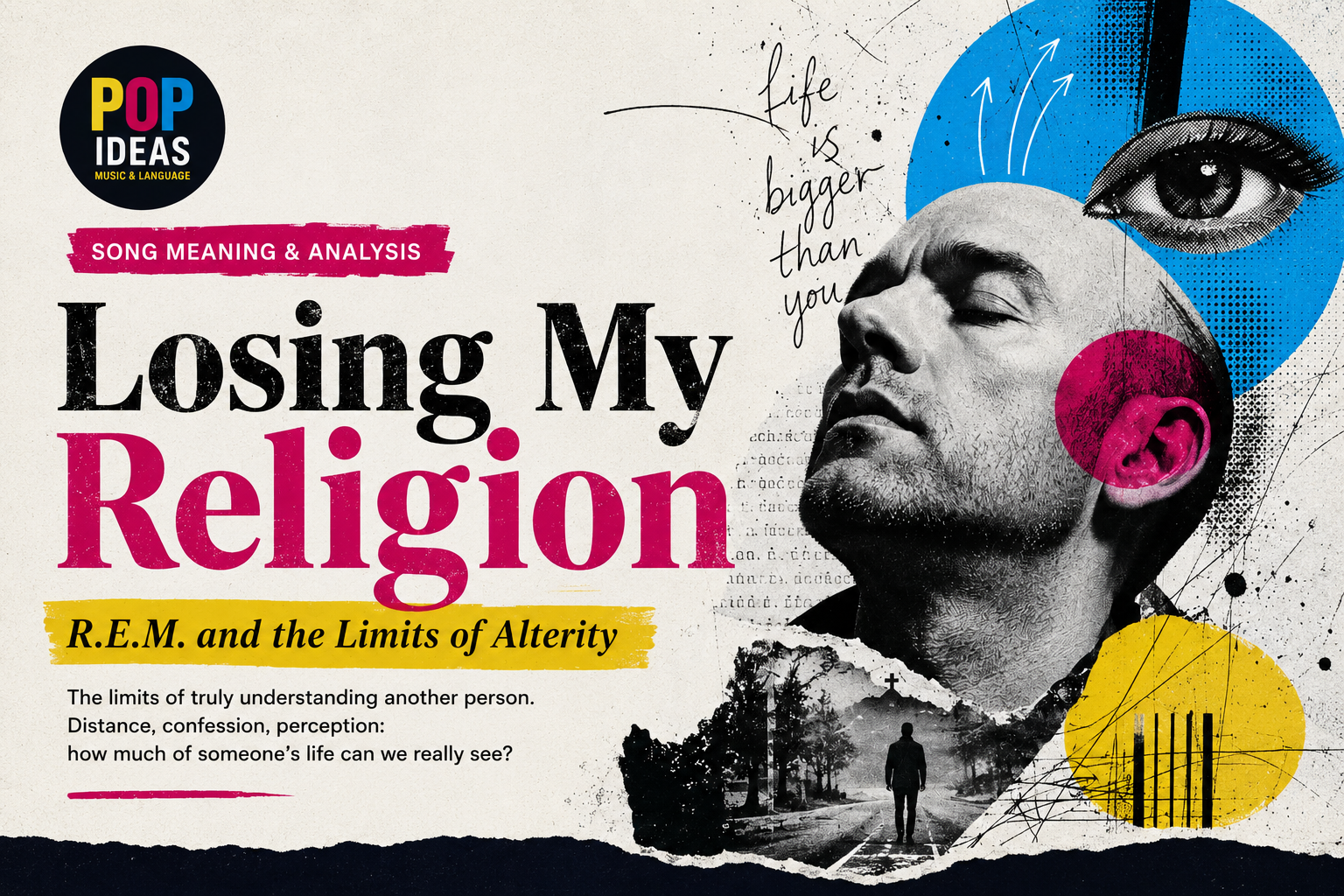
  • Losing My Religion Meaning: R.E.M. and the Limits of Alterity

    Losing My Religion Meaning: R.E.M. and the Limits of Alterity

    POP Ideas POP Ideas · Music & Language

    Losing My Religion Meaning: R.E.M. and the Limits of Alterity

    A look at the meaning behind R.E.M.’s lyrics — on the distance between what we live through and what others can actually see of us.

    The meaning of “Losing My Religion” is usually flattened into a song about obsessive love. This reading offers another possible meaning: alterity, a fancy word for something simple — the fact that other people are never fully knowable from the outside. How much of what we live through can really be seen, understood, or shared by someone else?

    🔎 Ideas to notice

    • “You are not me” → an epistemological limit: what one person lived through, the other didn’t.
    • The distance in your eyes → seeing someone’s life is not the same as understanding it.
    • “Losing my religion” → a Southern U.S. idiom for losing your patience or temper, not literally losing your faith.
    • Choosing my confessions → not everything has to be bared to the world.

    This is one possible interpretation. POP Ideas reads songs as case studies in how language creates meaning.

    Life Is Bigger Than You

    Oh, life is bigger / It’s bigger than you, and you are not me

    The line starts from an idea of radical humility: life is bigger than either of them, and “you are not me” isn’t just a statement about identity — it’s an epistemological limit. What one person lived through, the other didn’t, and that means neither of them has full authority to weigh in on the other’s experience.

    The Distance in Your Eyes

    The lengths that I will go to / The distance in your eyes

    “The lengths that I will go to” speaks to how far he’s willing to go; “the distance in your eyes” answers that commitment with an image of separation. The other person can see his whole life, his actions, his attempts — but only from their own eye, never from his. Seeing is not the same as understanding.

    Losing Your Religion, Not Your Faith

    That’s me in the corner / That’s me in the spotlight, losing my religion

    Being the center of everyone’s attention — in the corner, under the spotlight — coincides with a shift in habits and in the rigid structures of thought that used to hold him together. But the meaning of “losing my religion” isn’t, in this reading, about literally losing faith: it’s about losing everything that used to sustain him, the certainties that shaped the way he thought.

    Language note: “losing my religion” is also a colloquial Southern U.S. expression meaning to lose your patience or your temper — Michael Stipe builds the title on that double meaning, letting the regional idiom and the religious image sit inside the same phrase. You can read more about the song’s background on its Wikipedia entry.

    Trying to Keep Up With You

    Trying to keep up with you / And I don’t know if I can do it

    “Keep up with you” is a verbal phrase that means to match someone’s pace — like struggling not to fall behind a fast walker. Applied to a person instead of a physical stride, the phrase becomes more honest than it first sounds: trying to “keep up” with someone hits a real limit. He doesn’t know if he can do it. He doesn’t know if he can ever know everything that’s actually happening to the other person.

    Choosing My Confessions

    Every whisper, of every waking hour / I’m choosing my confessions

    Every whisper, every waking hour, involves a choice: what to say and what not to. “Choosing my confessions” is an acknowledgment that not everything has to be bared to the world — that there’s a right to reserve, even inside intimacy.

    A Hurt, Lost and Blinded Fool

    Trying to keep an eye on you / Like a hurt, lost and blinded fool, fool

    “Trying to keep an eye on you” is an attempt to stay close, to watch over, to care — but the line frames that attempt as the position of someone hurt, someone lost, a fool blinded by what he’s watching without fully seeing it.

    What If All These Fantasies Come Flailing Around?

    Consider this, the hint of the century / Consider this, the slip that brought me to my knees, failed / What if all these fantasies come flailing around?

    “Consider this, the hint of the century” works almost like a piece of life advice: no one can ever fully stand in someone else’s shoes. “The slip” that brought him to his knees is a real event or mistake that forced him to rethink how he sees things. And the question that closes the passage — what if all these fantasies come flailing around? — can be read on two levels at once, and both change the meaning of the verse: as the doubt that none of it was ever real, and as the concrete question of what would happen if he lost his health, his job, or any other thing holding his life together — the kind of loss that also forces a person to change their behavior.

    This reading does not try to close the meaning of the song, but to open one possible meaning among others.

    More Readings

    Another song whose meaning also treats identity as something defined in relation to someone else:

    • Come As You Are (Nirvana) → identity, contradiction, and the social gaze.
      Read the analysis
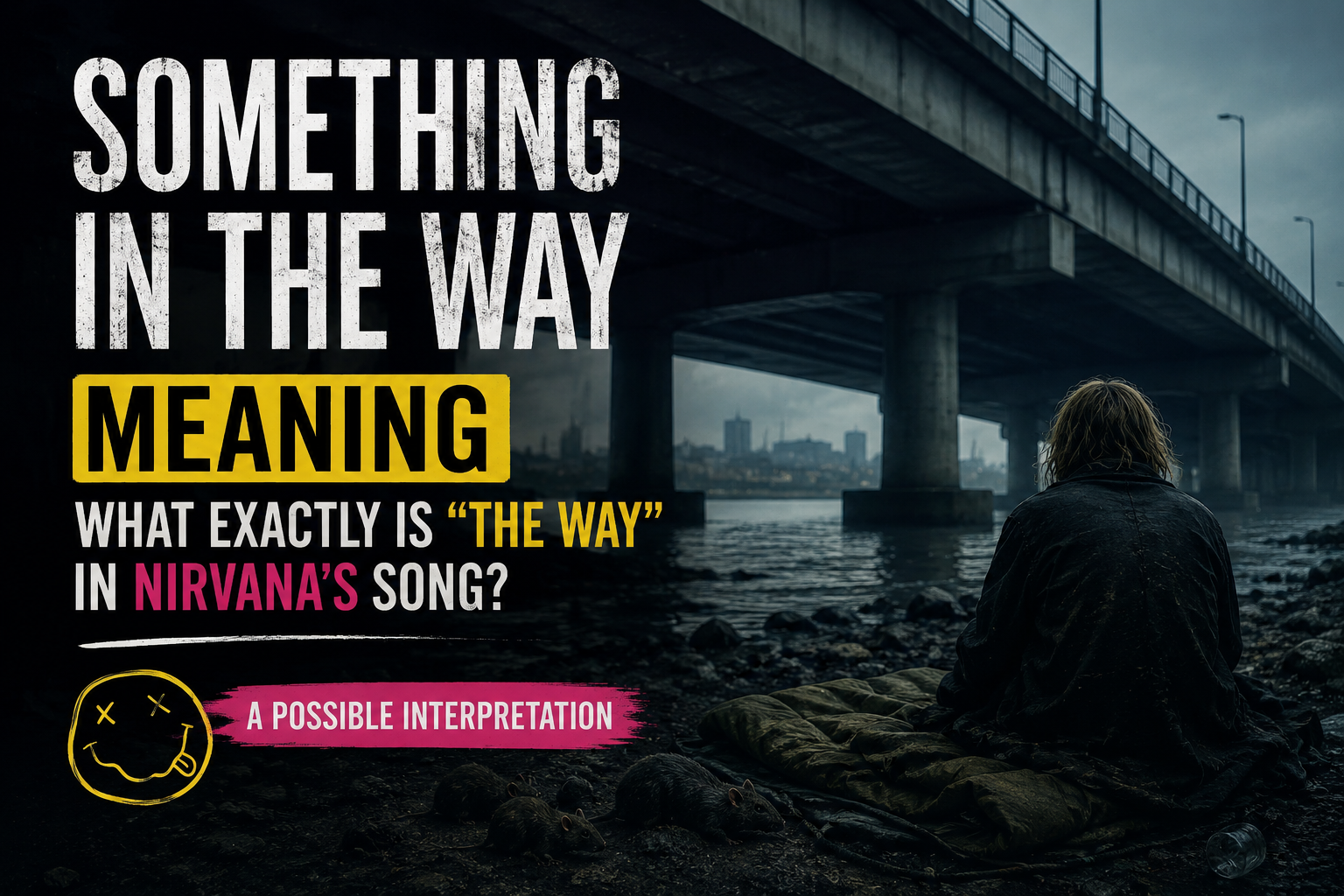
  • Something in the Way: Nirvana, Consumption and Moral Permission

    Something in the Way: Nirvana, Consumption and Moral Permission

    POP Ideas POP Ideas · Music & Language

    Something in the Way: Nirvana, Consumption and Moral Permission

    A possible interpretation of Nirvana’s song through language, consumption, addiction, and moral permission.

    🔎 Metaphors and Ideas to Notice

    • Way → not only a road, but also a method, manner, condition, or way of life.
    • The bridge → a border between two sides: consumption and refusal, addiction and non-addiction, guilt and purity.
    • Under the bridge → the speaker is not crossing into another life; he remains in-between.
    • The leaking tarp → protection fails; something hidden begins to leak through.
    • The trapped animals → what could be consumed becomes too close or too familiar to consume.
    • Grass and dripping water → survival is reduced to almost nothing.
    • The fish line → one form of consumption is allowed because it seems less morally charged.
    • The unnamed obstacle → the blockage may be moral, bodily, emotional, and social at once.

    1. Three Ways to Understand “Way”

    The first thing that caught my attention was the word way. In English, way does not only mean a physical road. According to Merriam-Webster, it can also refer to a route, a course of action, a method, a manner, a mode, a system, or a habitual form of being.

    That means Something in the Way can be read on several levels at once.

    1. Something in the path

    There is an obstacle that does not let me move forward.

    2. Something in the manner

    There is something in the way I live, think, feel, consume, or behave that does not work.

    3. Something in the way things are

    There is an invisible structure, condition, or system that shapes what I can and cannot do.

    What exactly is “the way” that something keeps getting in?

    2. A Bridge Between Two Moral Worlds

    A bridge usually exists so people can cross from one side to another. But in the song, the speaker does not cross. He stays underneath.

    That detail matters. The bridge can be read as a border between two ways of living: consumption and refusal, addiction and non-addiction, guilt and purity.

    On one side, there is eating, using, needing, surviving. On the other side, there is not eating, not using, not harming, trying to remain clean or morally safe.

    But the speaker is not fully on either side. He is under the bridge, suspended between two worlds.

    3. When Consumption Becomes Too Intimate

    The animal image is central. At first, the animals seem connected to survival. In a survival story, captured animals would normally become food.

    But here, something changes: they become companions. That shift transforms their moral status. They are no longer only possible food. They are part of the speaker’s world.

    This does not mean that the animals have one fixed symbolic meaning. They can be read literally, but they also belong to Cobain’s wider field of food, body, drugs, pain, and moral judgment.

    The stronger idea is this: what could be consumed becomes too close to consume. Need is still there, but attachment interrupts the act.

    4. Fish as the Permitted Exception

    After the animals become companions, the speaker survives on almost nothing: grass and dripping water. Consumption becomes minimal, passive, and strange.

    Then the fish becomes the exception. The line sounds like a justification. The speaker does not simply eat. He explains why this form of eating is acceptable.

    This is where the song can echo the logic of addiction. Not because fish literally mean drugs, but because the structure is similar: some forms of consumption are condemned, others are tolerated, and others are explained as “not that bad.”

    The question becomes: what can I allow myself to consume without fully condemning myself?

    5. Food, Drugs, and Moral Permission in Cobain’s Writing

    This reading connects with Jessica L. Wood’s article on Kurt Cobain’s Journals. Wood observes that Cobain often links food, drugs, the body, sickness, and moral judgment.

    In the passage Wood analyzes, Cobain contrasts addicts and vegetarians through food and drug-related metaphors. Wood says that Cobain suggests addicts are sincere, while vegetarians are hypocritical. The point is not simply what people eat or refuse to eat. The point is that consumption becomes a moral language.

    That helps me return to Something in the Way. The animals, grass, dripping water, and fish do not have to be read only as survival details. They can also belong to a wider pattern: food and the body become ways of talking about moral permission.

    In that sense, the fish line is not simply about eating. It sounds like a small moral argument inside a damaged world.

    Final Synthesis: What Is in the Way?

    If I had to explain this interpretation in one idea, I would say this: the speaker has started to consume something that later becomes too close, too familiar, or too morally charged to consume.

    The trapped animals become companions. They cannot simply be eaten anymore. But survival does not disappear. The body still needs something, so another form of consumption has to be justified.

    That may be the “something” in the way: the impossibility of crossing into a clean, innocent, or fully justified way of living.

    The speaker does not cross the bridge. He remains below it, between consumption and refusal, between need and guilt, between survival and moral permission.

    Perhaps that is why the song remains so disturbing: it never tells us how to cross to the other side.

    More Nirvana Readings on POP Ideas

    Keep exploring other POP Ideas articles on ambiguity, identity, emotional distance, contradiction, and survival in Kurt Cobain’s writing.

    • Come as You Are → identity, contradiction, and the impossibility of being only one thing.
      Read the analysis
    • All Apologies → guilt, exposure, silence, and the desire to disappear.
      Read the analysis
    • Dumb → emotional numbness, false happiness, and glue as a metaphor.
      Read the analysis
    • About a Girl → semantic ambiguity and the difficulty of defining a relationship.
      Read the analysis
    • Stay Away → imitation, social pressure, belonging, and rejection.
      Read the analysis

    References

    Keep Exploring

    Keep exploring Nirvana, English, music, metaphor, and culture through POP Ideas.

    Read more POP Ideas articles
  • La Balsa: Escape and Ambiguity in Argentine Rock

    La Balsa: Escape and Ambiguity in Argentine Rock

    POP Ideas POP Ideas · Music & Language

    La Balsa: Escape and Ambiguity in Argentine Rock

    A possible reading of La balsa, one of the most influential songs in Argentine rock.

    More than fifty years after its release, La balsa remains one of the most listened-to and analyzed songs in Argentine rock. What explains the fact that a song written in 1967 continues to raise so much interest?

    Perhaps one answer is that the song never fully explains itself. Its images are open, its metaphors allow different readings, and many of its questions remain unanswered. Each generation, as a result, seems to find something different in it.

    In this article, we will not try to discover the definitive meaning of the lyrics. Instead, our goal is to explore some of the song’s most suggestive metaphors and reflect on how language creates meaning.

    Over time, some listeners have interpreted the song as a metaphor for the desire to escape an oppressive reality, a reading influenced by the political and social context of Argentina at the time. However, the lyrics never explicitly mention those events. For that reason, we treat that interpretation as one of the many possibilities the song leaves open, rather than as a definitive explanation.

    🔎 Metaphors and ideas to notice

    • The abandoned world → not necessarily the world itself, but how it feels when someone is lonely or disconnected.
    • The place he loves most → an undefined destination; the desire to leave matters more than where he’s going.
    • The wood → the resources, effort, or courage needed before any real change is possible.
    • The raft → something built out of what’s available, a makeshift vehicle for escape.
    • To shipwreck → the paradox of building something meant to survive, only to risk losing it.
    • The open ambiguity → the song never explains itself, leaving room for each generation to read it differently.

    This is one possible interpretation. POP Ideas reads songs as case studies in how language creates meaning.

    🌍 An Abandoned World

    “Estoy muy solo y triste acá en este mundo abandonado.”

    “I am very lonely and sad here in this abandoned world.”

    Is the world abandoned… or does the narrator feel abandoned?

    The song begins by describing a feeling, not necessarily a fact. The “abandoned world” may be a real place, but it may also be a way of perceiving reality when someone feels lonely, disconnected, or unable to belong.

    🧭 The Desire to Escape

    “Tengo una idea, es la de irme al lugar que yo más quiera.”

    “I have an idea: to go to the place I love most.”

    Where is he actually going?

    Interestingly, we never find out where that place is. The song is not really focused on the destination, but on the desire to leave. Perhaps what matters is not where the narrator wants to go, but what he wants to get away from.

    🪵 Gathering the Wood

    “Me falta algo para ir… Tengo que conseguir mucha madera.”

    “I am missing something in order to go… I need to get a lot of wood.”

    What does the wood really stand for?

    The narrator realizes that wanting to leave is not enough. Before he can escape, he has to build the means to do so. The wood can be understood literally, as the material needed to build the raft. But it can also work as a metaphor for the resources, effort, courage, or preparation required to change one’s life.

    🛶 A Raft Built to Sink

    “Construiré una balsa y me iré a naufragar.”

    “I will build a raft and go off to shipwreck.”

    Why build something only to sink it?

    Here we find the great paradox of the song. Usually, a raft is built to survive, not to sink. Does this mean the narrator is looking for failure? Or is he willing to leave everything behind, even without any guarantee of reaching a safe destination? The song never answers that question.

    🤔 So… What Does It Mean?

    Perhaps that is not the best question. It may be more interesting to ask why the song leaves so many spaces open.

    We never know exactly where the narrator wants to go, nor what he is missing, nor what “madness” truly means. Even the shipwreck itself remains only partly explained.

    That ambiguity is probably one of the reasons why La balsa continues to generate new interpretations more than fifty years later.

    Maybe the greatest lesson of the song is that wanting to escape is not enough. First, you have to gather the wood. This reading does not try to close the meaning of the song, but to open one possible way of thinking about it.

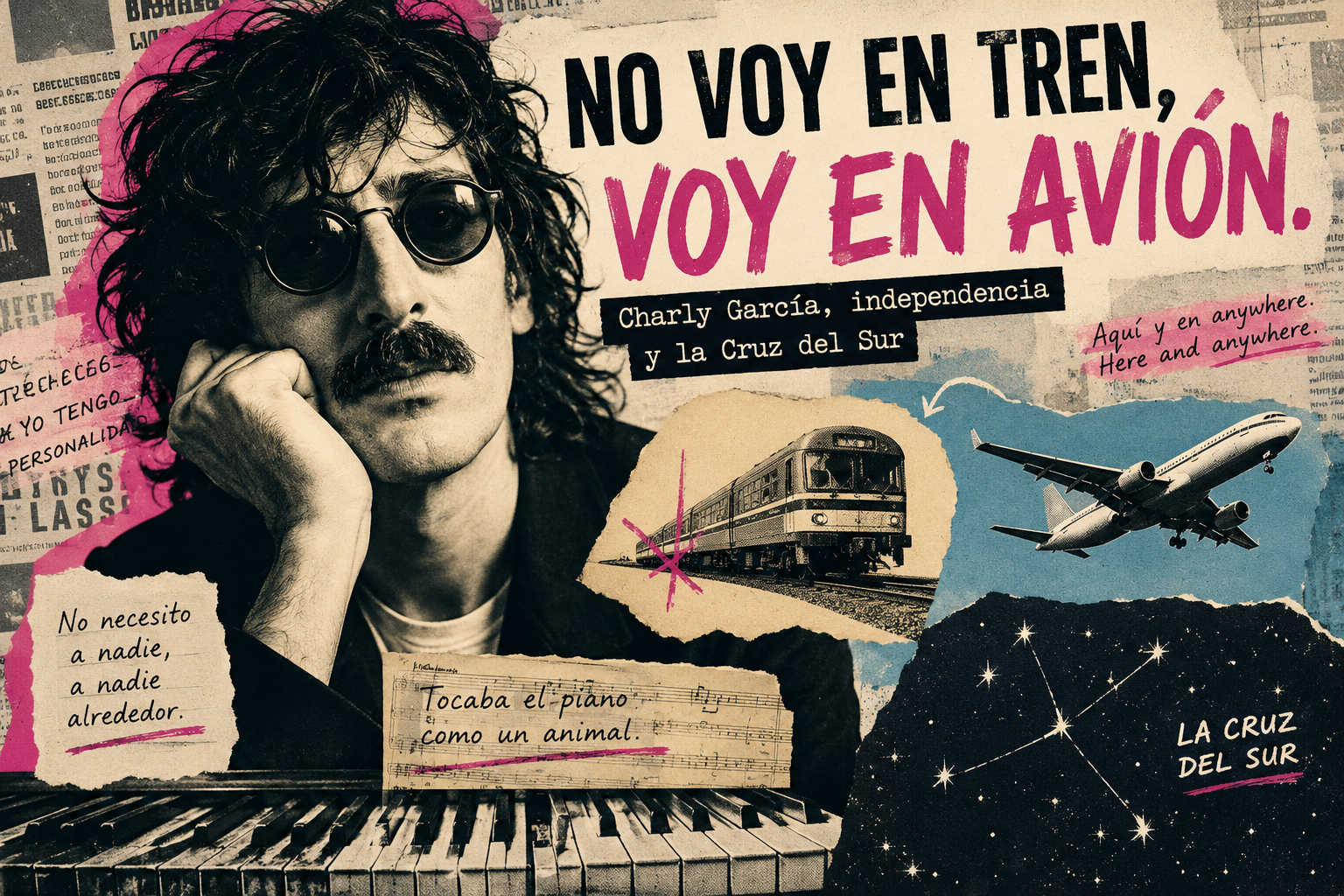
  • No Voy en Tren Meaning | Charly García, Independence and the Southern Cross

    No Voy en Tren Meaning | Charly García, Independence and the Southern Cross

    POP Ideas POP Ideas · Music & Language

    No Voy en Tren: Charly García, Independence and the Southern Cross

    A possible cultural and linguistic reading of a song about speed, isolation, media, personality and Southern identity

    No Voy en Tren can be read as more than a song about transportation — a declaration of independence, where the speaker refuses the marked path and claims his own way of existing in the world. In this reading, the train stands for the conventional route, while the plane suggests speed, freedom, and a different way of thinking.

    🔎 Metaphors and ideas to notice

    • Tren / train → the conventional, fixed, predictable path.
    • Avión / plane → speed, freedom, a different way of thinking.
    • “No necesito a nadie alrededor” → independence, distance, or isolation.
    • “Mi piel resista” → contact with others, exhaustion, or the difficulty of coexistence.
    • Televisión y revistas → media, consumer culture, prefabricated models of life.
    • “Tocaba el piano como un animal” → instinct, force, undomesticated creativity.
    • Mixto → someone difficult to classify.
    • La Cruz del Sur → orientation, Southern identity and belonging.
    • “El que apaga la luz” → ending a scene, remaining as the last witness.

    This is one possible interpretation. POP Ideas reads songs as case studies in how language creates meaning.

    The Train and the Plane

    No voy en tren, voy en avión.

    Why comparing a train to a plane?

    At first, this sounds like a simple comparison between two means of transportation. But another idea can be read into it: in Argentina, there’s an expression — “cuando vos salís y yo ya llegué” — a way of saying someone thinks faster, always one step ahead.

    A train follows rails already decided. A plane leaves the ground, rising above the fixed route. Perhaps Charly is not only saying how he travels, but how he thinks: “while you are still following the tracks, I am already somewhere else.”

    Of course, this is only one possible interpretation.

    I Don’t Need Anyone

    No necesito a nadie, a nadie alrededor.

    Freedom, or isolation?

    The line can be read in different ways — the next verse seems to give a clue. It may not be only about independence; there may also be tiredness, distance, or exhaustion toward other people.

    Skin and Other People

    Porque no hay nadie que mi piel resista.

    What does it mean that “my skin can stand”?

    At least two readings open up: I can’t stand people — exhaustion toward others — or the opposite, no one can stand me, the skin as a border between self and world. In both cases, the same idea appears: a difficulty in living with others.

    So when he says “I don’t need anyone around,” we can’t tell whether he’s defending his independence, or simply naming a distance that already exists.

    Television, Magazines and Consumption

    No veo televisión ni las revistas, no veo ya nada que no pueda hacer.

    Why does he reject the media?

    This likely isn’t just about not watching TV — it can be read as questioning what television and magazines represent. Media doesn’t only inform; it builds desire, telling us what to consume, what to want.

    The speaker doesn’t want to consume images of life. He wants to live for himself.

    Childhood and the Piano

    Cuando era niño nunca fui muy listo, tocaba el piano como un animal.

    Why does he return to childhood?

    Up to here, the song speaks from a strong identity. Then childhood appears — humanizing the speaker: there was once a child not considered “smart.”

    “Like an animal” can read as criticism or as praise — animals act by instinct, without calculation. Perhaps Charly is saying he played with natural force, without asking permission.

    Being “Mixto”

    Yo sé que algunos piensan que soy mixto, pero yo tengo personalidad.

    What does “mixto” mean?

    It may refer to someone hard to classify, who mixes styles or breaks categories. The speaker’s answer is clear: “I have personality.” Not a shapeless mixture, but an identity of his own.

    The Southern Cross

    Yo soy de la Cruz del Sur.

    Why does Charly mention the Southern Cross?

    The Southern Cross has long guided sailors to the South Celestial Pole — a navigation tool, not just a group of stars. Saying “I belong to the Southern Cross” may express a way of seeing the world: defining himself from the South rather than from Europe or North America.

    The constellation becomes both an identity and a compass.

    Closing and Turning Off the Light

    Soy el que cierra y el que apaga la luz.

    What does it mean to close and turn off the light?

    It may be the one who puts an end to something, who remains after everyone else has left, or who refuses to keep participating in a show that no longer interests him — someone who marks the end of a stage.

    Here and Anywhere

    Yo soy de la Cruz del Sur, aquí y en anywhere.

    Why mix Spanish and English?

    Charly could have said “aquí y en cualquier lugar,” but chooses anywhere. Argentine rock has always been in dialogue with the English-speaking world without becoming less local — the speaker belongs to the South, but isn’t trapped inside a border.

    Final Thought

    No Voy en Tren may not be a song about means of transportation. It can be read as a declaration of independence: the speaker rejects prefabricated paths, distances himself from others, questions media and consumer culture, accepts being difficult to classify, and finally presents himself as someone who belongs to the South while his voice can sound anywhere.

    That is why the plane is not only a plane — it can be read as a way of moving, thinking, and existing outside the marked tracks.

    This reading does not try to close the meaning of the song, but to open one possible way of thinking about it.

    POP Ideas · Translation, language and cultural analysis through songs, by Noelia Corso.

  • Dumb Meaning | Nirvana, Emotional Numbness and the Metaphor of Glue

    Dumb Meaning | Nirvana, Emotional Numbness and the Metaphor of Glue

    POP Ideas POP Ideas · Music & Language

    Dumb Meaning: Emotional Numbness, Glue and False Happiness in Nirvana

    A possible reading of Nirvana’s Dumb through metaphor, language and emotional escape.

    In this interpretation, Dumb is not simply about stupidity. It may be about emotional numbness: the strange state of feeling different, pretending to belong, and finding temporary ways to repair pain without truly healing it.

    The song moves through a chain of images: pretending, light, dumbness, happiness, a broken heart, glue, inhaling, floating, coming down and having a hangover. Read together, those images suggest a cycle of pain, escape and return.

    🔎 Metaphors and ideas to notice

    • “I’m not like them” → feeling different from other people.
    • “I can pretend” → social masking; acting like one belongs.
    • The sun → God, hope, purpose, certainty or an ideal.
    • The light → a smaller source of hope that still remains.
    • Dumb → not only “stupid,” but possibly silent, numb or disconnected.
    • Happy → not necessarily joy; perhaps emotional anesthesia.
    • The broken heart → emotional pain.
    • Glue → drugs, emotional escape or a temporary way to hold pain together.
    • Inhale → possibly consuming something, or taking in an escape.
    • Clouds → euphoria, fantasy or altered consciousness.
    • Come down → returning from that altered state.
    • Hangover → the physical and emotional cost after escape.

    This is one possible interpretation. POP Ideas reads songs as case studies in how language creates meaning.

    Not Like Them

    I’m not like them, but I can pretend.

    What does he mean by “I’m not like them”?

    The narrator immediately separates himself from everyone else — he feels different. Yet he also says he can pretend, which means he knows how to hide that difference. The first conflict in the song is not simply between him and the world: it is between who he really is and the role he performs for other people.

    The Sun and the Light

    The sun is gone, but I have a light.

    If the sun is gone, what is the light?

    The sun usually represents something greater than ourselves — it could symbolize God, hope, purpose, or the certainty that everything will eventually be alright. The narrator says the sun has disappeared, yet he still has a light. Perhaps it is weaker, perhaps artificial — but he is not completely in darkness.

    Fun After the Day Is Done

    The day is done, but I’m having fun.

    Why is he having fun if everything else sounds so sad?

    That is exactly what makes the line interesting: the surrounding images are not cheerful — the sun is gone, the day is over, and the narrator feels different from everyone else. So the “fun” may not be simple happiness. It may be distraction, escape, or simply the temporary feeling of not suffering as much.

    Dumb

    I think I’m dumb.

    What does “dumb” really mean here?

    Today, many people understand dumb as “stupid.” But according to Merriam-Webster, the word also carries older meanings related to silence, speechlessness and muteness — historically, it could describe someone unable to speak, someone silent, or someone left without words. That changes the possible meaning of the line: maybe the narrator is not only asking, “Am I stupid?” Maybe he is also asking whether he has become emotionally numb, stopped speaking, or disconnected from what he feels.

    Or Maybe Just Happy

    Or maybe just happy.

    Why does Cobain contrast “dumb” with “happy”?

    That contrast is fascinating, because the two words may not be opposites. Perhaps the narrator wonders whether his numbness feels like happiness — not because life has improved, but because he no longer feels the pain in the same way. In this reading, happiness does not sound like joy; it sounds more like anesthesia.

    The Broken Heart and the Glue

    My heart is broke, but I have some glue.

    If his heart is broken, why does he use glue?

    He does not say he has medicine, love, or time — he says he has glue. Glue fixes broken objects; it does not heal wounds. That image suggests a temporary repair rather than real recovery.

    Inhale

    Help me inhale and mend it with you.

    Why does Cobain choose the word “inhale”?

    That word feels unusually specific. He could have written “help me fix it” or “help me heal” — instead, he writes “help me inhale.” One possible interpretation is that the glue symbolizes drugs, or at least some form of emotional escape. The narrator is not truly healing his broken heart; he is temporarily holding it together.

    Clouds

    We’ll float around and hang out on clouds.

    What happens after inhaling the glue?

    Now the images begin to connect: they float, they drift through clouds, and the emotional pain disappears for a while. The clouds may represent euphoria, fantasy, or an altered state where the broken heart no longer feels as broken.

    Coming Down

    Then we’ll come down and have a hangover.

    But does the escape last?

    No. First they float. Then they come down. Finally, there is a hangover. Whether the glue represents drugs, emotional denial, or another kind of escape, the cycle remains the same: temporary relief followed by reality.

    More Nirvana Readings on POP Ideas

    Keep exploring other POP Ideas articles on ambiguity, identity, emotional distance and survival in Kurt Cobain’s writing.

    • Something in the Way → consumption, addiction and moral permission.
      Read the analysis
    • Come as You Are → identity, contradiction and the impossibility of being only one thing.
      Read the analysis
    • About a Girl → semantic ambiguity and the difficulty of defining a relationship.
      Read the analysis

    Final Thought

    One possible interpretation is that Dumb is not about stupidity at all — it may be about emotional numbness. The narrator feels different from everyone else. His heart is broken, and instead of healing it, he finds glue.

    He inhales, floats, and comes down — and then the cycle begins again.

    In this reading, happiness is not necessarily joy. It may be the temporary silence of pain.

  • La Novia Blanca Meaning | How La Mona Jiménez Turned Cocaine into a Wedding Metaphor

    La Novia Blanca Meaning | How La Mona Jiménez Turned Cocaine into a Wedding Metaphor

    POP Ideas POP Ideas · Music & Language

    La Novia Blanca Meaning: How La Mona Jiménez Turned Cocaine into a Wedding Metaphor

    A bilingual cultural reading for English speakers discovering Argentine music through Spanish.

    This article reads La Novia Blanca as a bilingual lesson in metaphor, translation and Argentine popular culture. Instead of only explaining what the song says, we compare the Spanish with a literal English translation and my own singable English adaptation, and then analyze the cultural meaning behind the words.

    🔎 Metaphors and ideas to notice

    • La novia blanca → cocaine personified as a bride.
    • El vestido blanco → apparent purity hiding danger.
    • El altar → the point of no return.
    • El casamiento → addiction as a destructive commitment.
    • La madre → the suffering of the family.
    • La muerte blanca → death associated with cocaine.
    • La balanza → the language of drug trafficking: weight, portions and money.
    • La esperanza → the false promise that the next time will be enough.
    • El traficante que no sabe de las almas → dehumanization.

    The full lyrics are not reproduced here. POP Ideas uses short excerpts for bilingual, educational and analytical purposes.

    🎤 My singable adaptation: this is not a literal translation. It is my own English version, created to preserve the imagery, flow and emotional effect of the original song.

    The Song Starts in an Emergency Room

    🇦🇷 Original Spanish🔍 Literal Translation🎤 Singable Adaptation
    En la sala de urgencia de un hospital,
    Una madre llorando quiere salvar,
    A su hijo…
    In a hospital emergency room,
    A crying mother is trying to save
    her son…
    At the emergency room in a hospital,
    A crying mother wants to save,
    to his son that soon is going to get married.

    Most songs about drugs begin with the drug itself. This one begins with a mother.

    That choice immediately changes the emotional perspective of the story: instead of presenting addiction through pleasure, rebellion or glamour, La Mona Jiménez presents it through its consequences. The hospital is not simply the setting — it is the destination. The song starts where many stories about addiction usually end.

    The White-Dressed Woman

    🇦🇷 Original Spanish🔍 Literal Translation🎤 Singable Adaptation
    Con esa mujer, que lo vino a buscar,
    Con su vestido blanco esperando está.
    With that woman who came looking for him,
    Waiting for him in her white dress.
    With that woman looking for him,
    with a white dress she is waiting for him.

    At first, listeners naturally imagine a bride waiting for the man she loves. However, the song deliberately misleads us: the woman is not a woman at all. She is cocaine.

    Instead of naming the drug directly, La Mona Jiménez personifies it as a beautiful bride dressed in white. This allows him to tell a story about addiction without ever needing to say the word cocaine inside the metaphor.

    Doctors Against the Bride

    🇦🇷 Original Spanish🔍 Literal Translation🎤 Singable Adaptation
    Los doctores se esfuerzan, para evitar
    Que la novia lo lleva para el altar.
    The doctors struggle to prevent
    The bride from taking him to the altar.
    The doctors are trying to avoid
    The bride takes him to the altar.

    This verse expands the wedding metaphor. Normally, the altar symbolizes the beginning of a new life — here, it symbolizes the beginning of destruction. The doctors are not trying to stop a wedding: they are trying to stop addiction before it becomes irreversible.

    When the Metaphor Reveals Itself

    🇦🇷 Original Spanish🔍 Literal Translation🎤 Singable Adaptation
    Porque esa novia blanca que se fracciona,
    Que ha varado en la balanza.
    Because that white bride is divided into portions,
    And ends up on the scale.
    Because she is the white bride, it is weighed
    gram by gram on balances.

    This is where the metaphor begins to reveal itself. Words such as fracciona and balanza belong to the vocabulary of drug trafficking, not weddings.

    The romantic world and the criminal world collide in just two lines — the listener suddenly realizes that the bride is not simply a bride. She is cocaine.

    The Dealer and the Loss of Humanity

    🇦🇷 Original Spanish🔍 Literal Translation🎤 Singable Adaptation
    Tu traficante que no sabe de las almas,
    Que va camino hacia la muerte blanca.
    Your dealer knows nothing about souls,
    As he walks toward white death.
    You drugdealer knows nothing about souls,
    That is on the road to the white death.

    One of the strongest lines in the song is not about cocaine — it is about the dealer. The lyric does not simply call him evil: instead, it says that he knows nothing about souls.

    He understands weight, money, purity and profit. But not people. The mother sees a son; the dealer sees a product.

    Purity Becomes Danger

    🇦🇷 Original Spanish🔍 Literal Translation🎤 Singable Adaptation
    Porque esa novia blanca,
    Cuanto más pura,
    Más te mata de esperanza.
    Because that white bride,
    The purer she is,
    The more she kills you with hope.
    Because she is the white bride, the purer,
    the more it kills you with hopes.

    White traditionally symbolizes innocence, weddings and purity. La Mona Jiménez completely reverses that symbolism: the purer the bride appears, the deadlier she becomes — and the most interesting word here is hope.

    The drug does not kill only through chemistry: it kills through promises, convincing people that happiness is always one more dose away.

    The Promise That Is Never Enough

    🇦🇷 Original Spanish🔍 Literal Translation🎤 Singable Adaptation
    Te va brindando cosas que jamás te alcanzan,
    Para llevarte poco a poco hacia el altar.
    It keeps offering you things that are never enough,
    Slowly leading you toward the altar.
    She gives you things that are never enough,
    To lead you slowly towards the altar.

    This may be the best definition of addiction in the entire song. The drug always promises something more: more confidence, more pleasure, more peace, more happiness.

    Yet nothing is ever enough. The altar becomes the final destination of a relationship built on endless promises that can never be fulfilled.

    Ambition, Betrayal and Cost

    🇦🇷 Original Spanish🔍 Literal Translation🎤 Singable Adaptation
    Ella puso el veneno de la ambición.
    Él corrió con los gastos de la traición.
    She brought the poison of ambition.
    He paid the price of betrayal.
    She planted the poison of ambition.
    He covered the costs of the betrayal.

    The bride does not simply bring death. She brings temptation. Ambition here is not only about money — it is the desire for something greater than reality: escape, power, confidence or pleasure.

    The young man ultimately pays the cost of believing that illusion.

    The City Goes Dark

    🇦🇷 Original Spanish🔍 Literal Translation🎤 Singable Adaptation
    Se apagaron las luces de la ciudad.
    Se murieron los sueños y el cielo se nubló.
    The city lights went out.
    Dreams died and the sky turned cloudy.
    The city lights went out.
    The dreams died and the sky got dark.

    The song moves from the body to the city: addiction is no longer only personal, it darkens the whole emotional landscape. The lights going out and the sky turning dark show the collapse of hope, dreams and future possibilities.

    Final Thoughts

    La Novia Blanca is much more than a song about cocaine. It is a lesson in metaphor.

    Rather than describing addiction directly, La Mona Jiménez, one of the most iconic voices of Argentine cuarteto, transforms it into a wedding: the bride becomes cocaine, the altar becomes the point of no return, marriage becomes addiction.

    For students learning Spanish, this song demonstrates that understanding a language is not only about vocabulary. It is about understanding the cultural symbols that give words their deepest meaning.

    Sometimes the most powerful stories are the ones that never need to say their subject aloud. La Novia Blanca never needs to say “cocaine” — the metaphor says everything.

    Leer este análisis en español →

  • How could we translate “De Música Ligera”: A summer love?

    POP Ideas POP Ideas · Music & Language

    De Música Ligera: Gustavo Cerati and the Weight of Endless Possibility

    A possible reading of Soda Stereo’s classic — not a song about a shallow love, but about two people trapped between memory and the fantasy of what could have been.

    Most people interpret De Música Ligera as a song about a fleeting or superficial romance. However, every time I hear the line “Ella durmió al calor de las masas,” I wonder whether Gustavo Cerati was exploring something far more complex. What if this is not a song about a failed relationship, but about two people who continue to desire each other, remember each other, and idealize each other like summer loves do?

    🔎 Metaphors and ideas to notice

    • Las masas / the crowd → the field of options and distractions that keep her from settling.
    • Soñarla / dreaming of her → memory and idealization rather than pursuing reality.
    • Escribirle / writing to her → a hesitation, a road not taken.
    • Las trampas del amor / the traps of love → the illusion that the next relationship will finally be enough.
    • Música ligera / “light music” love → not shallow, but fragile — unable to survive the weight of endless possibilities.
    • Cenizas de rosas / ashes of roses → promises already burned out, no longer meaningful.
    • Un roce secreto / a secret rendezvous → lingering temptation, and an honest admission of desire.
    • “Nada nos libra” / “nothing can save us” → both remain trapped between memory and possibility.

    This is one possible interpretation. POP Ideas reads songs as case studies in how language creates meaning.

    Asleep Among the Crowd

    Ella durmió al calor de las masas.

    She fell asleep in the warmth of the crowds.

    In De Música Ligera, most interpretations assume that the masses simply refers to a crowd of people. However, I have always imagined something different: perhaps the masses represent all the possibilities that surround us when we refuse to fully choose someone.

    In this reading, she remains surrounded by options, experiences, and opportunities. She finds comfort in the belief that something better may always be waiting ahead.

    Waking to Dream of Her

    Y yo desperté queriendo soñarla.

    And I woke up wanting to dream of her again.

    At first, the narrator appears different from her — he wakes up while she remains asleep among all those possibilities. Yet he does not wake up to find her, call her, or write to her. Instead, he wakes up wanting to dream of her again.

    That detail feels important, because dreams are not reality: the woman in his dream is not necessarily the woman herself, but the version of her that survives inside his memory. Perhaps he once had the chance to choose her and did not; perhaps she once had the chance to choose him and did not. Now all that remains is an idealized version of what might have been.

    The Letter Never Sent

    Algún tiempo atrás pensé en escribirle.

    Some time ago, I thought about writing to her.

    This line introduces distance and hesitation. He does not say that he wrote to her, or that he plans to write to her now — he simply admits that he once thought about it.

    If he truly wanted her back, he could contact her. Instead, he keeps her in the safer space of memory. Perhaps he understands that reality would destroy the fantasy.

    The Traps of Love

    Que nunca sorteé las trampas del amor.

    That I never escaped the traps of love.

    The traps of love may not be lies or betrayal. Perhaps the real trap is believing that the next possibility will finally bring us the happiness we are searching for.

    We convince ourselves that the next person will be different, that the next relationship will solve everything — and when it fails, we repeat the process all over again.

    “De Música Ligera”: Too Fragile to Last

    De aquel amor de música ligera.

    From that kind of love — like summer love.

    This is probably the most debated line in the song. Many listeners interpret it as a shallow relationship, but I am not entirely convinced. Perhaps Cerati is describing a relationship that was real, meaningful, and emotionally intense, yet unable to survive.

    Not because there was no love, but because neither person was ever able to stop searching for something more. It was not superficial — it was simply too fragile to survive the weight of endless possibilities.

    Ashes of Roses

    No le enviaré cenizas de rosas.

    I will not send her ashes of roses.

    A rose traditionally symbolizes love, romance, and promises. Ashes, however, are what remain after something has burned away. The narrator does not seem to be refusing romance — instead, he appears to be rejecting promises that no longer have meaning.

    Those promises have already been spoken. They have already failed. They have already turned to ashes. There is no point pretending otherwise.

    The Secret Rendezvous

    Ni pienso evitar un roce secreto.

    Nor will I try to avoid a secret rendezvous.

    A rendezvous is often used to describe a romantic date, a secretive encounter, or a private meeting between two or more people — the word carries exactly that charge of temptation here.

    This line reveals something important about both characters. The narrator does not present himself as loyal, faithful, or morally superior: he openly admits that temptation still exists, that desire still exists, that the possibility of making the same mistakes still exists. He is not promising eternal love because he knows better, yet he is not pretending to be immune to attraction either. That honesty makes the song feel surprisingly human.

    Nothing Left to Save Us

    Nada nos libra, nada más queda.

    Nothing can save us; nothing else remains.

    If this interpretation is correct, the ending becomes deeply tragic. The song is not about two people who stopped loving each other. They remain trapped between memory and reality, between desire and commitment, between what happened and what could have happened.

    Perhaps that is why De Música Ligera continues to resonate decades later. It reminds us that some people remain with us forever, not because they were the love of our lives, but because they became the possibility we never stopped imagining.

    More Argentine Rock Readings on POP Ideas

    Keep exploring how POP Ideas reads Argentine rock through metaphor, memory and identity.

    • No Voy en Tren → Charly García, independence and the Southern Cross.
      Read the analysis
    • La Balsa → Los Gatos, escape and ambiguity in Argentine rock.
      Read the analysis
  • Territorial Pissings: Nirvana and the Politics of Marking Ground

    Territorial Pissings: Nirvana and the Politics of Marking Ground

    POP Ideas POP Ideas · Music & Language

    Territorial Pissings: Nirvana and the Politics of Marking Ground

    A possible political reading of Kurt Cobain’s rage — territory, gender, alienation, and the search for a way out of the map.

    There is a phrase that often opens well-intentioned, almost obligatory speeches: “love one another.” It sounds good, marketable, comfortable. However, it only takes a war, a border, a crisis, or a real dispute for everything to change instantly. Suddenly, the world orders itself into much more primitive phrases: “this is mine,” “this is yours,” and “do not cross this line.”

    Why does this happen? It is not due to a divine truth or a natural reason. Instead, it is often because of something as basic and absurd as a mark — as if someone, at some point in history, urinated on a territory and decided that from then on, it belonged to them. Consequently, this has been the historical reality in almost every corner of the globe. Although our rhetoric changes, the underlying logic remains the same.

    “Territorial Pissings” by Nirvana is not just a song of rage. On the contrary, it is a brutal X-ray of this logic. Its brilliance lies not in stating a closed truth, but in writing from a deliberate ambiguity that allows for several layers of reading simultaneously.

    🔎 Metaphors and ideas to notice

    • Territorial / marking → the animal instinct behind property and control, stripped of its “civilized” disguise.
    • Pissing vs. urinating → a gendered act: aggressive, loud, outward-facing dominance.
    • The alien → the outsider, the political foreigner, and Marxist alienation all at once.
    • “A way, a better way” → the search for an exit that isn’t marking or being marked.
    • “Cultures weren’t opinions” → culture as inherited, unquestionable truth before “civilized” choice.
    • The clearing of estates → violence first, law second: the law only legitimizes what was already taken.

    This is one possible interpretation. POP Ideas reads songs as case studies in how language creates meaning.

    The Ambiguity of Method and Instinct

    Kurt Cobain is often reduced to an icon of apathy or chaos. Nevertheless, his writing possesses surgical precision: he does not provide “pre-chewed” messages, instead he constructs containers of meaning. While the audience argues about the song’s “true” meaning, he escapes through the middle — every key word opens a political, physical, and cultural field.

    The word “territorial” takes us directly to ethology, the study of animal behavior. A dog does not urinate out of physiological necessity; it urinates to mark — it is saying, “this is mine.” Cobain takes this logic and transfers it to the human plane. Whether it is a man marking his home, his partner, his country, or his ideas, the impulse is identical. The territory is not the land; it is the obsession with control.

    In this context, we can see how the song challenges the very idea of private property. By comparing human behavior to animal instincts, Cobain strips away the “civilized” veneer of our legal systems. If property is just a “pissing,” then its legitimacy is purely based on strength and visibility, not on any higher moral ground.

    The Gendered Power of the Mark

    In English, there is a significant difference between “urinating” and “pissing.” Urinating is clinical, neutral, and private. Pissing, however, is aggressive, loud, and directed outward. Culturally, women are often taught to “urinate,” while “pissing” is coded as masculine — an exhibition of dominance and a display of power. By titling the song “Territorial Pissings,” Cobain applies a specific gender to the conflict.

    He is not talking about abstract humanity. Instead, he addresses a specifically masculine and violent way of relating to the world. Therefore, the “pissing” becomes a metaphor for the aggressive colonization of spaces, both physical and ideological. This gendered reading is crucial because it connects the personal with the political, showing how patriarchy and territoriality are inextricably linked.

    Key Lines and Political Readings

    Original LyricsKey Analysis / Interpretation
    “When I’m there” Inevitable system: the “there” represents the inside of the established power structure. You don’t just arrive; you find yourself already within its borders.
    “Never met a wise man, if so it’s a woman” Disruption of patriarchy: a critique of the male-dominated “wisdom” that justifies territory and war. True insight exists outside the “marked” center.
    “Just because you’re paranoid don’t mean they’re not after you” Political realism: paranoia does not invalidate persecution. For the “alien,” the threat of the system is often a material reality.

    The Concept of the Alien and Alienation

    The word “alien” is the most powerful core of the song. It functions on at least three simultaneous levels: first, it refers to the “weirdo” — the one who doesn’t belong. Second, it points to the political foreigner — the “illegal” who crosses a border someone else marked. Finally, it mirrors Marxist alienation: the subject separated from themselves within the system.

    Cobain embodies all three. He was an outsider in rock culture, an “illegal” in the conservative value system of the time, and ultimately alienated from his own fame. Consequently, when he screams about being an alien, he is describing the friction of a body that refuses to be “marked” by the territory it inhabits.

    Furthermore, the term “alien” highlights the absurdity of borders. If someone is an “alien” just because they crossed a line, then the line itself is the source of the conflict. Cobain identifies with this displaced figure, choosing to embrace the “alien” status rather than fight for a piece of marked territory.

    Finding a Way Out of the Map

    In the bridge, we hear the haunting repetition: “Gotta find a way, a better way, I’d better wait.” This is profoundly human and very “Cobain” because it lacks heroic epicness: first, there is the necessity of a path. Then, the desire for a better one. Finally, there is the hesitation — a deep awareness of the risks involved in dissent.

    There is no revolutionary epic here. Instead, there is doubt, calculation, and the fatigue of being an outsider. Cobain does not romanticize the escape: he knows that leaving the marked territory carries a high cost, and it is not always possible to do so immediately. The “alien” is not a martyr; the alien is a survivor trying to navigate a world of traps.

    The word “way” is also a double entendre — it can mean a physical path or a method of existence. By searching for a “better way,” Cobain is looking for a method of living that doesn’t involve marking or being marked: a search for a space without owners, a crack in the map where one can simply exist without the pressure of territoriality.

    Marx and the Clearing of Estates

    The line “Cultures weren’t opinions” condenses a brutal historical critique. There was a time when you were born into a culture, and that was it — no choice, no reflection, no critical distance. Culture was not a stance; it was an established, unquestionable truth. While modernity introduced “opinion,” that transition was far from peaceful: it was built on displacement.

    This brings us to the Marxist concept of the “clearing of estates.” The formation of the first states was not a philosophical debate — it was simple: advance, mark, kill, expel, and afterward, legalize. First comes the violence (the “pissing”), and then comes the law (the “territory”). The law does not create the territory; it merely legitimizes it after the fact.

    “Territorial Pissings” echoes this history of despoilment. It reminds us that every “civilized” border started with an act of primitive aggression that was later dressed up in legal language.

    More Nirvana Readings on POP Ideas

    Keep exploring other POP Ideas articles on ambiguity, identity, and power in Kurt Cobain’s writing.

    • Something in the Way → consumption, addiction and moral permission.
      Read the analysis
    • Dumb → emotional numbness and glue as a metaphor for escape.
      Read the analysis
    • About a Girl → semantic ambiguity and the difficulty of defining a relationship.
      Read the analysis

    Conclusion: The Radical Act of Finding a Way

    Ultimately, “Territorial Pissings” is not a song about teenage angst. It is a raw indictment of how language, the body, and power are organized around the idea of ownership. Cobain doesn’t propose easy solutions or offer slogans — instead, he does something much more uncomfortable: he exposes the mechanism of the system while it is still running.

    While the public continues to debate what he “meant,” the singer had already found the only thing that mattered to him: an exit. In a world obsessed with marking, claiming, and owning, sometimes simply finding a “way” is the most radical act of all.

  • Decoding Semantic Ambiguity in Nirvana: A Linguistic Analysis of ‘About a Girl’?

    Decoding Semantic Ambiguity in Nirvana: A Linguistic Analysis of ‘About a Girl’?

    POP Ideas POP Ideas · Music & Language

    Semantic Ambiguity in Nirvana: A Linguistic Analysis of “About a Girl”

    An analysis of polysemy and ambiguity in Nirvana’s “About a Girl,” exploring the word “free” and metaphors of power.

    Nirvana is often associated with noise and fury, but in “About a Girl”, Kurt Cobain offers a masterclass in semantic ambiguity. In this analysis, we explore the metaphors of power and linguistic nuances that make this song a fundamental piece for understanding English composition.

    🔎 Metaphors and ideas to notice

    • “Free” → the double meaning between “at no cost” (economic) and “unrestricted” (emotional) — the axis of the whole ambiguity.
    • “Easy friend” → not promiscuity, but “low cognitive demand”: someone who simply listens.
    • “Fit this shoe” → not a soulmate, but utility: filling the role that’s needed.
    • “Hang me out to dry” → left exposed and vulnerable after being used.
    • “Standing in your line, pick a number” → the bureaucratic metaphor: love as paperwork, as a turn in line.
    • “I do” (repeated) → the song’s great cynical equalizer, putting marriage and transaction on the same level.
    • “Squeeze” → emotional vampirism, extracting from the other until they’re empty.

    This is one possible interpretation. POP Ideas reads songs as case studies in how language creates meaning.

    💡 The Central Polysemy: The “Free” Dilemma

    The genius of these lyrics lies in their ability to sustain two simultaneous narratives: it can be interpreted as a song about a worn-out romantic relationship or a sexual transaction. The entire linguistic analysis is built upon this duality.

    The turning point is the use of the term free. It can mean “at no cost” or “without limitations, in the sense of freedom.” The line “I can’t see you every night free” exploits this confusion:

    • Interpretation A (economic): “I can’t see you every night for free” → suggests a transactional relationship, supporting the “prostitute” theory.
    • Interpretation B (relational): “I can’t see you every night freely” → reflects a fear of commitment or a lack of emotional availability.

    Pragmatic Analysis: Metaphors of Use

    “I need an easy friend / With an ear to lend”

    Here, easy friend does not necessarily imply promiscuity, but rather “low cognitive demand.” He is looking for a functional, almost therapeutic relationship, where the other’s role is simply to listen.

    “I do think you fit this shoe”

    A variation of the idiom “if the shoe fits.” This is not a declaration of love (“you are my soulmate”), but a statement of utility: she fits the role he needs to fill.

    “I’ll take advantage while / You hang me out to dry”

    A brutal admission of mutual toxicity. He admits to opportunism (“take advantage”) while acknowledging that she leaves him exposed or vulnerable (“hang out to dry”). In English, this expression means to leave someone in a difficult situation without help, exposed and vulnerable.

    “I’m standing in your line / I do pick a number too”

    The definitive bureaucratic metaphor: romantically, he is just one of many suitors; transactionally, he is literally waiting his turn like a customer.

    The Weight of the Dramatic Pause

    Another example of ambiguity is the repetition of I do. That deliberate pause completely changes the intent of the phrase, moving it away from a simple everyday statement to give it a much deeper emotional weight.

    The use of “I do” is a clear example of Cobain’s nihilism. For him, there seems to be no moral difference between marriage and prostitution, as both are governed by the logic of the contract. This “I do” is the piece that joins both worlds in the worst possible way.

    The Institutionalization of Desire: Wedding vs. Transaction

    Cobain’s genius lies in using the language of the highest social commitment (“I do”) to describe a situation of degradation or routine. To put it bluntly: it’s the same “shit” from a different “bull.”

    • “I do” as a contract signature: at the altar, “I do” represents a legal and religious contract. On the street, the agreement with a prostitute is a commercial contract. In both cases, feeling is displaced by the fulfillment of a role.
    • The bureaucratization of affection: by saying “I do pick a number too,” he equates the wait of a client with that of a husband waiting for his wife to have “time” for him. Love doesn’t flow; it’s a turn in a queue.
    • Dehumanization: both the “girlfriend” and the “prostitute” end up as objects that must “fit this shoe.” It doesn’t matter who they are, as long as they fulfill the function he needs: listening, being there, being “easy.”

    Silence Accompanies the “I Do”

    By saying “I do” (I accept) and making that pause — which could mean “And you?” — Kurt exposes the transactional nature of the pair: “I am fulfilling my part of the contract… and you?” It is a claim of ownership that exists in both traditional marriage and paid services.

    The use of “I do” acts as the song’s great cynical equalizer. By evoking the marriage vow in a lyric that speaks of taking numbers and waiting turns, Cobain suggests there is no real difference between romantic devotion and a sexual transaction: both are institutions where the individual submits to a contract. That “I do,” with its dramatic pause, does not represent a surrender to love, but the signing of a surrender to a relationship that — whether paid or “free” — ends up being the same bureaucratic prison.

    Toxic Analysis: Mutual Opportunism

    To conclude, let’s analyze the final phrase: “I’ll take advantage while you hang me out to dry.” This is the darkest and most honest point of the song, a display of dominance and the desire to “squeeze” the other person.

    In the line, Cobain describes a cycle of reciprocal abuse that fits both a partner and a transactional relationship:

    • The urge to “squeeze” (take advantage): it’s not just about money — it’s an emotional or existential exploitation, using the other as a resource (to avoid loneliness, to vent, or to feel powerful) until they are empty.
    • Retaliation (“hang me out to dry”): he knows that while he takes advantage, she also takes her part — she punishes him, exposes him, or leaves him emotionally “out in the cold.”
    • The power struggle: there are no clear victims or perpetrators here, only two people trying to dominate each other. In marriage, it might be emotional blackmail; in prostitution, it is the coldness of the one who pays versus the indifference of the one who collects.

    Más lecturas / More Readings on POP Ideas

    Keep exploring how POP Ideas reads contract, power and ambiguity in Kurt Cobain’s writing.

    • El Amor como Contrato → a political science reading of “About a Girl” (Spanish).
      Leer el análisis
    • Dumb → emotional numbness and glue as a metaphor for escape.
      Read the analysis

    Final Note on Style

    The word “squeeze” works as an incredible visual metaphor to describe this emotional vampirism or consumerist relationship. This analysis faithfully reflects the “contractual” vision and the “bureaucratic metaphor” that directly connects to the idea of marriage as an institution.

  • Decoding Authenticity vs. Numbness: A Personal Interpretation of “Lithium”?

    Decoding Authenticity vs. Numbness: A Personal Interpretation of “Lithium”?

    For years, many have interpreted “Lithium” by Evanescence as a dark, brooding love song. However, what if the “lover” in the song isn’t a person at all? What if it’s about the complex, codependent relationship with medication?

    As a Political Science graduate and translator, I’ve always been drawn to the song’s dense metaphors. But from a personal perspective—having navigated my own neurological challenges—the song takes on a new, profound meaning. It’s an exploration of the battle for authenticity (our true self) versus the fog of prescribed numbness (our anesthetized self).

    This isn’t just an academic analysis. It is a personal interpretation of the song’s central conflict: the human desire to feel “well” without help, and the cost of that help.

    The Central Conflict: Authenticity vs. Numbness

    The title, “Lithium,” is our first and most important clue. Lithium is a potent mood stabilizer. From the very first line, Amy Lee personifies it: “Lithium, don’t wanna lock me up inside.”

    This immediately frames the conflict. When you suffer from a neurological or mood disorder, the illness itself is a prison. Consequently, the medication designed to “free you” can quickly become a new prison. It is a prison of numbness, of feeling disconnected from your own life. You are “fine,” but you are locked “inside” this new, artificial state.

    The Duality of the Cure

    This duality is the heart of the song. The singer is trapped between two undesirable states: the chaos of her “sorrow” and the emptiness of her “cure.” She is agonizingly aware of this paradox when she wails, “Oh, but God I wanna let it go.” She wants to let go of the pain, but to do so means accepting the numbness, which feels like a different kind of loss.

    “I Can’t Hold On To Me”: The Crisis of Dependency

    This is, in my opinion, the most important line in the entire song. In my Spanish adaptation, I translated this as “No puedo confiarme de mi” (I can’t trust myself). Why? Because when you are on potent medication, you can no longer trust yourself.

    Your sense of “wellness” is conditional. It depends on a pill. You know, deep down, that if you stop taking it, you will feel “very, very bad.” Therefore, your stability isn’t yours; it’s borrowed from a chemical. This creates a profound identity crisis. You cannot rely on your own mind. You are dependent.

    Why “Stay in Love with My Sorrow”?

    This interpretation gives new meaning to “I wanna stay in love with my sorrow.” This is not a death wish. It is a tragic but rational choice: she prefers her authentic pain (her “sorrow”) because, at the very least, it is hers. It is real. The alternative is an artificial wellness she cannot trust.

    Decoding the Metaphors: Analysis Table

    This theme of dependency and authenticity is woven into every line. Let’s analyze the key phrases through this specific lens.

    Original Lyrics (English) Analysis: The Medication Metaphor
    Lithium, don’t wanna lock me up inside THE MEDICATED PRISON: The singer’s direct plea to the medication. She feels it’s enclosing her in a new prison of numbness, walling her off from her true self.
    I wanna stay in love with my sorrow CHOOSING REAL PAIN: A preference for authentic, familiar pain over artificial “wellness.” Her “sorrow” is real and *hers*. The medicated state is false.
    Oh, but God I wanna let it go THE PARADOX: The agonizing duality. She hates the “sorrow” (the illness) and wants release, but she also hates the numbness (the cure). She is trapped with no good options.
    I can’t hold on to me THE DEPENDENCY CRISIS: The central theme. “I can’t trust myself.” She feels her “self” isn’t stable without the pill’s help, a total loss of autonomy.
    Come to bed, don’t make me sleep alone THE CODEPENDENT RELATIONSHIP: This is not a plea to a human lover. It’s a plea to the *medication* (or the illness itself). She is codependent, unable to be alone with her own mind.
    Always find my place among the ashes DESIRE FOR AUTHENTIC REBIRTH: The “ashes” represent a total, natural collapse. It’s the hope that if she lets herself fall apart, she can be reborn from scratch—this time, without help.

    The “Lover” as a Codependent Metaphor

    With this framework, the “love song” verses become even more tragic. “Come to bed, don’t make me sleep alone” is a portrait of profound loneliness. It is the emptiness of her condition.

    Furthermore, the line “Just didn’t drink enough to say you love me” fits perfectly. It’s the idea of needing another substance (alcohol) to force an emotional connection, to break through the very numbness the Lithium itself causes. She is in a codependent, abusive relationship with her own brain chemistry and the substances she uses to manage it.


    Conclusion: The Plea for a Real Self

    This song is a masterpiece. It captures an incredibly difficult feeling to articulate: the sense that the “cure” feels just as bad as the “disease.”

    Ultimately, “Lithium” is an exploration of identity. It is the voice of someone who has lost the ability to trust her own mind. She is faced with a terrible choice: the chaotic, painful “sorrow” that is authentic, or the stable, numb “wellness” that is artificial. As I’ve come to understand through my own experience, there is no sensation more desirable than feeling well, in a natural way. That desperate search for an authentic, unassisted self is the tragic and powerful message at the heart of “Lithium.”


  • Analyzing Nirvana’s “Oh Me”: Meaning

    Analyzing Nirvana’s “Oh Me”: Meaning

    Description: Explore the profound meaning behind “Oh Me,” Kurt Cobain’s haunting interpretation of the Meat Puppets’ song during Nirvana’s legendary MTV Unplugged performance.

    INTRODUCTION: Exploring the Nirvana ‘Oh Me’ Meaning

    Welcome to “POP Ideas.” Today, we delve into the Nirvana ‘Oh Me’ meaning, exploring one of the most revealing performances from their iconic MTV Unplugged session. This cover of a Meat Puppets song, through Kurt Cobain’s raw voice, became the echo of an entire generation. If you’re new to our Grunge Analysis Series, this is a perfect place to start.

    However, if you haven’t heard the performance yet, you can listen here:

    https://www.youtube.com/watch?v=T5LtSKKr7oY
    Nirvana performs “Oh Me” at MTV Unplugged in New York, November 1993.

    HISTORICAL CONTEXT: Nirvana and the Unplugged Revolution

    The MTV Unplugged Setting

    To truly grasp the significance of “Oh Me,” we must first travel back to November 1993. The MTV Unplugged format was at its peak, transforming the loudest rock bands into intimate acoustic troubadours. Nirvana, true to their anti-conventional spirit, did not follow the script. In a move that surprised many, Kurt Cobain chose to pay homage to one of his deepest influences: the Meat Puppets, an influential band in the alternative scene as documented by publications like Rolling Stone.

    The Meat Puppets’ Influence

    The Meat Puppets were an Arizona punk band that had evolved to a more experimental sound, blending alt-country with psychedelia. “Oh Me” appeared on their 1984 album “Meat Puppets II,” a work that captures the underground’s search for authenticity. Through Nirvana’s performance, this cult song was exposed to a global audience, resonating with an intensity that gave the original lyrics new meaning. By inviting Cris and Curt Kirkwood onstage, Nirvana didn’t just cover the song—they shared the spotlight.

    LYRICAL ANALYSIS: Unpacking the Nirvana ‘Oh Me’ Meaning

    The Song’s Central Themes

    To fully grasp the Nirvana ‘Oh Me’ meaning, we must look beyond the surface. The original song explores alienation and internal struggle. As an English Translator and Political Science Graduate, my analysis focuses on the phraseological and rhetorical aspects. The lyrics paint a picture of profound isolation, where the protagonist grapples with overwhelming emotions and detachment from the world. This feeling resonated deeply with a generation that often felt misunderstood and marginalized.

    Kurt Cobain’s Emotional Interpretation

    At the heart of “Oh Me” is not a battle cry, but a sigh of resignation. Kurt Cobain doesn’t just sing the words; he imbues them with new life, turning them into a window into his own psyche. Let’s examine these key phrases:

    Original Lyric (English)   Analysis / Key Interpretation
    If I had to lose a mile, if I had to touch feelings…   THE DILEMMA: This phrase encapsulates the struggle between erasing the past and confronting emotions. It suggests building an emotional wall as a survival strategy, reflecting a desire to avoid pain by distancing oneself from personal history. If we deny or try to hide our past, the more it intrudes into our lives.
    I don’t have to think, I only have to do it. The results are always perfect.   THE COMPULSION: A chilling reflection of addiction or compulsive behavior. The irony in “perfect results” suggests total surrender with a false sense of control, highlighting the self-deception inherent in destructive patterns. A lot of people believe that if they behave under certain patterns, the results can be “control”. A total misconception.
    Would you like to hear my voice sprung with emotion invented at your birth?   THE MASK: A direct challenge to hypocrisy and a critique of the forced happiness the entertainment industry demands from artists. This line questions authenticity, exposing the artificiality of manufactured emotion.
    I can’t see the end of me, my whole expanse I cannot see… infinity’s stored deep inside.   THE INTERNAL PRISON: Here, the soul’s immensity is presented not as a gift, but as an unexplored burden. This metaphor captures the feeling of being trapped by one’s own boundless inner world. However, at the same time, it recognizes the infinite posibilities of life itself.

    The Power of Transformation

    Kurt Cobain transformed Cris Kirkwood’s lyrics into a mirror of his own soul. The performance deepens the Nirvana ‘Oh Me’ meaning, making it a profound confession that resonates with universal human vulnerability. This interpretation reveals not just personal pain, but a collective struggle with identity and authenticity. Listeners found solace in Cobain’s anguished delivery, realizing their own unspoken feelings were being articulated through his voice.


    CULTURAL SIGNIFICANCE: “Oh Me” in the Grunge Pantheon

    A Symbol of Anti-Commercialism

    Nirvana’s decision to cover “Oh Me” during their MTV Unplugged session was more than a musical choice—it was a cultural statement. In an era when bands were pressured to play their biggest hits, Cobain used the global platform to champion a lesser-known indie band. This act solidified Nirvana’s image as authentic artists who valued artistic integrity over mainstream appeal. By bringing the Meat Puppets onstage, Nirvana demonstrated a solidarity rare in the music industry.

    Legacy and Lasting Impact

    The enduring impact of Nirvana’s “Oh Me” is undeniable. It introduced countless fans to the Meat Puppets, expanding alternative music’s reach far beyond its niche. The song showcased Kurt Cobain’s interpretive genius and his ability to infuse existing material with unique emotional depth. “Oh Me” remains a testament to grunge’s raw power and its ability to articulate a generation’s anxieties. It continues to inspire discussions about mental health, authenticity, and the pressures faced by artists, cementing its place as culturally significant work.

    If you enjoyed this analysis, I would love to hear from you on my social media channels. Don’t miss the next episode of “POP Ideas”, where we continue deconstructing narratives and exploring the cultural significance of iconic songs.

    Want to join the community?

    Ideas, resources, and creative processes around language, music, and culture.

    If you’d like to support the project or access exclusive materials:

    Shop (Gumroad)

    If this analysis was helpful, consider supporting independent content creation:

    Buy me a coffee on cafecito.app

    Buy me a coffee on Ko-fi

  • Come As You Are Lyrics Meaning: A Deep Philosophical Analysis

    Come As You Are Lyrics Meaning: A Deep Philosophical Analysis

    “Come as you are, as you were, as I want you to be”: Kurt Cobain’s Philosophy of Identity

    When you listen to Nirvana’s “Come As You Are,” it’s easy to get swept away by its iconic, watery guitar riff and catchy chorus. However, as with much of Kurt Cobain’s work, the surface tells only half the story. As a Political Scientist and translator, I’ve always been fascinated by how Cobain used simple words to explore incredibly complex ideas. Today, we will deconstruct the ‘Come As You Are’ lyrics meaning, not just to understand the words, but to uncover the profound reflection on identity hidden within its verses.

    This is the first part of a three-part series where we will analyze how Nirvana addresses the construction of subjectivity. Drawing on concepts from philosophy and discourse theory from my academic thesis, we will reveal a layer of meaning you may have never noticed before.


    Time, Space, and “The Other”: The Dimensions of Being

    The song begins with an invitation that is, in reality, a statement of principles about how we exist in the world. Let’s analyze the opening line:

    Come as you are, as you were, as I want you to be.

    Cobain isn’t just saying “show up.” He’s establishing a complex framework. “As you are” places you in the present, in this exact moment. “As you were” immediately introduces history—the past that shaped you. Your identity is not just who you are now, but the sum of everything you have been (Corso, 2024, p. 12).

    But it is the final phrase, “as I want you to be,” that introduces the most crucial element: “The Other.” We do not construct ourselves in a vacuum. Our identity is molded in relation to the expectations, desires, and perceptions of others (Corso, 2024, p. 14). You are you, your past, and also the version of you that exists in my mind. This is a deeply discursive process; we exist through language and social interaction.

    The Core Analysis: Deconstructing the Deepest Verses

    To better understand these ideas, I have selected the song’s most potent phrases and analyzed them in this table. The goal here is not a literal translation, but an interpretation that reveals their philosophical weight, based on my research.

    Key Lyric (English) Deep Analysis / Key Interpretation
    Come as you are, as you were, as I want you to be THE EXISTENTIAL FRAMEWORK: This line establishes the three dimensions of identity: the present (“are”), the past (“were”), and the social influence of The Other (“want you to be”). It’s not a simple invitation, but a definition of the human condition (Corso, 2024, p. 12).
    As a friend, as an old enemy ANTAGONISTIC IDENTITY: Here, Cobain introduces the idea that we are defined by opposition. The theorist Chantal Mouffe argues that political identity is formed against an “adversary”—not an enemy to be destroyed, but an ‘other’ that allows us to be who we are (Corso, 2024, p. 14).
    Come doused in mud, soaked in bleach HUMAN DUALITY: “Doused in mud” represents our flaws, our imperfect humanity. “Soaked in bleach” is the societal desire to purify ourselves, to wash away that dirt to appear flawless. Cobain invites us to come with both parts—our darkness and our light (Corso, 2024, p. 16).
    And I swear that I don’t have a gun THE REJECTION OF ANNIHILATION: Connected to the idea of the “old enemy,” denying possession of a gun suggests that this ‘other’ is not something to be eliminated. We need the adversary to define ourselves; therefore, we do not come to destroy it (Corso, 2024, p. 15).

    Contradiction as the Human Essence

    Another layer of the ‘Come As You Are’ lyrics meaning is found in verses like Take your time, hurry up / Choice is yours, don't be late. Far from being a mistake, this contradiction is central to the message. Human beings are inherently contradictory, driven by both reason and passion. Cobain shows us that part of “being” involves navigating these tensions (Corso, 2024, p. 15).

    Identity is not a static photograph but a dynamic process of constant definition and deconstruction. This tension is not a flaw; it is the essence of our subjectivity.


    Conclusion

    Ultimately, “Come As You Are” serves as a masterclass in social analysis disguised as a rock anthem. It invites us to accept our identities as historical, contradictory, and perpetually under construction. The song’s enduring power lies not in providing answers, but in perfectly articulating the questions that define our existence.

    If you enjoyed this analysis, please share your thoughts on social media. Don’t miss the next installment of our series on subjectivity in Nirvana’s music.


    Academic Reference

    Corso, N. del V. (2024). 

  • Decoding Nirvana’s “All Apologies”: A Deep Dive into the Lyrics & Meaning?

    Decoding Nirvana’s “All Apologies”: A Deep Dive into the Lyrics & Meaning?

    Peace at Last: Resignation and Transcendence in ‘All Apologies’

    We have reached the third and final installment of our series on the construction of identity in Nirvana’s discography. Today, we conclude this journey with “All Apologies,” a song that serves as Kurt Cobain’s lyrical testament: a profound reflection on the suffocation of social expectations and the ultimate quest for universal peace. This analysis provides the necessary cultural and academic context before you dive into our technical pronunciation and translation guides.

    Due to my background in the fields of Political Science and Translation, I perceive this song not as a cry of rage, but as a whisper of resignation. It represents the finality of an individual’s struggle against the structures that limit them—a conflict I describe in my research as “the dilemma of accepting… the culturally fixed repertoire of roles” or risking total exclusion (Corso, 2024, p. 20). Consequently, every line reveals a deeper layer of this internal friction.


    The Plea for Being and the Apology for Existing

    The song opens with a series of questions that expose total vulnerability, setting an immediate tone of exhaustion. This opening is crucial because it frames the entire piece as a dialogue with an oppressive external force—be it society, fame, or internalized expectations. Cobain isn’t just singing; he is negotiating the terms of his existence.

    “What else should I be? / All apologies.”

    The question “What else should I be?”, through the use of the modal verb “should,” implies a request for permission or guidance from an external authority (Corso, 2024, p. 21). It is not a definitive “what will I be?” but rather a plea. It is as if he is asking society: “Will you allow me to be who I am?” The immediate follow-up, “All apologies,” functions as a preemptive apology for failing to meet those imposed expectations (Corso, 2024, p. 21).

    The Limits of Expression

    This concept of limitation is masterfully reinforced in the subsequent lines: “What else could I write? / I don’t have the right.” Here, Cobain isn’t merely discussing songwriting; he is acknowledging the boundaries that social discourse and structures place upon self-expression (Corso, 2024, p. 21). It is an admission that even his art—his purest form of being—is conditioned by rules he did not create. Therefore, he remains an impostor on his own stage.


    Lyric Analysis Table: From Suffocation to Universal Unity

    “All Apologies” is an emotional odyssey that moves from the cage of social convention to liberation under the sun. This table breaks down that path, identifying the central concepts that drive the narrative. Notice how each phrase builds upon the last, shifting from personal distress toward a universal resolution.

    Key Lyric (English) Direct Meaning Thematic Interpretation & Analysis
    What else should I be? / All apologies What is expected of me? / I am sorry. THE EXISTENTIAL PLEA: The song opens by asking society what role it expects the subject to fill, followed by an apology for being unable or unwilling to comply (Corso, 2024, p. 21).
    Married / Buried United in contract / Put into the ground. SOCIAL SUFFOCATION: This metaphor equates the institution of marriage (and social contracts) with being buried. It represents feeling stifled by “normal” social roles (Corso, 2024, p. 22).
    I wish I was like you / Easily amused Desiring simplicity / Envying lack of depth. ENVY OF IGNORANCE: Cobain expresses a longing for simplicity, envying those who do not struggle with existential questions and are satisfied with superficial entertainment (Corso, 2024, p. 22).
    In the sun, I feel as one Under the light, I feel whole. NATURAL UNITY: The sun serves as the counterpoint to social suffocation. It represents a state of nature and fundamental equality where the subject feels “as one,” free from artificial restrictions (Corso, 2024, p. 22).
    All in all is all we are In the end, this is our totality. UNIVERSAL RESOLUTION: Repeated as a mantra, this phrase transforms individual anguish into a declaration of universal belonging. We are all part of a larger whole (Corso, 2024, p. 23).

    Trilogy Conclusion: Identity as Struggle and Acceptance

    When we unite these three songs, Nirvana reveals a complete arc of identity. In “Come as You Are,” we are told that we are a complex construct. Then, in “Stay Away,” we are warned against the dangers of imitation. Finally, in “All Apologies,” Cobain expresses the pain of being restricted by society, only to find peace in the idea that “all in all is all we are.” It is an achingly beautiful, yet liberating conclusion.

    If you are interested in practicing the English pronunciation or seeing my artistic Spanish translation, stay tuned for the next part of this guide.

    References

    Corso, N. del V. (2024). Subjectivity in Kurt Cobain’s songs “Come as you are”, “Stay Away”, “All apologies”: The use of metaphors and metaphorical expressions alluding to the construction of identities

  • Decoding Stay Away by Nirvana. Identity Construction as Imitation

    Decoding Stay Away by Nirvana. Identity Construction as Imitation

    “Monkey See, Monkey Do”: Nirvana’s Fierce Critique of Irreflexive Imitation

    Introduction to “STAY AWAY”

    Released in 1991 on the seminal album Nevermind, “STAY AWAY” by Nirvana stands as a powerful exploration of authenticity, conformity, and the visceral rejection of social pretense. Moreover, this song captures the essence of the burgeoning grunge movement, making it a key piece for understanding the broader cultural angst of Generation X.

    Historical and Cultural Context

    To fully grasp “Stay Away,” one must return to the musical landscape of 1991. In contrast to the polished, theatrical aesthetics of dominant hair metal and pop acts, the Seattle scene offered something raw and unfiltered. Nirvana’s sound channeled a widespread frustration that many young people felt but rarely saw reflected in mainstream media.

    The track’s original title was “Pay to Play,” a direct and cynical jab at a music industry that demanded bands finance their own access to stages and visibility. Changing the title to “Stay Away” broadened its scope, transforming a specific industry critique into a universal anthem about setting boundaries and protecting one’s identity.

    “Stay Away” is a prime example of saying much without becoming verbose. The track tackles a major pillar in the social construction of identity: imitation. From the perspective of Political Science and Linguistics, this work represents one of Kurt Cobain’s most direct and uncompromising critiques of conformity, over-adaptation, and consumerism.

    The title itself, “Stay Away,” functions as a political imperative. It is not a suggestion, but a call to action: reflect on one’s own behavior instead of blindly following the herd (Corso, 2024, p. 18).

    The Monkey Metaphor: Imitation Without Awareness

    The song opens with a phrase that operates as the thesis of the entire track: Monkey see, monkey do. This old adage refers to imitation without reflection or awareness of consequences (Corso, 2024, p. 18). Cobain is not referring to primates; he is addressing the sociology of the masses—our tendency to replicate behaviors simply because others do.

    Immediately after, he adds: (I don’t know why). This is the key moment. The imitating subject does not even know why they imitate; the act is passive, mechanical, and unexamined. Cobain invites the listener to abandon this mode of being.

    Key Analysis: Deconstructing Social Critique

    “Stay Away” is a collage of phrases aimed directly at social norms. The table below systematizes the most powerful lyrics that reveal Cobain’s critique of superficiality and inauthenticity:

    Original Lyrics Analysis / Key Interpretation
    Monkey see, monkey do BLIND IMITATION: The central metaphor describing the construction of identity through unreflective emulation. It represents the human tendency to adopt behaviors without questioning their origin (Corso, 2024, p. 17).
    Rather be dead than cool REJECTION OF INDIFFERENCE: Here, “cool” carries a negative connotation of emotional detachment. It is an ethical declaration: choosing intensity and authenticity over calculated emotional distance (Corso, 2024, p. 18).
    Less is more, love is blind CRITIQUE OF CONSUMERISM: “Less is more” promotes minimalism in opposition to material excess. “Love is blind” reinforces the search for value beyond appearances (Corso, 2024, p. 18).
    Fashion shits, fashion style / Throw it out and keep it in ATTACK ON THE CULTURE INDUSTRY: These contradictory lines denounce planned obsolescence and the endless cycle of consumption and waste (Corso, 2024, p. 19).
    Every line ends in rhyme THE SYSTEM’S PARADOX: Even while rejecting conformity, Cobain acknowledges adherence to formal structures. This highlights the difficulty of fully escaping established systems (Corso, 2024, p. 19).

    Deep Exploration: Central Themes

    The themes outlined above intertwine to produce a portrait of voluntary alienation. The song does not mourn loneliness; it demands it as a defense mechanism. The speaker does not seek belonging—he actively rejects “the club.”

    The musical structure reinforces this stance. The verses are contained and almost sardonic, while the chorus erupts into chaotic violence. This dynamic mirrors the tension between detached observation and the eventual emotional explosion that culminates in the scream: “Stay Away!”

    Conclusion: The Dilemma of Authenticity

    “Stay Away” is more than noise and fury—it is a manifesto. It exposes how much of what we call “our” identity is, in reality, a reproduction of traits, ideas, and styles borrowed from others (Corso, 2024, p. 20). The song urges listeners to become conscious of this process.

    Ultimately, Nirvana created a cultural artifact that captures a universal struggle: the fight to preserve personal integrity in a world that constantly demands conformity.


    References

    Corso, N. del V. (2024).


    Subjectivity in Kurt Cobain’s songs “Come as You Are,” “Stay Away,” “All Apologies”: The use of metaphors and metaphorical expressions alluding to the construction of identities

    .

  • The Battle of San Lorenzo: When History Meets Poetry

    The Battle of San Lorenzo: When History Meets Poetry

    POP Ideas POP Ideas · Educational Resources

    The Battle of San Lorenzo: When History Meets Poetry

    A free bilingual worksheet and classroom activity pack on Argentina’s most iconic military march.

    On February 3, 1813, at the San Carlos Convent, José de San Martín won his first battle on Argentine soil — and lost the grenadier who saved his life, Juan Bautista Cabral. Nearly ninety years later, in 1901, that battle was immortalized in the Marcha de San Lorenzo by composer Cayetano Alberto Silva, a patriotic march still sung today. Everything is right here on the page — read on, or download the printable PDF at the end.

    The Story Behind the March

    The Battle of San Lorenzo took place on February 3, 1813, at the San Carlos Convent (now San Lorenzo, Santa Fe). It was San Martín’s first military action in Argentina and, despite being a small engagement, it had huge symbolic importance. The famous “Marcha de San Lorenzo” immortalizes this battle and honors Juan Bautista Cabral, the heroic soldier who saved San Martín’s life.

    The Poetry in Translation

    Here’s the complete march in both Spanish and English. Notice how the translation captures not just the meaning, but the dramatic rhythm and emotional intensity.

    Spanish OriginalEnglish Translation
    Febo asoma, ya sus rayos
    iluminan el histórico convento.
    Tras los muros, sordos ruidos,
    oír se deja de corceles y de acero.
    The sun rises, its rays
    are illuminating the historical convent.
    Behind the walls, muffled noises,
    clattering of horses and steel can be heard.
    Son las huestes que prepara
    San Martín para luchar en San Lorenzo.
    El clarín, estridente sonó
    y la voz del gran jefe:
    ¡A la carga! Ordenó.
    It is the army that San Martín is preparing
    to fight in San Lorenzo.
    The shrill bugle sounded,
    and the voice of the great leader:
    “To the charge!” he ordered.
    Avanza el enemigo
    a paso redoblado,
    al viento desplegado
    su rojo pabellón.
    Al viento desplegado
    su rojo pabellón.
    The enemy advances
    at a double pace,
    their red flag unfurled
    in the wind.
    Their red flag unfurled
    in the wind.
    Y nuestros granaderos,
    aliados de la gloria,
    inscriben en la historia
    su página mejor.
    Inscriben en la historia
    su página mejor.
    And our grenadiers,
    allies of glory,
    are writing in history
    their finest page.
    They are writing in history
    their finest page.
    Cabral, soldado heroico,
    cubriéndose de gloria,
    cual precio a la victoria,
    su vida rinde, haciéndose inmortal.
    Cabral, heroic soldier,
    covered in glory,
    as the price of victory,
    gave his life, becoming immortal.
    Y allí, salvó su arrojo
    la libertad naciente
    de medio Continente.
    ¡Honor, honor al gran Cabral!
    And there, his courage saved
    the nascent freedom
    of half a continent.
    Honor, honor to the great Cabral!

    Notice how “Febo” (Phoebus, the sun god) becomes simply “the sun” — a choice that makes the text more accessible while keeping the poetic dawn imagery.

    Key Historical Figures

    José de San Martín

    The Libertador, architect of South American independence.

    Juan Bautista Cabral

    The brave grenadier who died saving San Martín.

    The Spanish Royalists

    The “enemy” with their “red flag unfurled.”

    📚 Classroom Activities Pack

    Perfect for Spanish/History classes (ages 14–18).

    Activity 1 · Translation Detective 🔍 — Intermediate Spanish · 20 minutes

    Compare these translation choices and discuss why the translator made each decision:

    SpanishLiteral TranslationActual TranslationWhy this choice?
    “Febo asoma”“Phoebus appears”“The sun rises”Students discuss
    “sordos ruidos”“deaf noises”“muffled noises”Students discuss
    “corceles”“steeds/war horses”“horses”Students discuss
    “¡A la carga!”“To the charge!”“A LA CARGA!”Students discuss

    Discussion questions:

    • When should translators keep cultural references vs. making them universal?
    • How does rhythm affect translation choices in poetry?

    Activity 2 · Historical Context Map — All levels · 30 minutes

    Materials needed: map of Argentina, timeline template.

    1. Locate San Lorenzo on a map of Argentina.
    2. Create a timeline of San Martín’s campaigns (1813–1824).
    3. Research and mark other key independence battles.
    4. Discuss: why was this small battle so important symbolically?

    Activity 3 · Poetry Analysis Worksheet 📝 — Advanced Spanish · 45 minutes

    Part A — Vocabulary Deep Dive: find these words in context and explain their meaning:

    • Febo (mythological reference)
    • huestes vs. ejército (why this word choice?)
    • clarín (what instrument is this?)
    • pabellón vs. bandera (formal vs. common term)
    • arrojo (courage, but what type exactly?)

    Part B — Literary Devices: identify and explain:

    1. Repetition: find the repeated lines — why repeat them?
    2. Imagery: list all visual and auditory images.
    3. Rhythm: how does the meter mirror military marching?
    4. Symbolism: what do colors represent? (red flag, golden sun)

    Part C — Cultural Impact: research and answer:

    • When was this march written? (1901, by Cayetano Alberto Silva)
    • How is it used in modern Argentina?
    • What other countries have similar patriotic marches?

    Activity 4 · Creative Response Projects 🎨 — Choose one

    • Option A — Bilingual Poem: write your own bilingual poem about a historical moment from your country. Include historical accuracy, poetic devices, and cultural references that might need translation notes.
    • Option B — Translation Challenge: take a famous song or poem from your culture and translate it into Spanish, keeping the meaning and emotion, the rhythm (as much as possible), and the cultural context (add explanatory notes).
    • Option C — Multimedia Presentation: create a 5-minute presentation combining historical background, a musical performance (find recordings online), a visual timeline, and a translation comparison.

    Activity 5 · Discussion Forum Questions 💬

    • Cultural Identity: how do national anthems and marches shape a country’s identity? Give examples from different countries.
    • Translation Ethics: should historical/patriotic texts be translated literally or adapted for modern audiences? Defend your position.
    • Memory and History: how do artistic works like this march influence how we remember historical events? Is this good or problematic?
    • Language Learning: how can studying translations of cultural texts help language learners understand not just vocabulary, but values and worldview?

    Teacher’s Answer Key & Extension Ideas

    Quick facts for teachers

    • Battle date: February 3, 1813
    • March composed: 1901 (88 years later!)
    • Composer: Cayetano Alberto Silva
    • Historical significance: first patriot victory on Argentine soil
    • Casualties: 1 dead (Cabral), 7 wounded (patriots) vs. 40+ (royalists)

    Assessment rubric ideas

    • Historical accuracy (25%)
    • Language use (25%)
    • Cultural understanding (25%)
    • Creative presentation (25%)

    Cross-curricular connections

    • Music: analyze the march’s musical structure.
    • Art: study paintings of the battle.
    • Geography: map San Martín’s liberation campaigns.
    • Philosophy: discuss concepts of freedom and independence.

    For teachers: this works great as a 17 de agosto (San Martín Day) special lesson, but can be used year-round for translation studies, Argentine history, or cultural analysis units.

    ¡Viva la Patria! 🇦🇷

    Prefer a printable version for the classroom?

    Download the PDF
  • Decoding “Raros Peinados Nuevos”by Charly García

    Decoding “Raros Peinados Nuevos”by Charly García

    POP Ideas POP Ideas · Music & Language

    Decoding “Raros Peinados Nuevos” by Charly García

    A line-by-line analysis of Charly García’s manifesto on authenticity, creative resistance, and the rejection of conformity.

    Charly García’s “Raros Peinados Nuevos” (“Weird New Hairstyles”) is one of the pillars of Spanish rock. Through its lyrics, we unravel a manifesto about authenticity, creative resistance, and the rejection of conformity — phrase by phrase.

    Right and Left: A Political Statement

    Y si vas a la derecha y cambiás hacia la izquierda, adelante

    And if you go right and switch to left, go ahead

    Far from being a simple directional instruction, this is a political statement. Written in a period after the dictatorship in Argentina, a time of transitions and political redefinitions, Charly García’s lyrics celebrate movement and change. “Going right and switching to left” is not a critique of inconsistency, but an affirmation of the freedom of thought and ideological evolution. What matters is not a fixed direction, but the courage to take a stand and, if necessary, change it — a call to action and constant reflection, unlike apathy.

    Standing Still vs. Taking a Stand

    Es mejor que estarse quieto, es mejor que ser un vigilante

    It’s better than standing still, it’s better than being a watchman

    This line reaffirms the first statement. “Standing still” and “being a watchman” are metaphors for political inaction and passivity. Charly García suggests it is preferable to make mistakes, to go “right and switch to left,” than to have no position at all — echoing the idea that “God vomits out the lukewarm,” those who are neither hot nor cold. For the artist, neutrality or lack of commitment is the true fault. What is valued is conviction, taking a stand, even if it evolves over time.

    Love Songs and Weird New Hairstyles

    Si me gustan las canciones de amor / Y me gustan esos raros peinados nuevos

    If I like love songs / And I like those weird new hairstyles

    With these lines, Charly García camouflages the political message behind an apparent simplicity. By including “love songs,” he seems to minimize the seriousness of his stance, making it accessible and personal. But the real statement is hidden in the “weird new hairstyles.” Hair has historically been a medium for protest: shaving one’s head, painting it with strange colors, or simply adopting an unconventional style has been a way of defying social norms and expressing an identity that rebels against impositions. The song speaks not only of political freedom but also of the personal freedom to be and express oneself without fear of judgment.

    From Critic to Nurse

    Ya no quiero criticar / Solo quiero ser un enfermero

    I don’t want to criticize anymore / I just want to be a nurse

    Here, Charly García distances himself from the acidic critique that characterized much of protest rock. He understands the difficulty and cost of having a political position, especially in an era where many died for their ideals. By declaring that he “just wants to be a nurse,” he adopts the role of a healer: his goal is no longer to point out others’ mistakes but to heal the wounds of a society that has suffered. Being a “nurse” implies caring for, encouraging, and reminding people that they should not give up on their ideals and values, even when life seems adverse — a call to preserve personal essence and dreams, because a life without them is not worth living.

    Working for Nothing, Singing to the Moon

    Y si trabajás al pedo y estás haciendo algo nuevo, adelante / Y si cantás a la luna y perdés la vida en un instante

    And if you work for nothing and you’re doing something new, go ahead / And if you sing to the moon and lose your life in an instant

    These lines encapsulate the essence of the artist and, at the same time, creative audacity. “Trabajás al pedo” (working for nothing) resonates deeply with those of us who dedicate ourselves to projects that society might consider useless or meaningless — I confess this part hits very close to home for me. But Charly García precisely celebrates that work: the effort that doesn’t seek immediate benefit or external validation, but is born from a genuine passion. “Singing to the moon” represents the purest and most selfless expression of art, one that doesn’t need an audience or a pragmatic purpose. “Losing your life in an instant” here is not a tragedy, but the culmination of an act of complete authenticity — total dedication to one’s calling, regardless of the consequences, because passion is what truly matters.

    A Challenge to the Idealists

    Si luchaste por un mundo mejor / Y te gustan esos raros peinados nuevos

    If you fought for a better world / And you like those weird new hairstyles

    Here Charly García addresses those with a past of social and political commitment. The song recognizes and validates those who “fought for a better world,” but it throws a challenge at them: do they maintain their authenticity in the present? The true fight doesn’t end with the battle — it continues in daily life. “Those weird new hairstyles” works as a bridge between the heroic past and the current identity: a call for conviction not to be hidden, but displayed with pride, regardless of the passage of time.

    The Doctor vs. the Nurse

    No quiero ver al doctor / Solo quiero ver al enfermero

    I don’t want to see the doctor / I just want to see the nurse

    In this dichotomy, Charly García criticizes the figure of the “doctor” as a representation of authority that diagnoses, dictates, and prescribes solutions from a position of power and distance — those leaders or intellectuals who claim to have the absolute truth about how society should function, without getting their hands dirty. The “nurse,” in contrast, is on the front line of action: dedicated to healing and relieving pain directly and personally, without pretensions of giving lessons. Charly García expresses his desire to be a force of tangible help, not a distant theorist.

    A Little Love, Some Reason

    Dame un poquito de amor, no quiero un toco / Quiero algo de razón, no quiero un loco

    Give me a little love, I don’t want a ton / I want some reason, I don’t want a crazy person

    This phrase is a plea for balance and humanity. Charly García rejects extremes: blind devotion or senseless fanaticism. What he seeks is a middle ground — a little love, and some reason. It’s a direct message to those with different opinions, asking not for complete acceptance, but a minimum of empathy: a valid argument to discuss, and a gesture of humanity that recognizes him as a person, even if we think differently. It’s an invitation to find common ground of respect in a polarized world.

    Turn Off the TV

    Apagá el televisor / Si lo que te gusta es gritar, desenchufá el cable del parlante

    Turn off the TV / If you like to scream, unplug the speaker cable

    In an act of peaceful radicalism, Charly García invites total disconnection. The television and speaker symbolize the mass media, social networks, and any platform that generates noise and polarization. The proposed solution is not to participate in the debate, but to withdraw from it — acts of personal resistance. True freedom begins when one stops being a passive receiver of information and regains control of their own voice and criteria.

    Silence Has Action

    El silencio tiene acción, el más cuerdo es el más delirante

    Silence has action, the sanest is the craziest

    “Silence has action” contradicts the notion that only loud words or protest are effective. Refraining from participating in the media’s “shouting” and polarization can be a powerful form of resistance — a conscious act of not validating a system that feeds on confrontation. “The sanest is the craziest” completely inverts the traditional notion of sanity: the “sane” person is the one who has suffered the injustices of the system to the point of appearing “delirious” in the eyes of society, while those whom society considers “sane” are those who passively accept an unjust system. The song celebrates those who dare to seem crazy by clinging to their humanity and authenticity.

    From Aviator to Nurse

    De chiquito fui aviador / Pero ahora soy un enfermero

    When I was little, I was an aviator / But now I’m a nurse

    This is the conclusion of Charly García’s symbolic journey. The “aviator” is a metaphor for someone who observes the world from above — from a position of distance and perspective, able to criticize and judge without being directly involved in the chaos of daily life. The “nurse,” by contrast, does not observe; they are on the battlefield, with the people, healing wounds directly. With this closing line, Charly affirms his decision to leave distant criticism behind and commit to direct action and empathy: a change of perspective from theory to practice, from observation to participation, and from criticism to help.

  • Tu Misterioso Alguien”: The Dua Lipa Cover Meaning, Explained

    Tu Misterioso Alguien”: The Dua Lipa Cover Meaning, Explained

    POP Ideas POP Ideas · Music & Language

    “Tu Misterioso Alguien”: The Dua Lipa Cover Meaning, Explained

    Why Dua Lipa sang a 2009 Argentine electropop cult hit at River Plate — full English translation and the heartbreaking story behind the lyrics.

    On November 8, 2025, Dua Lipa surprised 80,000 fans at River Plate, Argentina, by singing “Tu Misterioso Alguien” — a 2009 Argentine electropop cult hit by Miranda! The stadium went absolutely wild. Phones went up. People cried. TikTok exploded with clips of the moment.

    But why this song? The lyrics tell the story of a man who didn’t just lose his girlfriend — he lost her forever, because she became a happier, stronger version of herself with someone new. Here’s the full English translation and the meaning behind the lines that made an entire country cry and dance at the same time.

    🔎 Ideas to notice

    • “Te ves” → a Spanish double meaning: how you look, and how you see yourself.
    • “Tu rey y tu peón” → “your king and your pawn” — whatever version of a man she needs, he becomes it.
    • “Robbed me of you” → not “stole me” — the correct, less possessive translation.
    • Quiet empowerment → a woman levels up and walks away happier, without ever saying “girl power.”

    This is one possible interpretation. POP Ideas reads songs as case studies in how language creates meaning.

    The Real Story Behind “Tu Misterioso Alguien”

    This is not a simple “I miss my ex” song. It’s told from the point of view of a man who has just realized he didn’t just lose his girlfriend — he lost her forever, because she became a completely different woman: a better, happier, stronger version of herself, with someone else.

    1. “There’s Someone Who’s Changed the Way You See Yourself”

    Hay alguien que ha cambiado en ti la forma en que te ves

    “There’s someone who’s changed the way you see yourself”

    “Te ves” is a delicious Spanish double meaning: how you look in the mirror (your appearance), and how you see yourself (your self-worth, your identity). The new guy didn’t just make her put on better clothes or better makeup — he made her fall in love with who she is again. That’s the deepest cut for the ex: he never managed to do that.

    2. “Your King and Your Pawn”

    ¿Tu rey y tu peón?

    “Is he your king… or your pawn?”

    If she needs a king on a throne, he’ll be her king. If she needs someone to get on their knees and do the hard, unglamorous work for her, he’ll happily be her pawn. Whatever version of a man she needs, he will become it for her. The ex realizes: “I was never willing to be both. I only wanted to be the king.”

    3. The Final Blow

    Tu misterioso alguien me robó de ti

    “Your mysterious someone robbed me of you” (not “stole me” — robbed me of you)

    And then the cruelest detail in the bridge: now she wakes up every morning and makes his coffee — and she’s perfectly fine without the ex. He finally understands: she doesn’t need him anymore. She became the woman he always wished she would be… but with another man.

    Why Dua Lipa Chose This Song for Argentina

    Dua didn’t pick a random Latin hit. She chose a song that secretly celebrates female transformation — without ever saying “girl power.” It’s quiet empowerment: a woman levels up, finds someone who sees her fully, and walks away happier. The ex is left behind, not because she’s angry, but because she simply doesn’t need him anymore.

    That’s why 80,000 Argentines screamed every word. They weren’t just singing a nostalgic bop — they were singing the moment a woman becomes unstoppable. And Dua Lipa, who has spent years singing about owning your power and dancing through heartbreak, understood the assignment perfectly.

    Final Thought

    So next time you watch that River Plate clip and wonder why everyone is crying while dancing — now you know. It’s not just a cover. It’s the sound of someone realizing they were never the love of her life. They were just the guy who stood in the way of her becoming it.

    Leer este análisis en español →

  • Come As You Are: How Nirvana’s Metaphors Reveal the Contradictions of Identity

    POP Ideas POP Ideas · Music & Language

    Come As You Are: How Nirvana’s Metaphors Reveal the Contradictions of Identity

    A philosophical reading of identity, antagonism and the “purity paradox” in Nirvana’s “Come As You Are.”

    Nirvana’s “Come As You Are” doesn’t build an identity — it uses metaphor to talk about how identity actually works. Drawing from my background in Political Science and Translation, I read this track not just as a grunge anthem, but as a demonstration of how metaphor can describe identity as contradictory and historical: shaped by the present, weighed down by the past, and never fully separate from what others expect it to be. In my recent research (Corso, 2024), I explored exactly this: how Cobain uses metaphor not to construct identity, but to expose how contradictory and historical it already is.

    The song functions as a philosophical inquiry into the nature of authenticity in a postmodern world. When we analyze the text, we see a recurring tension between the individual’s true self and the performative self required by society. This isn’t just teenage angst; it is a sophisticated critique of social expectations. Consequently, “Come As You Are” remains one of the most intellectually dense tracks in the grunge canon, offering a blueprint for understanding the “self” as a precarious construction.

    🔎 Metaphors and ideas to notice

    • “As you are, as you were, as I want you to be” → the three planes of subjectivity: present, historical, and the social gaze.
    • “As a friend, as an old enemy” → identity needs an “other” — even an enemy — to define its own boundaries.
    • Mud vs. bleach → the purity paradox: raw, flawed humanity vs. the forced sanitation demanded for social consumption.
    • “I swear that I don’t have a gun” → a plea for trust, a moment of extreme vulnerability inside a song built on antagonism.

    This is one possible interpretation. POP Ideas reads songs as case studies in how language creates meaning.

    The Tripartite Structure of Existence

    Come as you are, as you were, as I want you to be

    The opening lines present a brilliant linguistic and philosophical trap. Within these few words, Cobain addresses three distinct planes of existence that define our subjectivity: first, the Present (“as you are”), an invitation to immediate authenticity; second, the Historical (“as you were”), acknowledging the baggage of our past; finally, the Social Gaze (“as I want you to be”), which immediately complicates the invitation. In other words, we are the result of the present, the past, and other people’s expectations — society itself.

    This structure suggests that our identity is never truly our own. It is constantly being negotiated between our history and the projections of the “Other.” In political theory, this mirrors the concept of subjectivity — the social and discursive construction of identity as something acted upon by outside forces. Cobain’s genius lay in his ability to condense these heavy sociological themes into a few bars of a rock song, effectively inviting the listener to a party where the dress code is fundamentally impossible to meet.

    Key Lyrics and Analysis

    Key LyricDirect MeaningThematic Interpretation & Analysis
    “Come as you are, as you were, as I want you to be” An invitation to authenticity, immediately followed by the speaker’s desires. The conditional invitation: the final clause negates the first two, highlighting how social acceptance is always tied to expectation.
    “As a friend, as an old enemy” Acknowledging both kinship and historical conflict. The necessary antagonist: reflecting Chantal Mouffe’s theory of agonism, identity requires an “other” — even an enemy — to define the boundaries of the “self.”
    “Doused in mud, soaked in bleach” Being covered in filth and simultaneously sanitized. The purity paradox: “mud” represents raw, flawed humanity; “bleach” represents the forced purification required for social consumption.

    The Purity Paradox: Mud vs. Bleach

    One of the most striking metaphors in the song is the juxtaposition of “mud” and “bleach.” In the context of the album title, Bleach, this takes on an even deeper meaning. “Mud” represents the organic, messy, and real parts of our identity — our failures and our “dirty” truths. “Bleach,” on the other hand, is the toxic chemical used to sanitize and erase. By asking the subject to be both, Cobain is highlighting the hypocrisy of a society that demands “authentic” people but only if they are “clean.”

    Furthermore, this duality reflects the internal struggle Cobain faced with his own image. As an artist, he was doused in the “mud” of the underground scene, but the industry attempted to soak him in “bleach” for mainstream appeal. Therefore, the line is not just a poetic image; it is a technical description of the commodification of subculture. When we apply this to political science, we see the process of co-optation, where radical identities are “bleached” to make them safe for the status quo.

    A Plea for Trust in a World of Anxiety

    The song’s bridge, “And I swear that I don’t have a gun,” is perhaps its most misunderstood section. In the wake of Cobain’s death, many read this as dark foreshadowing. However, within the context of the song’s ideological framework, it serves as a desperate plea for trust. If identity is built on antagonism (friend vs. enemy), then the declaration “I don’t have a gun” is an attempt to de-escalate that conflict. It is a moment of extreme vulnerability.

    Ultimately, “Come As You Are” is a philosophical masterpiece in the sense that, through metaphor, it shows the precarious nature of the human subject. It reminds us that while we are invited to “come as we are,” that invitation is often conditional.

  • Jesus dont want me for a sunbeam. The sunbeam metaphor and others.

    Jesus dont want me for a sunbeam. The sunbeam metaphor and others.

    POP Ideas POP Ideas · Music & Language

    Jesus Don’t Want Me for a Sunbeam: Nirvana’s Anthem of Alienation

    A close reading of Nirvana’s cover of “Jesus Don’t Want Me for a Sunbeam” — origins, the sunbeam metaphor, and the lyrical twist most listeners miss.

    When you picture Nirvana’s legendary 1993 MTV Unplugged performance, what comes to mind? The funereal lilies? Kurt Cobain’s pained vocals? The raw, stripped-down vulnerability? Perhaps no song encapsulates that atmosphere better than their cover of “Jesus Don’t Want Me for a Sunbeam.”

    It’s a slow, dirge-like performance that feels heavy with meaning. But what is that meaning? As a professional analyst and translator, I find this song to be one of the most profound declarations of identity in Nirvana’s entire catalog. It’s not just a song; it’s a thesis statement for the “outsider.” In this analysis, we’ll explore the song’s origins with The Vaselines, the powerful metaphor of the “sunbeam,” and the devastating lyrical twist that most listeners miss.

    🔎 Metaphors and ideas to notice

    • The sunbeam → not sunlight, but an idiom for someone perpetually cheerful, pure and good — a “being of light.”
    • The Vaselines original → twee and playful; Nirvana’s cover strips the irony and replaces it with sincerity.
    • The manifesto of rejection → each line rejects something bigger: belonging, dogma, martyrdom, and finally, self-sacrifice.
    • “Thee” vs. “me” → the pivot from anti-religion to a bleaker, more personal nihilism.

    This is one possible interpretation. POP Ideas reads songs as case studies in how language creates meaning.

    From Indie-Pop to Grunge Requiem: The Vaselines

    First, a critical piece of context: this is not a Nirvana song. It was originally written and performed by The Vaselines, a Scottish indie-pop band Kurt Cobain famously adored. This context is everything. The Vaselines’ original version is twee, almost childlike, and delivered with a playful, lo-fi charm.

    Nirvana’s version is the complete antithesis. They take the simple, almost naive lyrics and slow them to a crawl, transforming them into a solemn hymn. This artistic choice strips the song of its irony and replaces it with a devastating sincerity. It’s no longer a playful jab at religion; it’s the genuine, heartbreaking confession of someone who feels fundamentally excluded from “the light.”

    The “Sunbeam” as a Metaphor for Purity

    Jesus, don’t want me for a sunbeam

    The entire song hinges on its central metaphor: the “sunbeam.” On the surface, it’s a ray of sun. But pragmatically, it’s a common English idiom for a person who is perpetually cheerful, angelic, pure, and good — a “being of light.”

    When Cobain sings, “Jesus, don’t want me for a sunbeam,” he is making a profound statement about his own identity. He isn’t just saying, “Jesus doesn’t like me.” He is saying, “I am not made of the right material. I am not one of the pure.” This is reinforced by the next line, “Sunbeams are never made like me.” It’s a total acceptance of his own perceived darkness, his flaws, and his humanity. He’s not asking for entry into the club; he’s stating from the outset that he doesn’t, and can’t, belong.

    Lyrical Deep Dive: A Manifesto of Rejection

    The song’s power lies in its simplicity. It’s a series of rejections. As an analyst, I see these lines as a progression from rejecting dogma to rejecting existence itself. Let’s look at the key thematic phrases.

    Original LyricThematic Interpretation & Analysis
    Jesus, don’t want me for a sunbeam The thesis of exclusion: the song’s opening statement. It establishes that the narrator feels rejected by the central figure of salvation — a declaration of being unwanted by the “in-group.”
    Sunbeams are never made like me The statement of identity: this is the “why.” It’s not just that he’s unwanted; it’s that he is fundamentally, structurally different. He lacks the required “purity” by his very nature.
    Don’t expect me to cry / For all the reasons you had to die Rejection of dogma: a powerful refusal to participate in the expected emotional contract of religion. The narrator refuses to feel the guilt or perform the ritual grief associated with Christ’s sacrifice.
    Don’t expect me to die for thee Rejection of martyrdom (for others): the use of the archaic “thee” frames this as a direct response to religious demands. He refuses to be a martyr for a god or a cause.
    Don’t expect me to die for me Rejection of martyrdom (for self): the final, devastating twist. After rejecting martyrdom for a higher power, he also rejects it for himself — a profound nihilism, a weariness with the very idea of “dying for” anything.

    The Final Twist: “For Thee” vs. “For Me”

    This is the detail that is so often missed. The song is not just one repeated line. It pivots on two crucial, archaic-sounding words.

    1. “For thee” (/ði/): this is Early Modern English for “you” (objective case). It’s a direct, almost biblical, rejection of sacrificing oneself for a deity or external ideology.
    2. “For me” (/mi/): at the very end, the lyric shifts. “Don’t expect me to die for me.” The rejection turns inward. It’s a refusal of self-sacrifice, a negation of the idea that his own life is a cause worth dying for.

    This shift from “thee” to “me” is the entire philosophical journey of the song. It moves from anti-religion to a much bleaker, more personal nihilism. It perfectly captures the disillusionment of the era.

    Conclusion: The Sincere Outsider

    As a political scientist and cultural analyst, I interpret Nirvana’s “Jesus Don’t Want Me for a Sunbeam” as a profound anthem of alienation. Cobain’s delivery isn’t angry or mocking; it’s deeply melancholic and resigned.

    It’s the voice of someone who has looked at the societal ideals of purity, joy, and purpose (the “sunbeams”) and has quietly, definitively said, “That is not me.” There is no plea to be let in. There is only the stark, honest acceptance of being an outsider. And in that raw honesty, the song finds its timeless power.

    It’s a masterpiece of interpretation, taking a simple indie-pop song and turning it into a mirror that reflects the soul of a generation.

    More Nirvana Readings on POP Ideas

    Keep exploring other POP Ideas articles on ambiguity, identity, emotional distance and survival in Kurt Cobain’s writing.

    • Dumb → emotional numbness, false happiness, and glue as a metaphor.
      Read the analysis
    • Something in the Way → consumption, addiction and moral permission.
      Read the analysis
    • About a Girl → semantic ambiguity and the difficulty of defining a relationship.
      Read the analysis
  • Decoding “cuatro letras”: Learn Spanish with Antonio Ríos

    Decoding “cuatro letras”: Learn Spanish with Antonio Ríos

    POP Ideas POP Ideas · Bilingual Codes

    Decoding “Cuatro Letras”: Learn Spanish with Antonio Ríos

    Improve your Spanish listening skills with Antonio Ríos — interactive video exercises and a deep dive into Spanish communication verbs.

    Welcome back! Today we are exploring a linguistic phenomenon through the lens of Argentine culture. In the world of cumbia, few names carry as much weight as Antonio Ríos, “El Maestro.” His track “Cuatro Letras” (Four Letters) is a masterclass in emotional directness.

    Whether you say it in English (L-O-V-E) or Spanish (A-M-O-R), it only takes four letters to change a life. As a translator and teacher, I find these overlaps are the best “hooks” for memory. But before we get into the grammar, let’s put your ears to the test.

    Step 1: Listening Practice (Interactive Video)

    I have created a specific video exercise to help you sharpen your Spanish listening skills. Cumbia is perfect for this because the rhythm provides a steady beat for the lyrics. Watch the video below and try to catch the phrases as they appear!

    Can you catch the missing words? Use this video to train your ear to the Argentine accent.

    Step 2: Interactive Lyrics Challenge

    Now that you’ve watched the video, try to fill in the missing lyrics in this exercise. This will help you cement the vocabulary we are about to analyze.

    [h5p id=”3″]

    Step 3: The Teacher’s Analysis (Say vs. Tell)

    In the lyrics, Antonio sings: “Yo pedí que tú me digas…” (I asked you to tell me). This highlights a common confusion for English speakers: the difference between say, tell, and call in Spanish.

    While English strictly separates “saying something” and “telling someone,” Spanish often uses the verb decir for both. However, the nuance is in the pronouns. When he says “decírmelo” (tell it to me), he is attaching the object pronouns directly to the verb. In my experience as a translator, mastering these “attachments” is the secret to moving from intermediate to advanced Spanish.

    Cultural Insight: Passion in 90s Argentina

    This song is a product of 90s Argentina. It teaches a valuable cultural lesson: passion here is often expressed with raw sincerity and rhythmic simplicity. The phrase “Tengo herido el corazón” is a beautiful example. While we might simply say “I’m heartbroken,” the Spanish structure literally says “I have the heart wounded,” emphasizing the state of the organ itself as a result of the betrayal.

    Lyrics, Translation and Analysis

    Spanish LyricsLiteral TranslationKey Linguistic Analysis
    Cuatro letras nada másJust four lettersPragmatics: “nada más” shows that despite the complexity of the breakup, the solution was just one simple word.
    Pero tú me despreciasteBut you scorned meVocabulary: “despreciar” is stronger than “to dislike”; it implies a total lack of respect for the other person’s value.
    Vete pronto por favorPlease leave soonImperative: a polite but firm command. Adding “por favor” to a command like “vete” is common in dramatic songs.

    Pro-tip: notice the use of “daba” in “yo te daba mi vida.” This is the imperfect tense — it shows that his love wasn’t just a one-time event, but a continuous state of being, until she “exchanged” him (me cambiaste) for someone else.

    Support the Project & Keep Learning!

    If you found this analysis helpful, you can support my work and access exclusive, ad-free PDF guides for your Spanish journey.

    Visit my Gumroad Store
  • “Amor de Adolescente” (El Polaco): 6 Spanish Lessons with Voseo & IPA

    “Amor de Adolescente” (El Polaco): 6 Spanish Lessons with Voseo & IPA

    POP Ideas POP Ideas · Aprendé Español con Canciones

    “Amor de Adolescente” (El Polaco): 6 Spanish Lessons with Voseo & IPA

    Learn the voseo, the difference between imperfect and preterite, and common translation traps — through music.

    Songs are one of the best ways to learn how people actually speak. While textbooks teach grammar rules, music reveals emotions, regional expressions, cultural values, and the natural rhythm of a language. In “Amor de Adolescente,” El Polaco tells a story about first love, childhood promises, and nostalgia while providing excellent examples of Argentine Spanish.

    In this lesson, we’ll explore voseo, past tenses, emotional language, pronunciation, and some of the most common translation traps English speakers encounter when learning Spanish.

    📝 6 Key Lessons from the lyrics

    • “Decía” vs. “Dije” → the imperfect tense signals a habit or recurring childhood dream, not a single event.
    • Voseo → “vos” instead of “tú,” the standard way of speaking in Argentina, Uruguay and parts of Central America.
    • “Marry”: the “with” trap → Spanish says “casarse con,” but English “marry” takes no preposition.
    • Hurt, pain, ache → “me duele” doesn’t map onto English one-to-one; the nuance changes with each option.
    • Brighten up vs. illuminate → “iluminas” reads better as “brighten up” when talking about a person, not a concept.
    • The “we” bridge → a small phonetic trick to make “you and I are” flow more naturally when sung.

    1. The Nostalgic Past: “Decía” vs. “Dije”

    decía que algún día…

    In the line “decía que algún día,” the verb decía is in the imperfect tense. English speakers often translate this simply as “I said,” but that misses the point — “decía” implies a habit or a recurring thought in the past. Therefore, the most accurate translation is “I used to say.” This signals to the listener that the marriage promise was a persistent childhood dream, not just a one-time comment.

    2. The “Vos” Factor (Voseo)

    me casaría con vos

    You may have learned tú in school, but this song uses “vos”. This is known as “voseo,” and it is the standard way of speaking in Argentina, Uruguay, and parts of Central America. It adds an intimate, authentic regional flavor to the lyrics that every advanced Spanish learner should recognize.

    3. Marry: The “With” Trap

    In Spanish, we say “casarse con alguien” (to marry with someone). A very common mistake for Spanish speakers learning English is saying “marry with you.” However, in English, marry is a direct transitive verb: “I’d marry you.” When translating back to Spanish, remember that the con is mandatory!

    4. Expressing Pain: Hurt, Pain, and Ache

    …pero me duele…

    Spanish uses the verb doler (me duele), where the pain is the subject. When translating these emotions into English, the nuances matter:

    • Heartache: the specific word for emotional pain, or desamor.
    • It hurts: use this intransitively — avoid saying “it hurts me” literally unless someone is physically hitting you!
    • Pain in the…: in slang, a “pain in the ass” refers to a person who is extremely annoying, not a physical injury.

    5. Brighten Up vs. Illuminate

    iluminas mi camino

    While iluminas technically translates to “illuminate,” in English that verb is often reserved for metaphors regarding the brain or thoughts (“to illuminate a concept”). For a person who brings light and joy to your life, the phrasal verb “brighten up” (“you brighten up my path”) is much more natural and common in lyrics.

    6. Phonetic Strategy: The “We” Bridge

    tú y yo somos…

    Even though “you and I are…” is grammatically correct, I translated the lyrics as “you and I, we’re…” As a language coach, I recommend this to help the “flow” of air. For native Spanish speakers, moving from the vowel sound /aɪ/ (I) to /ɑːr/ (are) can be clunky — adding the “we” creates a bridge, making the linking much smoother when singing.

    Lyrics, IPA and Translation

    Original SpanishPronunciation (IPA)Literal TranslationSingable Adaptation
    decía que algún día/de.ˈsi.a/I saidI used to say
    me casaría con vos/kon bos/marry with youmarry you
    iluminas mi camino/i.lu.ˈmi.nas/illuminatebrighten up
    tú y yo somos…/ˈso.mos/you and I areyou and I, we’re*
    pero… me duele…/me ˈðwe.le/it hurts mebut… it hurts

    *”We’re” is used as a phonetic bridge to ensure a smoother transition while singing.

    📝 Practice: Reverse Translation Challenge

    Try to translate these English sentences into Spanish using the correct imperfect tense and “vos” pronoun where appropriate.

    1. “As a kid, I used to play here.” (habitual action)
    2. “You brighten up my life.” (use the solar metaphor)
    3. “It hurts (my heart) because of you.” (emotional pain)
    4. “She married her best friend.” (watch the preposition!)
    ✅ Click here to see the correct answers
    • 1. De niño, yo jugaba aquí.
    • 2. Vos iluminas mi vida.
    • 3. Me duele el corazón por vos.
    • 4. Ella se casó con su mejor amigo.