Tag: Kurt Cobain

  • “Underneath the Bridge, Tarp Has Sprung a Leak”: Meaning of the Metaphor in Nirvana

    “Underneath the Bridge, Tarp Has Sprung a Leak”: Meaning of the Metaphor in Nirvana

    POP Ideas POP Ideas · Música, Lenguaje y Cultura

    “Underneath the Bridge, Tarp Has Sprung a Leak”: significado de la metáfora en Nirvana

    Una posible lectura desde la teoría de la metáfora conceptual de Lakoff y Turner.

    La frase de inicio de “Something in the Way”, “Underneath the bridge, tarp has sprung a leak”, es un cúmulo de metáforas en sí misma. La teoría de la metáfora conceptual, desarrollada por George Lakoff y Mark Turner en More Than Cool Reason: A Field Guide to Poetic Metaphor, puede ayudarnos a entenderla. Según los autores, el lenguaje poético no inventa sensaciones de la nada, sino que toma nuestro conocimiento cotidiano del mundo físico y lo proyecta sobre estados emocionales abstractos.

    Underneath the bridge, tarp has sprung a leak

    “Debajo del puente, la lona empezó a tener una gotera”

    🔎 Las metáforas en juego

    • Estar debajo del puente → el control está arriba, ser controlado es estar abajo.
    • La lona (tarp) → un espacio delimitado, un límite entre lo protegido y lo hostil.
    • La gotera (sprung a leak) → la vida como un fluido que se escapa del cuerpo.

    Esta es una posible lectura, apoyada en la teoría de la metáfora conceptual de Lakoff y Turner. No pretende cerrar el significado de la canción, sino mostrar cómo funcionan sus imágenes.

    Estar abajo, no tener el control

    Lakoff y Turner explican que entendemos situaciones abstractas a través de “esquemas de imagen” (image-schemas): orientaciones humanas básicas como arriba-abajo, centro-periferia, delante-detrás. Una de las metáforas estructurales más básicas de nuestro sistema conceptual es EL CONTROL ESTÁ ARRIBA, SER CONTROLADO ES ESTAR ABAJO. A eso se suma otra: LOS ESTADOS SON UBICACIONES.

    Al situar al sujeto “debajo” de un puente, la letra transmite de inmediato un estado de subordinación, marginalidad o abatimiento. No está en la cima de nada ni tiene el control: está aplastado por el peso y la estructura de lo que lo rodea.

    La lona como límite

    Comprendemos el mundo también a través de “espacios delimitados” (bounded spaces): un adentro y un afuera, como una casa, un garaje o el propio cuerpo. La lona (tarp) funciona como esa barrera física — un límite pensado para proteger un interior de la hostilidad del exterior, el frío, la lluvia. Ese límite físico se proyecta sobre un límite psicológico: la última capa de protección de la mente o de la vida de alguien.

    La fuga: cuando la vida se escapa

    Esta es, quizás, la imagen más poderosa, y se apoya en otra metáfora fundamental que analizan los autores: LA VIDA ES UN FLUIDO EN EL CUERPO, donde perder ese fluido equivale a perder vitalidad — o a la muerte.

    Lakoff y Turner analizan un verso muy similar de W. H. Auden: “And the crack in the tea-cup opens / A lane to the land of the dead” (“Y la grieta en la taza de té abre / un camino a la tierra de los muertos”). Igual que la taza rota deja escapar el líquido, una lona con una gotera representa el fracaso de esa barrera protectora. El espacio interior ya no es seguro: la vitalidad se drena, o los elementos hostiles del afuera empiezan a filtrarse hacia adentro.

    Cuando algo deja de funcionar, además, solemos decir metafóricamente que está “apagado” o “fuera de servicio”. La lona goteando es exactamente eso: un mecanismo de defensa que dejó de funcionar, dejando a la persona expuesta.

    Síntesis

    La fuerza poética de este verso está en cómo toma una escena física dolorosamente ordinaria — estar debajo de un puente, tratando de cubrirse con una lona rota — y activa metáforas conceptuales que ya llevamos incorporadas sin darnos cuenta. A través de la orientación espacial (estar abajo, sometido) y la ruptura de un contenedor (perder la protección, perder vitalidad), la letra hace sentir, de manera inmediata y visceral, un estado abstracto de abandono y vulnerabilidad extrema.

    Esta lectura no pretende cerrar el significado de la canción, sino abrir una posible forma de pensarla.

    Más lecturas

    Este análisis se enfoca en un solo verso. Si querés la lectura completa de la canción — consumo, permiso moral y el resto de la letra:

  • Territorial Pissings: Nirvana and the Politics of Marking Ground

    Territorial Pissings: Nirvana and the Politics of Marking Ground

    POP Ideas POP Ideas · Music & Language

    Territorial Pissings: Nirvana and the Politics of Marking Ground

    A possible political reading of Kurt Cobain’s rage — territory, gender, alienation, and the search for a way out of the map.

    There is a phrase that often opens well-intentioned, almost obligatory speeches: “love one another.” It sounds good, marketable, comfortable. However, it only takes a war, a border, a crisis, or a real dispute for everything to change instantly. Suddenly, the world orders itself into much more primitive phrases: “this is mine,” “this is yours,” and “do not cross this line.”

    Why does this happen? It is not due to a divine truth or a natural reason. Instead, it is often because of something as basic and absurd as a mark — as if someone, at some point in history, urinated on a territory and decided that from then on, it belonged to them. Consequently, this has been the historical reality in almost every corner of the globe. Although our rhetoric changes, the underlying logic remains the same.

    “Territorial Pissings” by Nirvana is not just a song of rage. On the contrary, it is a brutal X-ray of this logic. Its brilliance lies not in stating a closed truth, but in writing from a deliberate ambiguity that allows for several layers of reading simultaneously.

    🔎 Metaphors and ideas to notice

    • Territorial / marking → the animal instinct behind property and control, stripped of its “civilized” disguise.
    • Pissing vs. urinating → a gendered act: aggressive, loud, outward-facing dominance.
    • The alien → the outsider, the political foreigner, and Marxist alienation all at once.
    • “A way, a better way” → the search for an exit that isn’t marking or being marked.
    • “Cultures weren’t opinions” → culture as inherited, unquestionable truth before “civilized” choice.
    • The clearing of estates → violence first, law second: the law only legitimizes what was already taken.

    This is one possible interpretation. POP Ideas reads songs as case studies in how language creates meaning.

    The Ambiguity of Method and Instinct

    Kurt Cobain is often reduced to an icon of apathy or chaos. Nevertheless, his writing possesses surgical precision: he does not provide “pre-chewed” messages, instead he constructs containers of meaning. While the audience argues about the song’s “true” meaning, he escapes through the middle — every key word opens a political, physical, and cultural field.

    The word “territorial” takes us directly to ethology, the study of animal behavior. A dog does not urinate out of physiological necessity; it urinates to mark — it is saying, “this is mine.” Cobain takes this logic and transfers it to the human plane. Whether it is a man marking his home, his partner, his country, or his ideas, the impulse is identical. The territory is not the land; it is the obsession with control.

    In this context, we can see how the song challenges the very idea of private property. By comparing human behavior to animal instincts, Cobain strips away the “civilized” veneer of our legal systems. If property is just a “pissing,” then its legitimacy is purely based on strength and visibility, not on any higher moral ground.

    The Gendered Power of the Mark

    In English, there is a significant difference between “urinating” and “pissing.” Urinating is clinical, neutral, and private. Pissing, however, is aggressive, loud, and directed outward. Culturally, women are often taught to “urinate,” while “pissing” is coded as masculine — an exhibition of dominance and a display of power. By titling the song “Territorial Pissings,” Cobain applies a specific gender to the conflict.

    He is not talking about abstract humanity. Instead, he addresses a specifically masculine and violent way of relating to the world. Therefore, the “pissing” becomes a metaphor for the aggressive colonization of spaces, both physical and ideological. This gendered reading is crucial because it connects the personal with the political, showing how patriarchy and territoriality are inextricably linked.

    Key Lines and Political Readings

    Original LyricsKey Analysis / Interpretation
    “When I’m there” Inevitable system: the “there” represents the inside of the established power structure. You don’t just arrive; you find yourself already within its borders.
    “Never met a wise man, if so it’s a woman” Disruption of patriarchy: a critique of the male-dominated “wisdom” that justifies territory and war. True insight exists outside the “marked” center.
    “Just because you’re paranoid don’t mean they’re not after you” Political realism: paranoia does not invalidate persecution. For the “alien,” the threat of the system is often a material reality.

    The Concept of the Alien and Alienation

    The word “alien” is the most powerful core of the song. It functions on at least three simultaneous levels: first, it refers to the “weirdo” — the one who doesn’t belong. Second, it points to the political foreigner — the “illegal” who crosses a border someone else marked. Finally, it mirrors Marxist alienation: the subject separated from themselves within the system.

    Cobain embodies all three. He was an outsider in rock culture, an “illegal” in the conservative value system of the time, and ultimately alienated from his own fame. Consequently, when he screams about being an alien, he is describing the friction of a body that refuses to be “marked” by the territory it inhabits.

    Furthermore, the term “alien” highlights the absurdity of borders. If someone is an “alien” just because they crossed a line, then the line itself is the source of the conflict. Cobain identifies with this displaced figure, choosing to embrace the “alien” status rather than fight for a piece of marked territory.

    Finding a Way Out of the Map

    In the bridge, we hear the haunting repetition: “Gotta find a way, a better way, I’d better wait.” This is profoundly human and very “Cobain” because it lacks heroic epicness: first, there is the necessity of a path. Then, the desire for a better one. Finally, there is the hesitation — a deep awareness of the risks involved in dissent.

    There is no revolutionary epic here. Instead, there is doubt, calculation, and the fatigue of being an outsider. Cobain does not romanticize the escape: he knows that leaving the marked territory carries a high cost, and it is not always possible to do so immediately. The “alien” is not a martyr; the alien is a survivor trying to navigate a world of traps.

    The word “way” is also a double entendre — it can mean a physical path or a method of existence. By searching for a “better way,” Cobain is looking for a method of living that doesn’t involve marking or being marked: a search for a space without owners, a crack in the map where one can simply exist without the pressure of territoriality.

    Marx and the Clearing of Estates

    The line “Cultures weren’t opinions” condenses a brutal historical critique. There was a time when you were born into a culture, and that was it — no choice, no reflection, no critical distance. Culture was not a stance; it was an established, unquestionable truth. While modernity introduced “opinion,” that transition was far from peaceful: it was built on displacement.

    This brings us to the Marxist concept of the “clearing of estates.” The formation of the first states was not a philosophical debate — it was simple: advance, mark, kill, expel, and afterward, legalize. First comes the violence (the “pissing”), and then comes the law (the “territory”). The law does not create the territory; it merely legitimizes it after the fact.

    “Territorial Pissings” echoes this history of despoilment. It reminds us that every “civilized” border started with an act of primitive aggression that was later dressed up in legal language.

    More Nirvana Readings on POP Ideas

    Keep exploring other POP Ideas articles on ambiguity, identity, and power in Kurt Cobain’s writing.

    • Something in the Way → consumption, addiction and moral permission.
      Read the analysis
    • Dumb → emotional numbness and glue as a metaphor for escape.
      Read the analysis
    • About a Girl → semantic ambiguity and the difficulty of defining a relationship.
      Read the analysis

    Conclusion: The Radical Act of Finding a Way

    Ultimately, “Territorial Pissings” is not a song about teenage angst. It is a raw indictment of how language, the body, and power are organized around the idea of ownership. Cobain doesn’t propose easy solutions or offer slogans — instead, he does something much more uncomfortable: he exposes the mechanism of the system while it is still running.

    While the public continues to debate what he “meant,” the singer had already found the only thing that mattered to him: an exit. In a world obsessed with marking, claiming, and owning, sometimes simply finding a “way” is the most radical act of all.

  • Decoding Semantic Ambiguity in Nirvana: A Linguistic Analysis of ‘About a Girl’?

    Decoding Semantic Ambiguity in Nirvana: A Linguistic Analysis of ‘About a Girl’?

    POP Ideas POP Ideas · Music & Language

    Semantic Ambiguity in Nirvana: A Linguistic Analysis of “About a Girl”

    An analysis of polysemy and ambiguity in Nirvana’s “About a Girl,” exploring the word “free” and metaphors of power.

    Nirvana is often associated with noise and fury, but in “About a Girl”, Kurt Cobain offers a masterclass in semantic ambiguity. In this analysis, we explore the metaphors of power and linguistic nuances that make this song a fundamental piece for understanding English composition.

    🔎 Metaphors and ideas to notice

    • “Free” → the double meaning between “at no cost” (economic) and “unrestricted” (emotional) — the axis of the whole ambiguity.
    • “Easy friend” → not promiscuity, but “low cognitive demand”: someone who simply listens.
    • “Fit this shoe” → not a soulmate, but utility: filling the role that’s needed.
    • “Hang me out to dry” → left exposed and vulnerable after being used.
    • “Standing in your line, pick a number” → the bureaucratic metaphor: love as paperwork, as a turn in line.
    • “I do” (repeated) → the song’s great cynical equalizer, putting marriage and transaction on the same level.
    • “Squeeze” → emotional vampirism, extracting from the other until they’re empty.

    This is one possible interpretation. POP Ideas reads songs as case studies in how language creates meaning.

    💡 The Central Polysemy: The “Free” Dilemma

    The genius of these lyrics lies in their ability to sustain two simultaneous narratives: it can be interpreted as a song about a worn-out romantic relationship or a sexual transaction. The entire linguistic analysis is built upon this duality.

    The turning point is the use of the term free. It can mean “at no cost” or “without limitations, in the sense of freedom.” The line “I can’t see you every night free” exploits this confusion:

    • Interpretation A (economic): “I can’t see you every night for free” → suggests a transactional relationship, supporting the “prostitute” theory.
    • Interpretation B (relational): “I can’t see you every night freely” → reflects a fear of commitment or a lack of emotional availability.

    Pragmatic Analysis: Metaphors of Use

    “I need an easy friend / With an ear to lend”

    Here, easy friend does not necessarily imply promiscuity, but rather “low cognitive demand.” He is looking for a functional, almost therapeutic relationship, where the other’s role is simply to listen.

    “I do think you fit this shoe”

    A variation of the idiom “if the shoe fits.” This is not a declaration of love (“you are my soulmate”), but a statement of utility: she fits the role he needs to fill.

    “I’ll take advantage while / You hang me out to dry”

    A brutal admission of mutual toxicity. He admits to opportunism (“take advantage”) while acknowledging that she leaves him exposed or vulnerable (“hang out to dry”). In English, this expression means to leave someone in a difficult situation without help, exposed and vulnerable.

    “I’m standing in your line / I do pick a number too”

    The definitive bureaucratic metaphor: romantically, he is just one of many suitors; transactionally, he is literally waiting his turn like a customer.

    The Weight of the Dramatic Pause

    Another example of ambiguity is the repetition of I do. That deliberate pause completely changes the intent of the phrase, moving it away from a simple everyday statement to give it a much deeper emotional weight.

    The use of “I do” is a clear example of Cobain’s nihilism. For him, there seems to be no moral difference between marriage and prostitution, as both are governed by the logic of the contract. This “I do” is the piece that joins both worlds in the worst possible way.

    The Institutionalization of Desire: Wedding vs. Transaction

    Cobain’s genius lies in using the language of the highest social commitment (“I do”) to describe a situation of degradation or routine. To put it bluntly: it’s the same “shit” from a different “bull.”

    • “I do” as a contract signature: at the altar, “I do” represents a legal and religious contract. On the street, the agreement with a prostitute is a commercial contract. In both cases, feeling is displaced by the fulfillment of a role.
    • The bureaucratization of affection: by saying “I do pick a number too,” he equates the wait of a client with that of a husband waiting for his wife to have “time” for him. Love doesn’t flow; it’s a turn in a queue.
    • Dehumanization: both the “girlfriend” and the “prostitute” end up as objects that must “fit this shoe.” It doesn’t matter who they are, as long as they fulfill the function he needs: listening, being there, being “easy.”

    Silence Accompanies the “I Do”

    By saying “I do” (I accept) and making that pause — which could mean “And you?” — Kurt exposes the transactional nature of the pair: “I am fulfilling my part of the contract… and you?” It is a claim of ownership that exists in both traditional marriage and paid services.

    The use of “I do” acts as the song’s great cynical equalizer. By evoking the marriage vow in a lyric that speaks of taking numbers and waiting turns, Cobain suggests there is no real difference between romantic devotion and a sexual transaction: both are institutions where the individual submits to a contract. That “I do,” with its dramatic pause, does not represent a surrender to love, but the signing of a surrender to a relationship that — whether paid or “free” — ends up being the same bureaucratic prison.

    Toxic Analysis: Mutual Opportunism

    To conclude, let’s analyze the final phrase: “I’ll take advantage while you hang me out to dry.” This is the darkest and most honest point of the song, a display of dominance and the desire to “squeeze” the other person.

    In the line, Cobain describes a cycle of reciprocal abuse that fits both a partner and a transactional relationship:

    • The urge to “squeeze” (take advantage): it’s not just about money — it’s an emotional or existential exploitation, using the other as a resource (to avoid loneliness, to vent, or to feel powerful) until they are empty.
    • Retaliation (“hang me out to dry”): he knows that while he takes advantage, she also takes her part — she punishes him, exposes him, or leaves him emotionally “out in the cold.”
    • The power struggle: there are no clear victims or perpetrators here, only two people trying to dominate each other. In marriage, it might be emotional blackmail; in prostitution, it is the coldness of the one who pays versus the indifference of the one who collects.

    Más lecturas / More Readings on POP Ideas

    Keep exploring how POP Ideas reads contract, power and ambiguity in Kurt Cobain’s writing.

    • El Amor como Contrato → a political science reading of “About a Girl” (Spanish).
      Leer el análisis
    • Dumb → emotional numbness and glue as a metaphor for escape.
      Read the analysis

    Final Note on Style

    The word “squeeze” works as an incredible visual metaphor to describe this emotional vampirism or consumerist relationship. This analysis faithfully reflects the “contractual” vision and the “bureaucratic metaphor” that directly connects to the idea of marriage as an institution.

  • Analyzing Nirvana’s “Oh Me”: Meaning

    Analyzing Nirvana’s “Oh Me”: Meaning

    Description: Explore the profound meaning behind “Oh Me,” Kurt Cobain’s haunting interpretation of the Meat Puppets’ song during Nirvana’s legendary MTV Unplugged performance.

    INTRODUCTION: Exploring the Nirvana ‘Oh Me’ Meaning

    Welcome to “POP Ideas.” Today, we delve into the Nirvana ‘Oh Me’ meaning, exploring one of the most revealing performances from their iconic MTV Unplugged session. This cover of a Meat Puppets song, through Kurt Cobain’s raw voice, became the echo of an entire generation. If you’re new to our Grunge Analysis Series, this is a perfect place to start.

    However, if you haven’t heard the performance yet, you can listen here:

    https://www.youtube.com/watch?v=T5LtSKKr7oY
    Nirvana performs “Oh Me” at MTV Unplugged in New York, November 1993.

    HISTORICAL CONTEXT: Nirvana and the Unplugged Revolution

    The MTV Unplugged Setting

    To truly grasp the significance of “Oh Me,” we must first travel back to November 1993. The MTV Unplugged format was at its peak, transforming the loudest rock bands into intimate acoustic troubadours. Nirvana, true to their anti-conventional spirit, did not follow the script. In a move that surprised many, Kurt Cobain chose to pay homage to one of his deepest influences: the Meat Puppets, an influential band in the alternative scene as documented by publications like Rolling Stone.

    The Meat Puppets’ Influence

    The Meat Puppets were an Arizona punk band that had evolved to a more experimental sound, blending alt-country with psychedelia. “Oh Me” appeared on their 1984 album “Meat Puppets II,” a work that captures the underground’s search for authenticity. Through Nirvana’s performance, this cult song was exposed to a global audience, resonating with an intensity that gave the original lyrics new meaning. By inviting Cris and Curt Kirkwood onstage, Nirvana didn’t just cover the song—they shared the spotlight.

    LYRICAL ANALYSIS: Unpacking the Nirvana ‘Oh Me’ Meaning

    The Song’s Central Themes

    To fully grasp the Nirvana ‘Oh Me’ meaning, we must look beyond the surface. The original song explores alienation and internal struggle. As an English Translator and Political Science Graduate, my analysis focuses on the phraseological and rhetorical aspects. The lyrics paint a picture of profound isolation, where the protagonist grapples with overwhelming emotions and detachment from the world. This feeling resonated deeply with a generation that often felt misunderstood and marginalized.

    Kurt Cobain’s Emotional Interpretation

    At the heart of “Oh Me” is not a battle cry, but a sigh of resignation. Kurt Cobain doesn’t just sing the words; he imbues them with new life, turning them into a window into his own psyche. Let’s examine these key phrases:

    Original Lyric (English)   Analysis / Key Interpretation
    If I had to lose a mile, if I had to touch feelings…   THE DILEMMA: This phrase encapsulates the struggle between erasing the past and confronting emotions. It suggests building an emotional wall as a survival strategy, reflecting a desire to avoid pain by distancing oneself from personal history. If we deny or try to hide our past, the more it intrudes into our lives.
    I don’t have to think, I only have to do it. The results are always perfect.   THE COMPULSION: A chilling reflection of addiction or compulsive behavior. The irony in “perfect results” suggests total surrender with a false sense of control, highlighting the self-deception inherent in destructive patterns. A lot of people believe that if they behave under certain patterns, the results can be “control”. A total misconception.
    Would you like to hear my voice sprung with emotion invented at your birth?   THE MASK: A direct challenge to hypocrisy and a critique of the forced happiness the entertainment industry demands from artists. This line questions authenticity, exposing the artificiality of manufactured emotion.
    I can’t see the end of me, my whole expanse I cannot see… infinity’s stored deep inside.   THE INTERNAL PRISON: Here, the soul’s immensity is presented not as a gift, but as an unexplored burden. This metaphor captures the feeling of being trapped by one’s own boundless inner world. However, at the same time, it recognizes the infinite posibilities of life itself.

    The Power of Transformation

    Kurt Cobain transformed Cris Kirkwood’s lyrics into a mirror of his own soul. The performance deepens the Nirvana ‘Oh Me’ meaning, making it a profound confession that resonates with universal human vulnerability. This interpretation reveals not just personal pain, but a collective struggle with identity and authenticity. Listeners found solace in Cobain’s anguished delivery, realizing their own unspoken feelings were being articulated through his voice.


    CULTURAL SIGNIFICANCE: “Oh Me” in the Grunge Pantheon

    A Symbol of Anti-Commercialism

    Nirvana’s decision to cover “Oh Me” during their MTV Unplugged session was more than a musical choice—it was a cultural statement. In an era when bands were pressured to play their biggest hits, Cobain used the global platform to champion a lesser-known indie band. This act solidified Nirvana’s image as authentic artists who valued artistic integrity over mainstream appeal. By bringing the Meat Puppets onstage, Nirvana demonstrated a solidarity rare in the music industry.

    Legacy and Lasting Impact

    The enduring impact of Nirvana’s “Oh Me” is undeniable. It introduced countless fans to the Meat Puppets, expanding alternative music’s reach far beyond its niche. The song showcased Kurt Cobain’s interpretive genius and his ability to infuse existing material with unique emotional depth. “Oh Me” remains a testament to grunge’s raw power and its ability to articulate a generation’s anxieties. It continues to inspire discussions about mental health, authenticity, and the pressures faced by artists, cementing its place as culturally significant work.

    If you enjoyed this analysis, I would love to hear from you on my social media channels. Don’t miss the next episode of “POP Ideas”, where we continue deconstructing narratives and exploring the cultural significance of iconic songs.

    Want to join the community?

    Ideas, resources, and creative processes around language, music, and culture.

    If you’d like to support the project or access exclusive materials:

    Shop (Gumroad)

    If this analysis was helpful, consider supporting independent content creation:

    Buy me a coffee on cafecito.app

    Buy me a coffee on Ko-fi

  • Come As You Are Lyrics Meaning: A Deep Philosophical Analysis

    Come As You Are Lyrics Meaning: A Deep Philosophical Analysis

    “Come as you are, as you were, as I want you to be”: Kurt Cobain’s Philosophy of Identity

    When you listen to Nirvana’s “Come As You Are,” it’s easy to get swept away by its iconic, watery guitar riff and catchy chorus. However, as with much of Kurt Cobain’s work, the surface tells only half the story. As a Political Scientist and translator, I’ve always been fascinated by how Cobain used simple words to explore incredibly complex ideas. Today, we will deconstruct the ‘Come As You Are’ lyrics meaning, not just to understand the words, but to uncover the profound reflection on identity hidden within its verses.

    This is the first part of a three-part series where we will analyze how Nirvana addresses the construction of subjectivity. Drawing on concepts from philosophy and discourse theory from my academic thesis, we will reveal a layer of meaning you may have never noticed before.


    Time, Space, and “The Other”: The Dimensions of Being

    The song begins with an invitation that is, in reality, a statement of principles about how we exist in the world. Let’s analyze the opening line:

    Come as you are, as you were, as I want you to be.

    Cobain isn’t just saying “show up.” He’s establishing a complex framework. “As you are” places you in the present, in this exact moment. “As you were” immediately introduces history—the past that shaped you. Your identity is not just who you are now, but the sum of everything you have been (Corso, 2024, p. 12).

    But it is the final phrase, “as I want you to be,” that introduces the most crucial element: “The Other.” We do not construct ourselves in a vacuum. Our identity is molded in relation to the expectations, desires, and perceptions of others (Corso, 2024, p. 14). You are you, your past, and also the version of you that exists in my mind. This is a deeply discursive process; we exist through language and social interaction.

    The Core Analysis: Deconstructing the Deepest Verses

    To better understand these ideas, I have selected the song’s most potent phrases and analyzed them in this table. The goal here is not a literal translation, but an interpretation that reveals their philosophical weight, based on my research.

    Key Lyric (English) Deep Analysis / Key Interpretation
    Come as you are, as you were, as I want you to be THE EXISTENTIAL FRAMEWORK: This line establishes the three dimensions of identity: the present (“are”), the past (“were”), and the social influence of The Other (“want you to be”). It’s not a simple invitation, but a definition of the human condition (Corso, 2024, p. 12).
    As a friend, as an old enemy ANTAGONISTIC IDENTITY: Here, Cobain introduces the idea that we are defined by opposition. The theorist Chantal Mouffe argues that political identity is formed against an “adversary”—not an enemy to be destroyed, but an ‘other’ that allows us to be who we are (Corso, 2024, p. 14).
    Come doused in mud, soaked in bleach HUMAN DUALITY: “Doused in mud” represents our flaws, our imperfect humanity. “Soaked in bleach” is the societal desire to purify ourselves, to wash away that dirt to appear flawless. Cobain invites us to come with both parts—our darkness and our light (Corso, 2024, p. 16).
    And I swear that I don’t have a gun THE REJECTION OF ANNIHILATION: Connected to the idea of the “old enemy,” denying possession of a gun suggests that this ‘other’ is not something to be eliminated. We need the adversary to define ourselves; therefore, we do not come to destroy it (Corso, 2024, p. 15).

    Contradiction as the Human Essence

    Another layer of the ‘Come As You Are’ lyrics meaning is found in verses like Take your time, hurry up / Choice is yours, don't be late. Far from being a mistake, this contradiction is central to the message. Human beings are inherently contradictory, driven by both reason and passion. Cobain shows us that part of “being” involves navigating these tensions (Corso, 2024, p. 15).

    Identity is not a static photograph but a dynamic process of constant definition and deconstruction. This tension is not a flaw; it is the essence of our subjectivity.


    Conclusion

    Ultimately, “Come As You Are” serves as a masterclass in social analysis disguised as a rock anthem. It invites us to accept our identities as historical, contradictory, and perpetually under construction. The song’s enduring power lies not in providing answers, but in perfectly articulating the questions that define our existence.

    If you enjoyed this analysis, please share your thoughts on social media. Don’t miss the next installment of our series on subjectivity in Nirvana’s music.


    Academic Reference

    Corso, N. del V. (2024). 

  • Decoding Nirvana’s “All Apologies”: A Deep Dive into the Lyrics & Meaning?

    Decoding Nirvana’s “All Apologies”: A Deep Dive into the Lyrics & Meaning?

    Peace at Last: Resignation and Transcendence in ‘All Apologies’

    We have reached the third and final installment of our series on the construction of identity in Nirvana’s discography. Today, we conclude this journey with “All Apologies,” a song that serves as Kurt Cobain’s lyrical testament: a profound reflection on the suffocation of social expectations and the ultimate quest for universal peace. This analysis provides the necessary cultural and academic context before you dive into our technical pronunciation and translation guides.

    Due to my background in the fields of Political Science and Translation, I perceive this song not as a cry of rage, but as a whisper of resignation. It represents the finality of an individual’s struggle against the structures that limit them—a conflict I describe in my research as “the dilemma of accepting… the culturally fixed repertoire of roles” or risking total exclusion (Corso, 2024, p. 20). Consequently, every line reveals a deeper layer of this internal friction.


    The Plea for Being and the Apology for Existing

    The song opens with a series of questions that expose total vulnerability, setting an immediate tone of exhaustion. This opening is crucial because it frames the entire piece as a dialogue with an oppressive external force—be it society, fame, or internalized expectations. Cobain isn’t just singing; he is negotiating the terms of his existence.

    “What else should I be? / All apologies.”

    The question “What else should I be?”, through the use of the modal verb “should,” implies a request for permission or guidance from an external authority (Corso, 2024, p. 21). It is not a definitive “what will I be?” but rather a plea. It is as if he is asking society: “Will you allow me to be who I am?” The immediate follow-up, “All apologies,” functions as a preemptive apology for failing to meet those imposed expectations (Corso, 2024, p. 21).

    The Limits of Expression

    This concept of limitation is masterfully reinforced in the subsequent lines: “What else could I write? / I don’t have the right.” Here, Cobain isn’t merely discussing songwriting; he is acknowledging the boundaries that social discourse and structures place upon self-expression (Corso, 2024, p. 21). It is an admission that even his art—his purest form of being—is conditioned by rules he did not create. Therefore, he remains an impostor on his own stage.


    Lyric Analysis Table: From Suffocation to Universal Unity

    “All Apologies” is an emotional odyssey that moves from the cage of social convention to liberation under the sun. This table breaks down that path, identifying the central concepts that drive the narrative. Notice how each phrase builds upon the last, shifting from personal distress toward a universal resolution.

    Key Lyric (English) Direct Meaning Thematic Interpretation & Analysis
    What else should I be? / All apologies What is expected of me? / I am sorry. THE EXISTENTIAL PLEA: The song opens by asking society what role it expects the subject to fill, followed by an apology for being unable or unwilling to comply (Corso, 2024, p. 21).
    Married / Buried United in contract / Put into the ground. SOCIAL SUFFOCATION: This metaphor equates the institution of marriage (and social contracts) with being buried. It represents feeling stifled by “normal” social roles (Corso, 2024, p. 22).
    I wish I was like you / Easily amused Desiring simplicity / Envying lack of depth. ENVY OF IGNORANCE: Cobain expresses a longing for simplicity, envying those who do not struggle with existential questions and are satisfied with superficial entertainment (Corso, 2024, p. 22).
    In the sun, I feel as one Under the light, I feel whole. NATURAL UNITY: The sun serves as the counterpoint to social suffocation. It represents a state of nature and fundamental equality where the subject feels “as one,” free from artificial restrictions (Corso, 2024, p. 22).
    All in all is all we are In the end, this is our totality. UNIVERSAL RESOLUTION: Repeated as a mantra, this phrase transforms individual anguish into a declaration of universal belonging. We are all part of a larger whole (Corso, 2024, p. 23).

    Trilogy Conclusion: Identity as Struggle and Acceptance

    When we unite these three songs, Nirvana reveals a complete arc of identity. In “Come as You Are,” we are told that we are a complex construct. Then, in “Stay Away,” we are warned against the dangers of imitation. Finally, in “All Apologies,” Cobain expresses the pain of being restricted by society, only to find peace in the idea that “all in all is all we are.” It is an achingly beautiful, yet liberating conclusion.

    If you are interested in practicing the English pronunciation or seeing my artistic Spanish translation, stay tuned for the next part of this guide.

    References

    Corso, N. del V. (2024). Subjectivity in Kurt Cobain’s songs “Come as you are”, “Stay Away”, “All apologies”: The use of metaphors and metaphorical expressions alluding to the construction of identities

  • Decoding Stay Away by Nirvana. Identity Construction as Imitation

    Decoding Stay Away by Nirvana. Identity Construction as Imitation

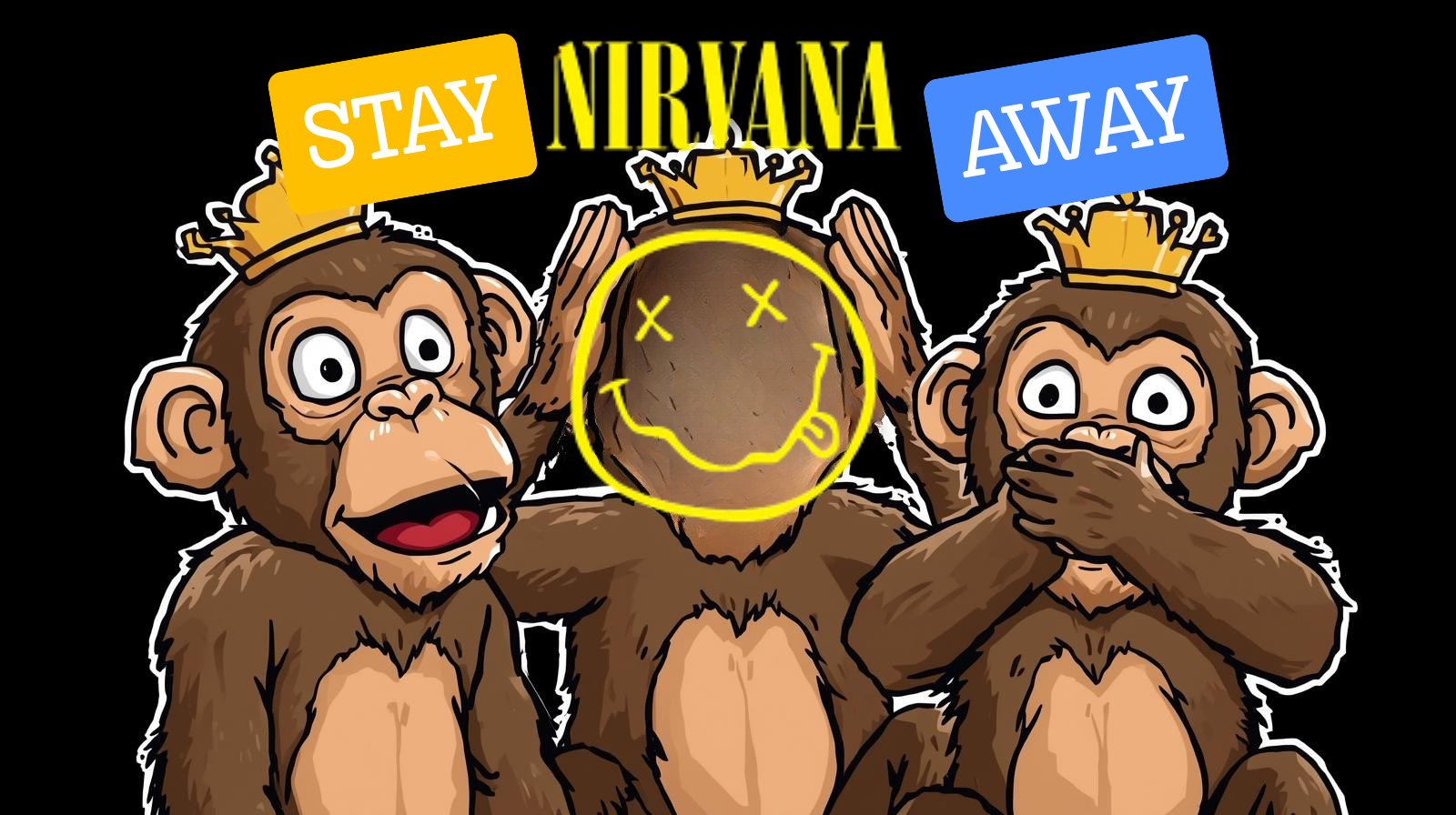
    “Monkey See, Monkey Do”: Nirvana’s Fierce Critique of Irreflexive Imitation

    Introduction to “STAY AWAY”

    Released in 1991 on the seminal album Nevermind, “STAY AWAY” by Nirvana stands as a powerful exploration of authenticity, conformity, and the visceral rejection of social pretense. Moreover, this song captures the essence of the burgeoning grunge movement, making it a key piece for understanding the broader cultural angst of Generation X.

    Historical and Cultural Context

    To fully grasp “Stay Away,” one must return to the musical landscape of 1991. In contrast to the polished, theatrical aesthetics of dominant hair metal and pop acts, the Seattle scene offered something raw and unfiltered. Nirvana’s sound channeled a widespread frustration that many young people felt but rarely saw reflected in mainstream media.

    The track’s original title was “Pay to Play,” a direct and cynical jab at a music industry that demanded bands finance their own access to stages and visibility. Changing the title to “Stay Away” broadened its scope, transforming a specific industry critique into a universal anthem about setting boundaries and protecting one’s identity.

    “Stay Away” is a prime example of saying much without becoming verbose. The track tackles a major pillar in the social construction of identity: imitation. From the perspective of Political Science and Linguistics, this work represents one of Kurt Cobain’s most direct and uncompromising critiques of conformity, over-adaptation, and consumerism.

    The title itself, “Stay Away,” functions as a political imperative. It is not a suggestion, but a call to action: reflect on one’s own behavior instead of blindly following the herd (Corso, 2024, p. 18).

    The Monkey Metaphor: Imitation Without Awareness

    The song opens with a phrase that operates as the thesis of the entire track: Monkey see, monkey do. This old adage refers to imitation without reflection or awareness of consequences (Corso, 2024, p. 18). Cobain is not referring to primates; he is addressing the sociology of the masses—our tendency to replicate behaviors simply because others do.

    Immediately after, he adds: (I don’t know why). This is the key moment. The imitating subject does not even know why they imitate; the act is passive, mechanical, and unexamined. Cobain invites the listener to abandon this mode of being.

    Key Analysis: Deconstructing Social Critique

    “Stay Away” is a collage of phrases aimed directly at social norms. The table below systematizes the most powerful lyrics that reveal Cobain’s critique of superficiality and inauthenticity:

    Original Lyrics Analysis / Key Interpretation
    Monkey see, monkey do BLIND IMITATION: The central metaphor describing the construction of identity through unreflective emulation. It represents the human tendency to adopt behaviors without questioning their origin (Corso, 2024, p. 17).
    Rather be dead than cool REJECTION OF INDIFFERENCE: Here, “cool” carries a negative connotation of emotional detachment. It is an ethical declaration: choosing intensity and authenticity over calculated emotional distance (Corso, 2024, p. 18).
    Less is more, love is blind CRITIQUE OF CONSUMERISM: “Less is more” promotes minimalism in opposition to material excess. “Love is blind” reinforces the search for value beyond appearances (Corso, 2024, p. 18).
    Fashion shits, fashion style / Throw it out and keep it in ATTACK ON THE CULTURE INDUSTRY: These contradictory lines denounce planned obsolescence and the endless cycle of consumption and waste (Corso, 2024, p. 19).
    Every line ends in rhyme THE SYSTEM’S PARADOX: Even while rejecting conformity, Cobain acknowledges adherence to formal structures. This highlights the difficulty of fully escaping established systems (Corso, 2024, p. 19).

    Deep Exploration: Central Themes

    The themes outlined above intertwine to produce a portrait of voluntary alienation. The song does not mourn loneliness; it demands it as a defense mechanism. The speaker does not seek belonging—he actively rejects “the club.”

    The musical structure reinforces this stance. The verses are contained and almost sardonic, while the chorus erupts into chaotic violence. This dynamic mirrors the tension between detached observation and the eventual emotional explosion that culminates in the scream: “Stay Away!”

    Conclusion: The Dilemma of Authenticity

    “Stay Away” is more than noise and fury—it is a manifesto. It exposes how much of what we call “our” identity is, in reality, a reproduction of traits, ideas, and styles borrowed from others (Corso, 2024, p. 20). The song urges listeners to become conscious of this process.

    Ultimately, Nirvana created a cultural artifact that captures a universal struggle: the fight to preserve personal integrity in a world that constantly demands conformity.


    References

    Corso, N. del V. (2024).


    Subjectivity in Kurt Cobain’s songs “Come as You Are,” “Stay Away,” “All Apologies”: The use of metaphors and metaphorical expressions alluding to the construction of identities

    .

  • Come As You Are: How Nirvana’s Metaphors Reveal the Contradictions of Identity

    POP Ideas POP Ideas · Music & Language

    Come As You Are: How Nirvana’s Metaphors Reveal the Contradictions of Identity

    A philosophical reading of identity, antagonism and the “purity paradox” in Nirvana’s “Come As You Are.”

    Nirvana’s “Come As You Are” doesn’t build an identity — it uses metaphor to talk about how identity actually works. Drawing from my background in Political Science and Translation, I read this track not just as a grunge anthem, but as a demonstration of how metaphor can describe identity as contradictory and historical: shaped by the present, weighed down by the past, and never fully separate from what others expect it to be. In my recent research (Corso, 2024), I explored exactly this: how Cobain uses metaphor not to construct identity, but to expose how contradictory and historical it already is.

    The song functions as a philosophical inquiry into the nature of authenticity in a postmodern world. When we analyze the text, we see a recurring tension between the individual’s true self and the performative self required by society. This isn’t just teenage angst; it is a sophisticated critique of social expectations. Consequently, “Come As You Are” remains one of the most intellectually dense tracks in the grunge canon, offering a blueprint for understanding the “self” as a precarious construction.

    🔎 Metaphors and ideas to notice

    • “As you are, as you were, as I want you to be” → the three planes of subjectivity: present, historical, and the social gaze.
    • “As a friend, as an old enemy” → identity needs an “other” — even an enemy — to define its own boundaries.
    • Mud vs. bleach → the purity paradox: raw, flawed humanity vs. the forced sanitation demanded for social consumption.
    • “I swear that I don’t have a gun” → a plea for trust, a moment of extreme vulnerability inside a song built on antagonism.

    This is one possible interpretation. POP Ideas reads songs as case studies in how language creates meaning.

    The Tripartite Structure of Existence

    Come as you are, as you were, as I want you to be

    The opening lines present a brilliant linguistic and philosophical trap. Within these few words, Cobain addresses three distinct planes of existence that define our subjectivity: first, the Present (“as you are”), an invitation to immediate authenticity; second, the Historical (“as you were”), acknowledging the baggage of our past; finally, the Social Gaze (“as I want you to be”), which immediately complicates the invitation. In other words, we are the result of the present, the past, and other people’s expectations — society itself.

    This structure suggests that our identity is never truly our own. It is constantly being negotiated between our history and the projections of the “Other.” In political theory, this mirrors the concept of subjectivity — the social and discursive construction of identity as something acted upon by outside forces. Cobain’s genius lay in his ability to condense these heavy sociological themes into a few bars of a rock song, effectively inviting the listener to a party where the dress code is fundamentally impossible to meet.

    Key Lyrics and Analysis

    Key LyricDirect MeaningThematic Interpretation & Analysis
    “Come as you are, as you were, as I want you to be” An invitation to authenticity, immediately followed by the speaker’s desires. The conditional invitation: the final clause negates the first two, highlighting how social acceptance is always tied to expectation.
    “As a friend, as an old enemy” Acknowledging both kinship and historical conflict. The necessary antagonist: reflecting Chantal Mouffe’s theory of agonism, identity requires an “other” — even an enemy — to define the boundaries of the “self.”
    “Doused in mud, soaked in bleach” Being covered in filth and simultaneously sanitized. The purity paradox: “mud” represents raw, flawed humanity; “bleach” represents the forced purification required for social consumption.

    The Purity Paradox: Mud vs. Bleach

    One of the most striking metaphors in the song is the juxtaposition of “mud” and “bleach.” In the context of the album title, Bleach, this takes on an even deeper meaning. “Mud” represents the organic, messy, and real parts of our identity — our failures and our “dirty” truths. “Bleach,” on the other hand, is the toxic chemical used to sanitize and erase. By asking the subject to be both, Cobain is highlighting the hypocrisy of a society that demands “authentic” people but only if they are “clean.”

    Furthermore, this duality reflects the internal struggle Cobain faced with his own image. As an artist, he was doused in the “mud” of the underground scene, but the industry attempted to soak him in “bleach” for mainstream appeal. Therefore, the line is not just a poetic image; it is a technical description of the commodification of subculture. When we apply this to political science, we see the process of co-optation, where radical identities are “bleached” to make them safe for the status quo.

    A Plea for Trust in a World of Anxiety

    The song’s bridge, “And I swear that I don’t have a gun,” is perhaps its most misunderstood section. In the wake of Cobain’s death, many read this as dark foreshadowing. However, within the context of the song’s ideological framework, it serves as a desperate plea for trust. If identity is built on antagonism (friend vs. enemy), then the declaration “I don’t have a gun” is an attempt to de-escalate that conflict. It is a moment of extreme vulnerability.

    Ultimately, “Come As You Are” is a philosophical masterpiece in the sense that, through metaphor, it shows the precarious nature of the human subject. It reminds us that while we are invited to “come as we are,” that invitation is often conditional.

  • Jesus dont want me for a sunbeam. The sunbeam metaphor and others.

    Jesus dont want me for a sunbeam. The sunbeam metaphor and others.

    POP Ideas POP Ideas · Music & Language

    Jesus Don’t Want Me for a Sunbeam: Nirvana’s Anthem of Alienation

    A close reading of Nirvana’s cover of “Jesus Don’t Want Me for a Sunbeam” — origins, the sunbeam metaphor, and the lyrical twist most listeners miss.

    When you picture Nirvana’s legendary 1993 MTV Unplugged performance, what comes to mind? The funereal lilies? Kurt Cobain’s pained vocals? The raw, stripped-down vulnerability? Perhaps no song encapsulates that atmosphere better than their cover of “Jesus Don’t Want Me for a Sunbeam.”

    It’s a slow, dirge-like performance that feels heavy with meaning. But what is that meaning? As a professional analyst and translator, I find this song to be one of the most profound declarations of identity in Nirvana’s entire catalog. It’s not just a song; it’s a thesis statement for the “outsider.” In this analysis, we’ll explore the song’s origins with The Vaselines, the powerful metaphor of the “sunbeam,” and the devastating lyrical twist that most listeners miss.

    🔎 Metaphors and ideas to notice

    • The sunbeam → not sunlight, but an idiom for someone perpetually cheerful, pure and good — a “being of light.”
    • The Vaselines original → twee and playful; Nirvana’s cover strips the irony and replaces it with sincerity.
    • The manifesto of rejection → each line rejects something bigger: belonging, dogma, martyrdom, and finally, self-sacrifice.
    • “Thee” vs. “me” → the pivot from anti-religion to a bleaker, more personal nihilism.

    This is one possible interpretation. POP Ideas reads songs as case studies in how language creates meaning.

    From Indie-Pop to Grunge Requiem: The Vaselines

    First, a critical piece of context: this is not a Nirvana song. It was originally written and performed by The Vaselines, a Scottish indie-pop band Kurt Cobain famously adored. This context is everything. The Vaselines’ original version is twee, almost childlike, and delivered with a playful, lo-fi charm.

    Nirvana’s version is the complete antithesis. They take the simple, almost naive lyrics and slow them to a crawl, transforming them into a solemn hymn. This artistic choice strips the song of its irony and replaces it with a devastating sincerity. It’s no longer a playful jab at religion; it’s the genuine, heartbreaking confession of someone who feels fundamentally excluded from “the light.”

    The “Sunbeam” as a Metaphor for Purity

    Jesus, don’t want me for a sunbeam

    The entire song hinges on its central metaphor: the “sunbeam.” On the surface, it’s a ray of sun. But pragmatically, it’s a common English idiom for a person who is perpetually cheerful, angelic, pure, and good — a “being of light.”

    When Cobain sings, “Jesus, don’t want me for a sunbeam,” he is making a profound statement about his own identity. He isn’t just saying, “Jesus doesn’t like me.” He is saying, “I am not made of the right material. I am not one of the pure.” This is reinforced by the next line, “Sunbeams are never made like me.” It’s a total acceptance of his own perceived darkness, his flaws, and his humanity. He’s not asking for entry into the club; he’s stating from the outset that he doesn’t, and can’t, belong.

    Lyrical Deep Dive: A Manifesto of Rejection

    The song’s power lies in its simplicity. It’s a series of rejections. As an analyst, I see these lines as a progression from rejecting dogma to rejecting existence itself. Let’s look at the key thematic phrases.

    Original LyricThematic Interpretation & Analysis
    Jesus, don’t want me for a sunbeam The thesis of exclusion: the song’s opening statement. It establishes that the narrator feels rejected by the central figure of salvation — a declaration of being unwanted by the “in-group.”
    Sunbeams are never made like me The statement of identity: this is the “why.” It’s not just that he’s unwanted; it’s that he is fundamentally, structurally different. He lacks the required “purity” by his very nature.
    Don’t expect me to cry / For all the reasons you had to die Rejection of dogma: a powerful refusal to participate in the expected emotional contract of religion. The narrator refuses to feel the guilt or perform the ritual grief associated with Christ’s sacrifice.
    Don’t expect me to die for thee Rejection of martyrdom (for others): the use of the archaic “thee” frames this as a direct response to religious demands. He refuses to be a martyr for a god or a cause.
    Don’t expect me to die for me Rejection of martyrdom (for self): the final, devastating twist. After rejecting martyrdom for a higher power, he also rejects it for himself — a profound nihilism, a weariness with the very idea of “dying for” anything.

    The Final Twist: “For Thee” vs. “For Me”

    This is the detail that is so often missed. The song is not just one repeated line. It pivots on two crucial, archaic-sounding words.

    1. “For thee” (/ði/): this is Early Modern English for “you” (objective case). It’s a direct, almost biblical, rejection of sacrificing oneself for a deity or external ideology.
    2. “For me” (/mi/): at the very end, the lyric shifts. “Don’t expect me to die for me.” The rejection turns inward. It’s a refusal of self-sacrifice, a negation of the idea that his own life is a cause worth dying for.

    This shift from “thee” to “me” is the entire philosophical journey of the song. It moves from anti-religion to a much bleaker, more personal nihilism. It perfectly captures the disillusionment of the era.

    Conclusion: The Sincere Outsider

    As a political scientist and cultural analyst, I interpret Nirvana’s “Jesus Don’t Want Me for a Sunbeam” as a profound anthem of alienation. Cobain’s delivery isn’t angry or mocking; it’s deeply melancholic and resigned.

    It’s the voice of someone who has looked at the societal ideals of purity, joy, and purpose (the “sunbeams”) and has quietly, definitively said, “That is not me.” There is no plea to be let in. There is only the stark, honest acceptance of being an outsider. And in that raw honesty, the song finds its timeless power.

    It’s a masterpiece of interpretation, taking a simple indie-pop song and turning it into a mirror that reflects the soul of a generation.

    More Nirvana Readings on POP Ideas

    Keep exploring other POP Ideas articles on ambiguity, identity, emotional distance and survival in Kurt Cobain’s writing.

    • Dumb → emotional numbness, false happiness, and glue as a metaphor.
      Read the analysis
    • Something in the Way → consumption, addiction and moral permission.
      Read the analysis
    • About a Girl → semantic ambiguity and the difficulty of defining a relationship.
      Read the analysis