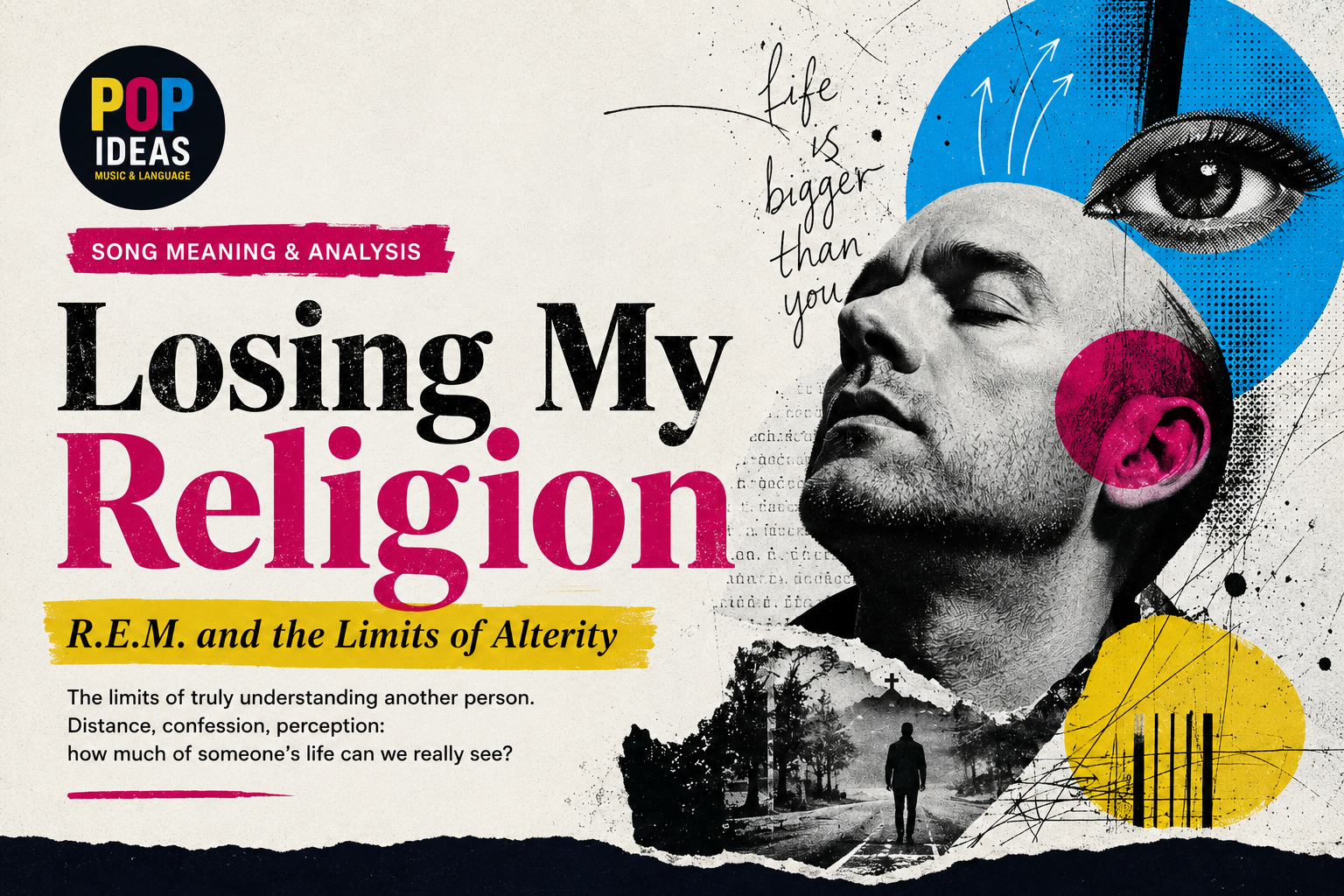
Losing My Religion Meaning: R.E.M. and the Limits of Alterity
 POP Ideas · Music & Language
Losing My Religion Meaning: R.E.M. and the Limits of Alterity
A look at the meaning behind R.E.M.’s lyrics — on the distance between what we live through and what others can actually see of us.
The meaning of “Losing My Religion” is usually flattened into a song about obsessive love. This reading offers another possible meaning: alterity, a fancy word for something simple — the fact that other people are never fully knowable from the outside. How much of what we live through can really be seen, understood, or shared by someone else?
🔎 Ideas to notice
This is one possible interpretation. POP Ideas reads songs as case studies in how language creates meaning.
Life Is Bigger Than You
Oh, life is bigger / It’s bigger than you, and you are not me
The line starts from an idea of radical humility: life is bigger than either of them, and “you are not me” isn’t just a statement about identity — it’s an epistemological limit. What one person lived through, the other didn’t, and that means neither of them has full authority to weigh in on the other’s experience.
The Distance in Your Eyes
The lengths that I will go to / The distance in your eyes
“The lengths that I will go to” speaks to how far he’s willing to go; “the distance in your eyes” answers that commitment with an image of separation. The other person can see his whole life, his actions, his attempts — but only from their own eye, never from his. Seeing is not the same as understanding.
Losing Your Religion, Not Your Faith
That’s me in the corner / That’s me in the spotlight, losing my religion
Being the center of everyone’s attention — in the corner, under the spotlight — coincides with a shift in habits and in the rigid structures of thought that used to hold him together. But the meaning of “losing my religion” isn’t, in this reading, about literally losing faith: it’s about losing everything that used to sustain him, the certainties that shaped the way he thought.
Language note: “losing my religion” is also a colloquial Southern U.S. expression meaning to lose your patience or your temper — Michael Stipe builds the title on that double meaning, letting the regional idiom and the religious image sit inside the same phrase. You can read more about the song’s background on its Wikipedia entry.
Trying to Keep Up With You
Trying to keep up with you / And I don’t know if I can do it
“Keep up with you” is a verbal phrase that means to match someone’s pace — like struggling not to fall behind a fast walker. Applied to a person instead of a physical stride, the phrase becomes more honest than it first sounds: trying to “keep up” with someone hits a real limit. He doesn’t know if he can do it. He doesn’t know if he can ever know everything that’s actually happening to the other person.
Choosing My Confessions
Every whisper, of every waking hour / I’m choosing my confessions
Every whisper, every waking hour, involves a choice: what to say and what not to. “Choosing my confessions” is an acknowledgment that not everything has to be bared to the world — that there’s a right to reserve, even inside intimacy.
A Hurt, Lost and Blinded Fool
Trying to keep an eye on you / Like a hurt, lost and blinded fool, fool
“Trying to keep an eye on you” is an attempt to stay close, to watch over, to care — but the line frames that attempt as the position of someone hurt, someone lost, a fool blinded by what he’s watching without fully seeing it.
What If All These Fantasies Come Flailing Around?
Consider this, the hint of the century / Consider this, the slip that brought me to my knees, failed / What if all these fantasies come flailing around?
“Consider this, the hint of the century” works almost like a piece of life advice: no one can ever fully stand in someone else’s shoes. “The slip” that brought him to his knees is a real event or mistake that forced him to rethink how he sees things. And the question that closes the passage — what if all these fantasies come flailing around? — can be read on two levels at once, and both change the meaning of the verse: as the doubt that none of it was ever real, and as the concrete question of what would happen if he lost his health, his job, or any other thing holding his life together — the kind of loss that also forces a person to change their behavior.
This reading does not try to close the meaning of the song, but to open one possible meaning among others.
More Readings
Another song whose meaning also treats identity as something defined in relation to someone else:
- Come As You Are (Nirvana) → identity, contradiction, and the social gaze.
Read the analysis