
Tag: Song Meaning

  • Losing My Religion Meaning: R.E.M. and the Limits of Alterity

    Losing My Religion Meaning: R.E.M. and the Limits of Alterity

    POP Ideas POP Ideas · Music & Language

    Losing My Religion Meaning: R.E.M. and the Limits of Alterity

    A look at the meaning behind R.E.M.’s lyrics — on the distance between what we live through and what others can actually see of us.

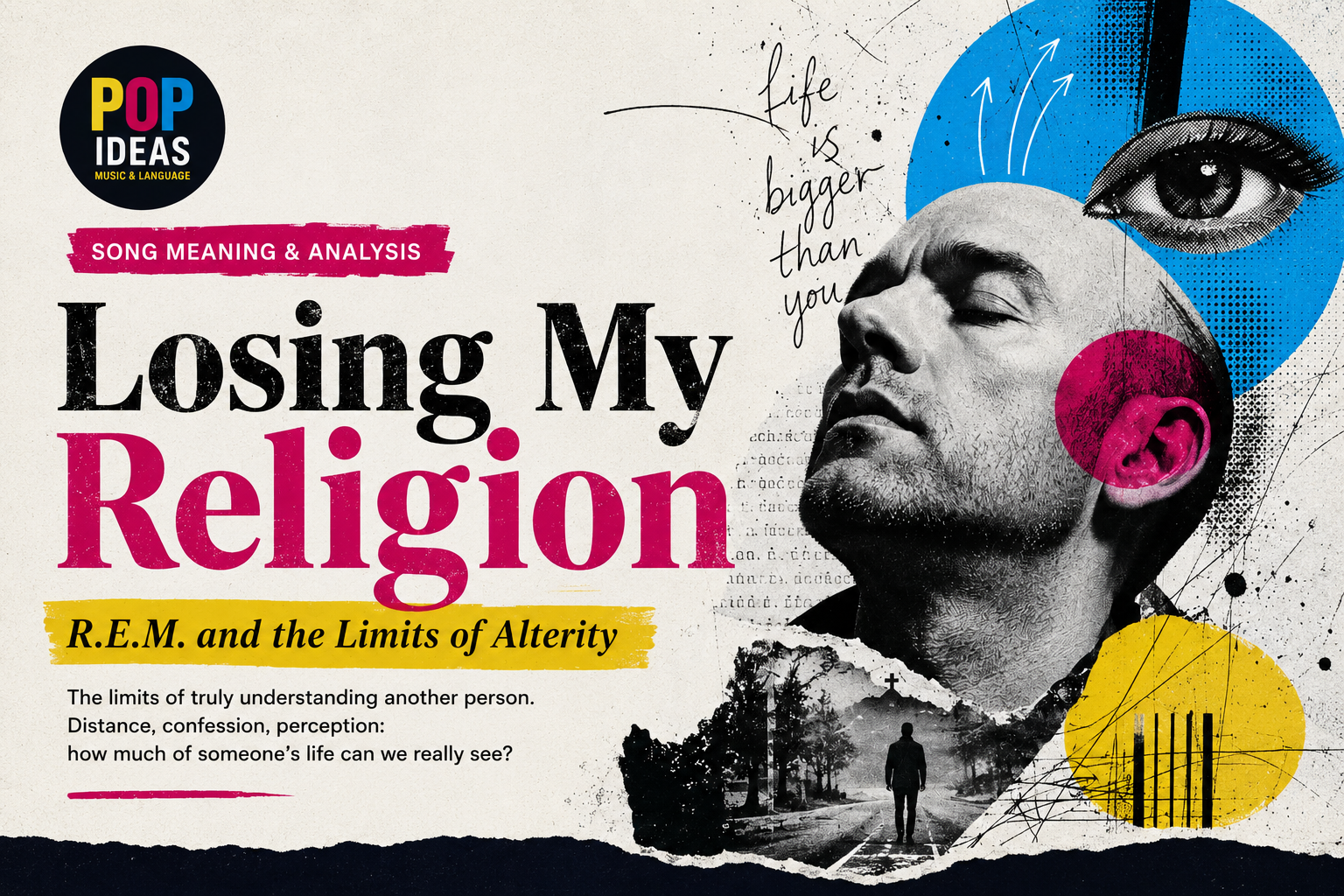
    The meaning of “Losing My Religion” is usually flattened into a song about obsessive love. This reading offers another possible meaning: alterity, a fancy word for something simple — the fact that other people are never fully knowable from the outside. How much of what we live through can really be seen, understood, or shared by someone else?

    🔎 Ideas to notice

    • “You are not me” → an epistemological limit: what one person lived through, the other didn’t.
    • The distance in your eyes → seeing someone’s life is not the same as understanding it.
    • “Losing my religion” → a Southern U.S. idiom for losing your patience or temper, not literally losing your faith.
    • Choosing my confessions → not everything has to be bared to the world.

    This is one possible interpretation. POP Ideas reads songs as case studies in how language creates meaning.

    Life Is Bigger Than You

    Oh, life is bigger / It’s bigger than you, and you are not me

    The line starts from an idea of radical humility: life is bigger than either of them, and “you are not me” isn’t just a statement about identity — it’s an epistemological limit. What one person lived through, the other didn’t, and that means neither of them has full authority to weigh in on the other’s experience.

    The Distance in Your Eyes

    The lengths that I will go to / The distance in your eyes

    “The lengths that I will go to” speaks to how far he’s willing to go; “the distance in your eyes” answers that commitment with an image of separation. The other person can see his whole life, his actions, his attempts — but only from their own eye, never from his. Seeing is not the same as understanding.

    Losing Your Religion, Not Your Faith

    That’s me in the corner / That’s me in the spotlight, losing my religion

    Being the center of everyone’s attention — in the corner, under the spotlight — coincides with a shift in habits and in the rigid structures of thought that used to hold him together. But the meaning of “losing my religion” isn’t, in this reading, about literally losing faith: it’s about losing everything that used to sustain him, the certainties that shaped the way he thought.

    Language note: “losing my religion” is also a colloquial Southern U.S. expression meaning to lose your patience or your temper — Michael Stipe builds the title on that double meaning, letting the regional idiom and the religious image sit inside the same phrase. You can read more about the song’s background on its Wikipedia entry.

    Trying to Keep Up With You

    Trying to keep up with you / And I don’t know if I can do it

    “Keep up with you” is a verbal phrase that means to match someone’s pace — like struggling not to fall behind a fast walker. Applied to a person instead of a physical stride, the phrase becomes more honest than it first sounds: trying to “keep up” with someone hits a real limit. He doesn’t know if he can do it. He doesn’t know if he can ever know everything that’s actually happening to the other person.

    Choosing My Confessions

    Every whisper, of every waking hour / I’m choosing my confessions

    Every whisper, every waking hour, involves a choice: what to say and what not to. “Choosing my confessions” is an acknowledgment that not everything has to be bared to the world — that there’s a right to reserve, even inside intimacy.

    A Hurt, Lost and Blinded Fool

    Trying to keep an eye on you / Like a hurt, lost and blinded fool, fool

    “Trying to keep an eye on you” is an attempt to stay close, to watch over, to care — but the line frames that attempt as the position of someone hurt, someone lost, a fool blinded by what he’s watching without fully seeing it.

    What If All These Fantasies Come Flailing Around?

    Consider this, the hint of the century / Consider this, the slip that brought me to my knees, failed / What if all these fantasies come flailing around?

    “Consider this, the hint of the century” works almost like a piece of life advice: no one can ever fully stand in someone else’s shoes. “The slip” that brought him to his knees is a real event or mistake that forced him to rethink how he sees things. And the question that closes the passage — what if all these fantasies come flailing around? — can be read on two levels at once, and both change the meaning of the verse: as the doubt that none of it was ever real, and as the concrete question of what would happen if he lost his health, his job, or any other thing holding his life together — the kind of loss that also forces a person to change their behavior.

    This reading does not try to close the meaning of the song, but to open one possible meaning among others.

    More Readings

    Another song whose meaning also treats identity as something defined in relation to someone else:

    • Come As You Are (Nirvana) → identity, contradiction, and the social gaze.
      Read the analysis
  • La Balsa: Escape and Ambiguity in Argentine Rock

    La Balsa: Escape and Ambiguity in Argentine Rock

    POP Ideas POP Ideas · Music & Language

    La Balsa: Escape and Ambiguity in Argentine Rock

    A possible reading of La balsa, one of the most influential songs in Argentine rock.

    More than fifty years after its release, La balsa remains one of the most listened-to and analyzed songs in Argentine rock. What explains the fact that a song written in 1967 continues to raise so much interest?

    Perhaps one answer is that the song never fully explains itself. Its images are open, its metaphors allow different readings, and many of its questions remain unanswered. Each generation, as a result, seems to find something different in it.

    In this article, we will not try to discover the definitive meaning of the lyrics. Instead, our goal is to explore some of the song’s most suggestive metaphors and reflect on how language creates meaning.

    Over time, some listeners have interpreted the song as a metaphor for the desire to escape an oppressive reality, a reading influenced by the political and social context of Argentina at the time. However, the lyrics never explicitly mention those events. For that reason, we treat that interpretation as one of the many possibilities the song leaves open, rather than as a definitive explanation.

    🔎 Metaphors and ideas to notice

    • The abandoned world → not necessarily the world itself, but how it feels when someone is lonely or disconnected.
    • The place he loves most → an undefined destination; the desire to leave matters more than where he’s going.
    • The wood → the resources, effort, or courage needed before any real change is possible.
    • The raft → something built out of what’s available, a makeshift vehicle for escape.
    • To shipwreck → the paradox of building something meant to survive, only to risk losing it.
    • The open ambiguity → the song never explains itself, leaving room for each generation to read it differently.

    This is one possible interpretation. POP Ideas reads songs as case studies in how language creates meaning.

    🌍 An Abandoned World

    “Estoy muy solo y triste acá en este mundo abandonado.”

    “I am very lonely and sad here in this abandoned world.”

    Is the world abandoned… or does the narrator feel abandoned?

    The song begins by describing a feeling, not necessarily a fact. The “abandoned world” may be a real place, but it may also be a way of perceiving reality when someone feels lonely, disconnected, or unable to belong.

    🧭 The Desire to Escape

    “Tengo una idea, es la de irme al lugar que yo más quiera.”

    “I have an idea: to go to the place I love most.”

    Where is he actually going?

    Interestingly, we never find out where that place is. The song is not really focused on the destination, but on the desire to leave. Perhaps what matters is not where the narrator wants to go, but what he wants to get away from.

    🪵 Gathering the Wood

    “Me falta algo para ir… Tengo que conseguir mucha madera.”

    “I am missing something in order to go… I need to get a lot of wood.”

    What does the wood really stand for?

    The narrator realizes that wanting to leave is not enough. Before he can escape, he has to build the means to do so. The wood can be understood literally, as the material needed to build the raft. But it can also work as a metaphor for the resources, effort, courage, or preparation required to change one’s life.

    🛶 A Raft Built to Sink

    “Construiré una balsa y me iré a naufragar.”

    “I will build a raft and go off to shipwreck.”

    Why build something only to sink it?

    Here we find the great paradox of the song. Usually, a raft is built to survive, not to sink. Does this mean the narrator is looking for failure? Or is he willing to leave everything behind, even without any guarantee of reaching a safe destination? The song never answers that question.

    🤔 So… What Does It Mean?

    Perhaps that is not the best question. It may be more interesting to ask why the song leaves so many spaces open.

    We never know exactly where the narrator wants to go, nor what he is missing, nor what “madness” truly means. Even the shipwreck itself remains only partly explained.

    That ambiguity is probably one of the reasons why La balsa continues to generate new interpretations more than fifty years later.

    Maybe the greatest lesson of the song is that wanting to escape is not enough. First, you have to gather the wood. This reading does not try to close the meaning of the song, but to open one possible way of thinking about it.

  • No Voy en Tren Meaning | Charly García, Independence and the Southern Cross

    No Voy en Tren Meaning | Charly García, Independence and the Southern Cross

    POP Ideas POP Ideas · Music & Language

    No Voy en Tren: Charly García, Independence and the Southern Cross

    A possible cultural and linguistic reading of a song about speed, isolation, media, personality and Southern identity

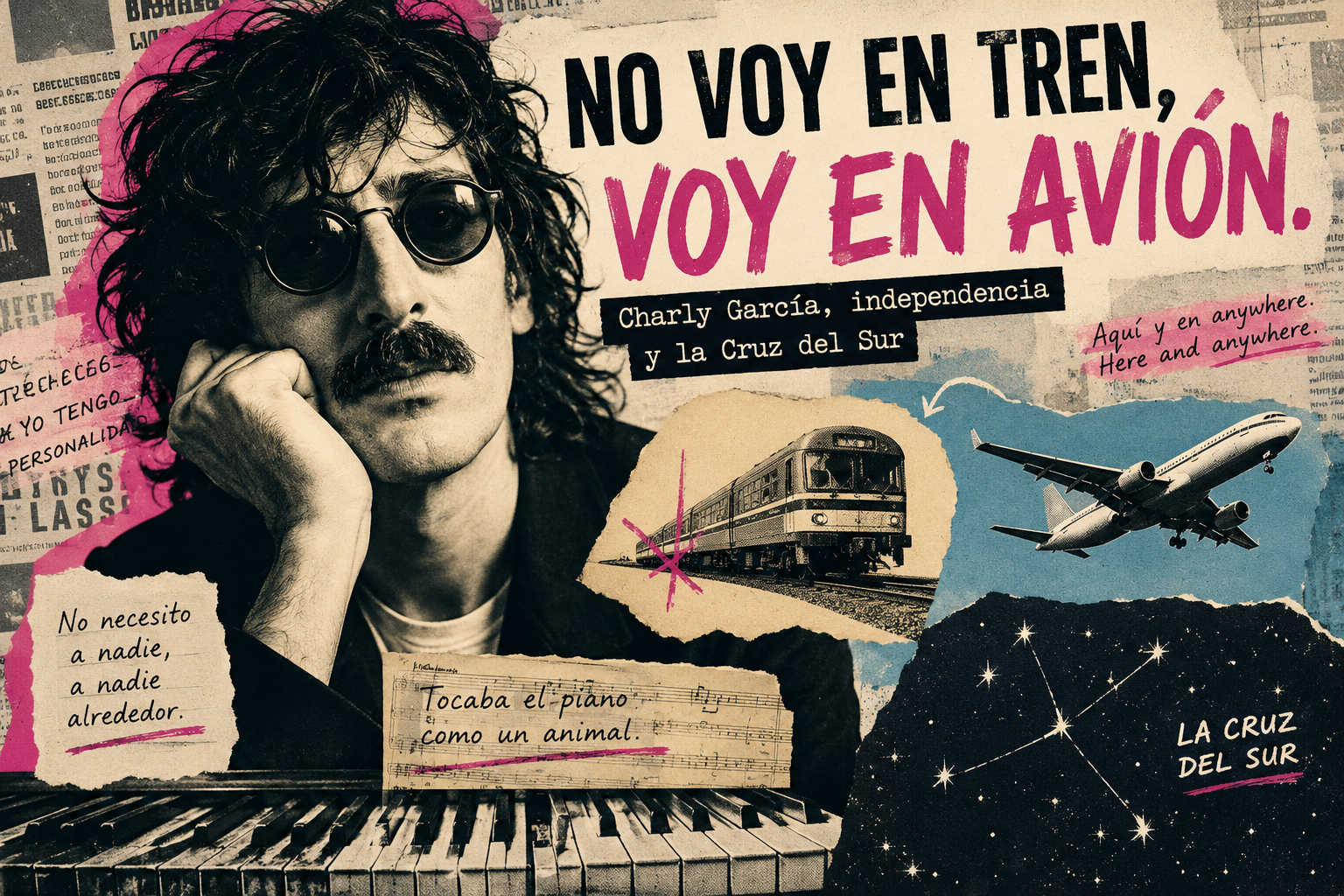
    No Voy en Tren can be read as more than a song about transportation — a declaration of independence, where the speaker refuses the marked path and claims his own way of existing in the world. In this reading, the train stands for the conventional route, while the plane suggests speed, freedom, and a different way of thinking.

    🔎 Metaphors and ideas to notice

    • Tren / train → the conventional, fixed, predictable path.
    • Avión / plane → speed, freedom, a different way of thinking.
    • “No necesito a nadie alrededor” → independence, distance, or isolation.
    • “Mi piel resista” → contact with others, exhaustion, or the difficulty of coexistence.
    • Televisión y revistas → media, consumer culture, prefabricated models of life.
    • “Tocaba el piano como un animal” → instinct, force, undomesticated creativity.
    • Mixto → someone difficult to classify.
    • La Cruz del Sur → orientation, Southern identity and belonging.
    • “El que apaga la luz” → ending a scene, remaining as the last witness.

    This is one possible interpretation. POP Ideas reads songs as case studies in how language creates meaning.

    The Train and the Plane

    No voy en tren, voy en avión.

    Why comparing a train to a plane?

    At first, this sounds like a simple comparison between two means of transportation. But another idea can be read into it: in Argentina, there’s an expression — “cuando vos salís y yo ya llegué” — a way of saying someone thinks faster, always one step ahead.

    A train follows rails already decided. A plane leaves the ground, rising above the fixed route. Perhaps Charly is not only saying how he travels, but how he thinks: “while you are still following the tracks, I am already somewhere else.”

    Of course, this is only one possible interpretation.

    I Don’t Need Anyone

    No necesito a nadie, a nadie alrededor.

    Freedom, or isolation?

    The line can be read in different ways — the next verse seems to give a clue. It may not be only about independence; there may also be tiredness, distance, or exhaustion toward other people.

    Skin and Other People

    Porque no hay nadie que mi piel resista.

    What does it mean that “my skin can stand”?

    At least two readings open up: I can’t stand people — exhaustion toward others — or the opposite, no one can stand me, the skin as a border between self and world. In both cases, the same idea appears: a difficulty in living with others.

    So when he says “I don’t need anyone around,” we can’t tell whether he’s defending his independence, or simply naming a distance that already exists.

    Television, Magazines and Consumption

    No veo televisión ni las revistas, no veo ya nada que no pueda hacer.

    Why does he reject the media?

    This likely isn’t just about not watching TV — it can be read as questioning what television and magazines represent. Media doesn’t only inform; it builds desire, telling us what to consume, what to want.

    The speaker doesn’t want to consume images of life. He wants to live for himself.

    Childhood and the Piano

    Cuando era niño nunca fui muy listo, tocaba el piano como un animal.

    Why does he return to childhood?

    Up to here, the song speaks from a strong identity. Then childhood appears — humanizing the speaker: there was once a child not considered “smart.”

    “Like an animal” can read as criticism or as praise — animals act by instinct, without calculation. Perhaps Charly is saying he played with natural force, without asking permission.

    Being “Mixto”

    Yo sé que algunos piensan que soy mixto, pero yo tengo personalidad.

    What does “mixto” mean?

    It may refer to someone hard to classify, who mixes styles or breaks categories. The speaker’s answer is clear: “I have personality.” Not a shapeless mixture, but an identity of his own.

    The Southern Cross

    Yo soy de la Cruz del Sur.

    Why does Charly mention the Southern Cross?

    The Southern Cross has long guided sailors to the South Celestial Pole — a navigation tool, not just a group of stars. Saying “I belong to the Southern Cross” may express a way of seeing the world: defining himself from the South rather than from Europe or North America.

    The constellation becomes both an identity and a compass.

    Closing and Turning Off the Light

    Soy el que cierra y el que apaga la luz.

    What does it mean to close and turn off the light?

    It may be the one who puts an end to something, who remains after everyone else has left, or who refuses to keep participating in a show that no longer interests him — someone who marks the end of a stage.

    Here and Anywhere

    Yo soy de la Cruz del Sur, aquí y en anywhere.

    Why mix Spanish and English?

    Charly could have said “aquí y en cualquier lugar,” but chooses anywhere. Argentine rock has always been in dialogue with the English-speaking world without becoming less local — the speaker belongs to the South, but isn’t trapped inside a border.

    Final Thought

    No Voy en Tren may not be a song about means of transportation. It can be read as a declaration of independence: the speaker rejects prefabricated paths, distances himself from others, questions media and consumer culture, accepts being difficult to classify, and finally presents himself as someone who belongs to the South while his voice can sound anywhere.

    That is why the plane is not only a plane — it can be read as a way of moving, thinking, and existing outside the marked tracks.

    This reading does not try to close the meaning of the song, but to open one possible way of thinking about it.

    POP Ideas · Translation, language and cultural analysis through songs, by Noelia Corso.

  • Dumb Meaning | Nirvana, Emotional Numbness and the Metaphor of Glue

    Dumb Meaning | Nirvana, Emotional Numbness and the Metaphor of Glue

    POP Ideas POP Ideas · Music & Language

    Dumb Meaning: Emotional Numbness, Glue and False Happiness in Nirvana

    A possible reading of Nirvana’s Dumb through metaphor, language and emotional escape.

    In this interpretation, Dumb is not simply about stupidity. It may be about emotional numbness: the strange state of feeling different, pretending to belong, and finding temporary ways to repair pain without truly healing it.

    The song moves through a chain of images: pretending, light, dumbness, happiness, a broken heart, glue, inhaling, floating, coming down and having a hangover. Read together, those images suggest a cycle of pain, escape and return.

    🔎 Metaphors and ideas to notice

    • “I’m not like them” → feeling different from other people.
    • “I can pretend” → social masking; acting like one belongs.
    • The sun → God, hope, purpose, certainty or an ideal.
    • The light → a smaller source of hope that still remains.
    • Dumb → not only “stupid,” but possibly silent, numb or disconnected.
    • Happy → not necessarily joy; perhaps emotional anesthesia.
    • The broken heart → emotional pain.
    • Glue → drugs, emotional escape or a temporary way to hold pain together.
    • Inhale → possibly consuming something, or taking in an escape.
    • Clouds → euphoria, fantasy or altered consciousness.
    • Come down → returning from that altered state.
    • Hangover → the physical and emotional cost after escape.

    This is one possible interpretation. POP Ideas reads songs as case studies in how language creates meaning.

    Not Like Them

    I’m not like them, but I can pretend.

    What does he mean by “I’m not like them”?

    The narrator immediately separates himself from everyone else — he feels different. Yet he also says he can pretend, which means he knows how to hide that difference. The first conflict in the song is not simply between him and the world: it is between who he really is and the role he performs for other people.

    The Sun and the Light

    The sun is gone, but I have a light.

    If the sun is gone, what is the light?

    The sun usually represents something greater than ourselves — it could symbolize God, hope, purpose, or the certainty that everything will eventually be alright. The narrator says the sun has disappeared, yet he still has a light. Perhaps it is weaker, perhaps artificial — but he is not completely in darkness.

    Fun After the Day Is Done

    The day is done, but I’m having fun.

    Why is he having fun if everything else sounds so sad?

    That is exactly what makes the line interesting: the surrounding images are not cheerful — the sun is gone, the day is over, and the narrator feels different from everyone else. So the “fun” may not be simple happiness. It may be distraction, escape, or simply the temporary feeling of not suffering as much.

    Dumb

    I think I’m dumb.

    What does “dumb” really mean here?

    Today, many people understand dumb as “stupid.” But according to Merriam-Webster, the word also carries older meanings related to silence, speechlessness and muteness — historically, it could describe someone unable to speak, someone silent, or someone left without words. That changes the possible meaning of the line: maybe the narrator is not only asking, “Am I stupid?” Maybe he is also asking whether he has become emotionally numb, stopped speaking, or disconnected from what he feels.

    Or Maybe Just Happy

    Or maybe just happy.

    Why does Cobain contrast “dumb” with “happy”?

    That contrast is fascinating, because the two words may not be opposites. Perhaps the narrator wonders whether his numbness feels like happiness — not because life has improved, but because he no longer feels the pain in the same way. In this reading, happiness does not sound like joy; it sounds more like anesthesia.

    The Broken Heart and the Glue

    My heart is broke, but I have some glue.

    If his heart is broken, why does he use glue?

    He does not say he has medicine, love, or time — he says he has glue. Glue fixes broken objects; it does not heal wounds. That image suggests a temporary repair rather than real recovery.

    Inhale

    Help me inhale and mend it with you.

    Why does Cobain choose the word “inhale”?

    That word feels unusually specific. He could have written “help me fix it” or “help me heal” — instead, he writes “help me inhale.” One possible interpretation is that the glue symbolizes drugs, or at least some form of emotional escape. The narrator is not truly healing his broken heart; he is temporarily holding it together.

    Clouds

    We’ll float around and hang out on clouds.

    What happens after inhaling the glue?

    Now the images begin to connect: they float, they drift through clouds, and the emotional pain disappears for a while. The clouds may represent euphoria, fantasy, or an altered state where the broken heart no longer feels as broken.

    Coming Down

    Then we’ll come down and have a hangover.

    But does the escape last?

    No. First they float. Then they come down. Finally, there is a hangover. Whether the glue represents drugs, emotional denial, or another kind of escape, the cycle remains the same: temporary relief followed by reality.

    More Nirvana Readings on POP Ideas

    Keep exploring other POP Ideas articles on ambiguity, identity, emotional distance and survival in Kurt Cobain’s writing.

    • Something in the Way → consumption, addiction and moral permission.
      Read the analysis
    • Come as You Are → identity, contradiction and the impossibility of being only one thing.
      Read the analysis
    • About a Girl → semantic ambiguity and the difficulty of defining a relationship.
      Read the analysis

    Final Thought

    One possible interpretation is that Dumb is not about stupidity at all — it may be about emotional numbness. The narrator feels different from everyone else. His heart is broken, and instead of healing it, he finds glue.

    He inhales, floats, and comes down — and then the cycle begins again.

    In this reading, happiness is not necessarily joy. It may be the temporary silence of pain.

  • La Novia Blanca Meaning | How La Mona Jiménez Turned Cocaine into a Wedding Metaphor

    La Novia Blanca Meaning | How La Mona Jiménez Turned Cocaine into a Wedding Metaphor

    POP Ideas POP Ideas · Music & Language

    La Novia Blanca Meaning: How La Mona Jiménez Turned Cocaine into a Wedding Metaphor

    A bilingual cultural reading for English speakers discovering Argentine music through Spanish.

    This article reads La Novia Blanca as a bilingual lesson in metaphor, translation and Argentine popular culture. Instead of only explaining what the song says, we compare the Spanish with a literal English translation and my own singable English adaptation, and then analyze the cultural meaning behind the words.

    🔎 Metaphors and ideas to notice

    • La novia blanca → cocaine personified as a bride.
    • El vestido blanco → apparent purity hiding danger.
    • El altar → the point of no return.
    • El casamiento → addiction as a destructive commitment.
    • La madre → the suffering of the family.
    • La muerte blanca → death associated with cocaine.
    • La balanza → the language of drug trafficking: weight, portions and money.
    • La esperanza → the false promise that the next time will be enough.
    • El traficante que no sabe de las almas → dehumanization.

    The full lyrics are not reproduced here. POP Ideas uses short excerpts for bilingual, educational and analytical purposes.

    🎤 My singable adaptation: this is not a literal translation. It is my own English version, created to preserve the imagery, flow and emotional effect of the original song.

    The Song Starts in an Emergency Room

    🇦🇷 Original Spanish🔍 Literal Translation🎤 Singable Adaptation
    En la sala de urgencia de un hospital,
    Una madre llorando quiere salvar,
    A su hijo…
    In a hospital emergency room,
    A crying mother is trying to save
    her son…
    At the emergency room in a hospital,
    A crying mother wants to save,
    to his son that soon is going to get married.

    Most songs about drugs begin with the drug itself. This one begins with a mother.

    That choice immediately changes the emotional perspective of the story: instead of presenting addiction through pleasure, rebellion or glamour, La Mona Jiménez presents it through its consequences. The hospital is not simply the setting — it is the destination. The song starts where many stories about addiction usually end.

    The White-Dressed Woman

    🇦🇷 Original Spanish🔍 Literal Translation🎤 Singable Adaptation
    Con esa mujer, que lo vino a buscar,
    Con su vestido blanco esperando está.
    With that woman who came looking for him,
    Waiting for him in her white dress.
    With that woman looking for him,
    with a white dress she is waiting for him.

    At first, listeners naturally imagine a bride waiting for the man she loves. However, the song deliberately misleads us: the woman is not a woman at all. She is cocaine.

    Instead of naming the drug directly, La Mona Jiménez personifies it as a beautiful bride dressed in white. This allows him to tell a story about addiction without ever needing to say the word cocaine inside the metaphor.

    Doctors Against the Bride

    🇦🇷 Original Spanish🔍 Literal Translation🎤 Singable Adaptation
    Los doctores se esfuerzan, para evitar
    Que la novia lo lleva para el altar.
    The doctors struggle to prevent
    The bride from taking him to the altar.
    The doctors are trying to avoid
    The bride takes him to the altar.

    This verse expands the wedding metaphor. Normally, the altar symbolizes the beginning of a new life — here, it symbolizes the beginning of destruction. The doctors are not trying to stop a wedding: they are trying to stop addiction before it becomes irreversible.

    When the Metaphor Reveals Itself

    🇦🇷 Original Spanish🔍 Literal Translation🎤 Singable Adaptation
    Porque esa novia blanca que se fracciona,
    Que ha varado en la balanza.
    Because that white bride is divided into portions,
    And ends up on the scale.
    Because she is the white bride, it is weighed
    gram by gram on balances.

    This is where the metaphor begins to reveal itself. Words such as fracciona and balanza belong to the vocabulary of drug trafficking, not weddings.

    The romantic world and the criminal world collide in just two lines — the listener suddenly realizes that the bride is not simply a bride. She is cocaine.

    The Dealer and the Loss of Humanity

    🇦🇷 Original Spanish🔍 Literal Translation🎤 Singable Adaptation
    Tu traficante que no sabe de las almas,
    Que va camino hacia la muerte blanca.
    Your dealer knows nothing about souls,
    As he walks toward white death.
    You drugdealer knows nothing about souls,
    That is on the road to the white death.

    One of the strongest lines in the song is not about cocaine — it is about the dealer. The lyric does not simply call him evil: instead, it says that he knows nothing about souls.

    He understands weight, money, purity and profit. But not people. The mother sees a son; the dealer sees a product.

    Purity Becomes Danger

    🇦🇷 Original Spanish🔍 Literal Translation🎤 Singable Adaptation
    Porque esa novia blanca,
    Cuanto más pura,
    Más te mata de esperanza.
    Because that white bride,
    The purer she is,
    The more she kills you with hope.
    Because she is the white bride, the purer,
    the more it kills you with hopes.

    White traditionally symbolizes innocence, weddings and purity. La Mona Jiménez completely reverses that symbolism: the purer the bride appears, the deadlier she becomes — and the most interesting word here is hope.

    The drug does not kill only through chemistry: it kills through promises, convincing people that happiness is always one more dose away.

    The Promise That Is Never Enough

    🇦🇷 Original Spanish🔍 Literal Translation🎤 Singable Adaptation
    Te va brindando cosas que jamás te alcanzan,
    Para llevarte poco a poco hacia el altar.
    It keeps offering you things that are never enough,
    Slowly leading you toward the altar.
    She gives you things that are never enough,
    To lead you slowly towards the altar.

    This may be the best definition of addiction in the entire song. The drug always promises something more: more confidence, more pleasure, more peace, more happiness.

    Yet nothing is ever enough. The altar becomes the final destination of a relationship built on endless promises that can never be fulfilled.

    Ambition, Betrayal and Cost

    🇦🇷 Original Spanish🔍 Literal Translation🎤 Singable Adaptation
    Ella puso el veneno de la ambición.
    Él corrió con los gastos de la traición.
    She brought the poison of ambition.
    He paid the price of betrayal.
    She planted the poison of ambition.
    He covered the costs of the betrayal.

    The bride does not simply bring death. She brings temptation. Ambition here is not only about money — it is the desire for something greater than reality: escape, power, confidence or pleasure.

    The young man ultimately pays the cost of believing that illusion.

    The City Goes Dark

    🇦🇷 Original Spanish🔍 Literal Translation🎤 Singable Adaptation
    Se apagaron las luces de la ciudad.
    Se murieron los sueños y el cielo se nubló.
    The city lights went out.
    Dreams died and the sky turned cloudy.
    The city lights went out.
    The dreams died and the sky got dark.

    The song moves from the body to the city: addiction is no longer only personal, it darkens the whole emotional landscape. The lights going out and the sky turning dark show the collapse of hope, dreams and future possibilities.

    Final Thoughts

    La Novia Blanca is much more than a song about cocaine. It is a lesson in metaphor.

    Rather than describing addiction directly, La Mona Jiménez, one of the most iconic voices of Argentine cuarteto, transforms it into a wedding: the bride becomes cocaine, the altar becomes the point of no return, marriage becomes addiction.

    For students learning Spanish, this song demonstrates that understanding a language is not only about vocabulary. It is about understanding the cultural symbols that give words their deepest meaning.

    Sometimes the most powerful stories are the ones that never need to say their subject aloud. La Novia Blanca never needs to say “cocaine” — the metaphor says everything.

    Leer este análisis en español →

  • Come As You Are: How Nirvana’s Metaphors Reveal the Contradictions of Identity

    POP Ideas POP Ideas · Music & Language

    Come As You Are: How Nirvana’s Metaphors Reveal the Contradictions of Identity

    A philosophical reading of identity, antagonism and the “purity paradox” in Nirvana’s “Come As You Are.”

    Nirvana’s “Come As You Are” doesn’t build an identity — it uses metaphor to talk about how identity actually works. Drawing from my background in Political Science and Translation, I read this track not just as a grunge anthem, but as a demonstration of how metaphor can describe identity as contradictory and historical: shaped by the present, weighed down by the past, and never fully separate from what others expect it to be. In my recent research (Corso, 2024), I explored exactly this: how Cobain uses metaphor not to construct identity, but to expose how contradictory and historical it already is.

    The song functions as a philosophical inquiry into the nature of authenticity in a postmodern world. When we analyze the text, we see a recurring tension between the individual’s true self and the performative self required by society. This isn’t just teenage angst; it is a sophisticated critique of social expectations. Consequently, “Come As You Are” remains one of the most intellectually dense tracks in the grunge canon, offering a blueprint for understanding the “self” as a precarious construction.

    🔎 Metaphors and ideas to notice

    • “As you are, as you were, as I want you to be” → the three planes of subjectivity: present, historical, and the social gaze.
    • “As a friend, as an old enemy” → identity needs an “other” — even an enemy — to define its own boundaries.
    • Mud vs. bleach → the purity paradox: raw, flawed humanity vs. the forced sanitation demanded for social consumption.
    • “I swear that I don’t have a gun” → a plea for trust, a moment of extreme vulnerability inside a song built on antagonism.

    This is one possible interpretation. POP Ideas reads songs as case studies in how language creates meaning.

    The Tripartite Structure of Existence

    Come as you are, as you were, as I want you to be

    The opening lines present a brilliant linguistic and philosophical trap. Within these few words, Cobain addresses three distinct planes of existence that define our subjectivity: first, the Present (“as you are”), an invitation to immediate authenticity; second, the Historical (“as you were”), acknowledging the baggage of our past; finally, the Social Gaze (“as I want you to be”), which immediately complicates the invitation. In other words, we are the result of the present, the past, and other people’s expectations — society itself.

    This structure suggests that our identity is never truly our own. It is constantly being negotiated between our history and the projections of the “Other.” In political theory, this mirrors the concept of subjectivity — the social and discursive construction of identity as something acted upon by outside forces. Cobain’s genius lay in his ability to condense these heavy sociological themes into a few bars of a rock song, effectively inviting the listener to a party where the dress code is fundamentally impossible to meet.

    Key Lyrics and Analysis

    Key LyricDirect MeaningThematic Interpretation & Analysis
    “Come as you are, as you were, as I want you to be” An invitation to authenticity, immediately followed by the speaker’s desires. The conditional invitation: the final clause negates the first two, highlighting how social acceptance is always tied to expectation.
    “As a friend, as an old enemy” Acknowledging both kinship and historical conflict. The necessary antagonist: reflecting Chantal Mouffe’s theory of agonism, identity requires an “other” — even an enemy — to define the boundaries of the “self.”
    “Doused in mud, soaked in bleach” Being covered in filth and simultaneously sanitized. The purity paradox: “mud” represents raw, flawed humanity; “bleach” represents the forced purification required for social consumption.

    The Purity Paradox: Mud vs. Bleach

    One of the most striking metaphors in the song is the juxtaposition of “mud” and “bleach.” In the context of the album title, Bleach, this takes on an even deeper meaning. “Mud” represents the organic, messy, and real parts of our identity — our failures and our “dirty” truths. “Bleach,” on the other hand, is the toxic chemical used to sanitize and erase. By asking the subject to be both, Cobain is highlighting the hypocrisy of a society that demands “authentic” people but only if they are “clean.”

    Furthermore, this duality reflects the internal struggle Cobain faced with his own image. As an artist, he was doused in the “mud” of the underground scene, but the industry attempted to soak him in “bleach” for mainstream appeal. Therefore, the line is not just a poetic image; it is a technical description of the commodification of subculture. When we apply this to political science, we see the process of co-optation, where radical identities are “bleached” to make them safe for the status quo.

    A Plea for Trust in a World of Anxiety

    The song’s bridge, “And I swear that I don’t have a gun,” is perhaps its most misunderstood section. In the wake of Cobain’s death, many read this as dark foreshadowing. However, within the context of the song’s ideological framework, it serves as a desperate plea for trust. If identity is built on antagonism (friend vs. enemy), then the declaration “I don’t have a gun” is an attempt to de-escalate that conflict. It is a moment of extreme vulnerability.

    Ultimately, “Come As You Are” is a philosophical masterpiece in the sense that, through metaphor, it shows the precarious nature of the human subject. It reminds us that while we are invited to “come as we are,” that invitation is often conditional.