
Jesus dont want me for a sunbeam. The sunbeam metaphor and others.
 POP Ideas · Music & Language
Jesus Don’t Want Me for a Sunbeam: Nirvana’s Anthem of Alienation
A close reading of Nirvana’s cover of “Jesus Don’t Want Me for a Sunbeam” — origins, the sunbeam metaphor, and the lyrical twist most listeners miss.
When you picture Nirvana’s legendary 1993 MTV Unplugged performance, what comes to mind? The funereal lilies? Kurt Cobain’s pained vocals? The raw, stripped-down vulnerability? Perhaps no song encapsulates that atmosphere better than their cover of “Jesus Don’t Want Me for a Sunbeam.”
It’s a slow, dirge-like performance that feels heavy with meaning. But what is that meaning? As a professional analyst and translator, I find this song to be one of the most profound declarations of identity in Nirvana’s entire catalog. It’s not just a song; it’s a thesis statement for the “outsider.” In this analysis, we’ll explore the song’s origins with The Vaselines, the powerful metaphor of the “sunbeam,” and the devastating lyrical twist that most listeners miss.
🔎 Metaphors and ideas to notice
This is one possible interpretation. POP Ideas reads songs as case studies in how language creates meaning.
From Indie-Pop to Grunge Requiem: The Vaselines
First, a critical piece of context: this is not a Nirvana song. It was originally written and performed by The Vaselines, a Scottish indie-pop band Kurt Cobain famously adored. This context is everything. The Vaselines’ original version is twee, almost childlike, and delivered with a playful, lo-fi charm.
Nirvana’s version is the complete antithesis. They take the simple, almost naive lyrics and slow them to a crawl, transforming them into a solemn hymn. This artistic choice strips the song of its irony and replaces it with a devastating sincerity. It’s no longer a playful jab at religion; it’s the genuine, heartbreaking confession of someone who feels fundamentally excluded from “the light.”
The “Sunbeam” as a Metaphor for Purity
Jesus, don’t want me for a sunbeam
The entire song hinges on its central metaphor: the “sunbeam.” On the surface, it’s a ray of sun. But pragmatically, it’s a common English idiom for a person who is perpetually cheerful, angelic, pure, and good — a “being of light.”
When Cobain sings, “Jesus, don’t want me for a sunbeam,” he is making a profound statement about his own identity. He isn’t just saying, “Jesus doesn’t like me.” He is saying, “I am not made of the right material. I am not one of the pure.” This is reinforced by the next line, “Sunbeams are never made like me.” It’s a total acceptance of his own perceived darkness, his flaws, and his humanity. He’s not asking for entry into the club; he’s stating from the outset that he doesn’t, and can’t, belong.
Lyrical Deep Dive: A Manifesto of Rejection
The song’s power lies in its simplicity. It’s a series of rejections. As an analyst, I see these lines as a progression from rejecting dogma to rejecting existence itself. Let’s look at the key thematic phrases.
| Original Lyric | Thematic Interpretation & Analysis |
|---|---|
| Jesus, don’t want me for a sunbeam | The thesis of exclusion: the song’s opening statement. It establishes that the narrator feels rejected by the central figure of salvation — a declaration of being unwanted by the “in-group.” |
| Sunbeams are never made like me | The statement of identity: this is the “why.” It’s not just that he’s unwanted; it’s that he is fundamentally, structurally different. He lacks the required “purity” by his very nature. |
| Don’t expect me to cry / For all the reasons you had to die | Rejection of dogma: a powerful refusal to participate in the expected emotional contract of religion. The narrator refuses to feel the guilt or perform the ritual grief associated with Christ’s sacrifice. |
| Don’t expect me to die for thee | Rejection of martyrdom (for others): the use of the archaic “thee” frames this as a direct response to religious demands. He refuses to be a martyr for a god or a cause. |
| Don’t expect me to die for me | Rejection of martyrdom (for self): the final, devastating twist. After rejecting martyrdom for a higher power, he also rejects it for himself — a profound nihilism, a weariness with the very idea of “dying for” anything. |
The Final Twist: “For Thee” vs. “For Me”
This is the detail that is so often missed. The song is not just one repeated line. It pivots on two crucial, archaic-sounding words.
- “For thee” (/ði/): this is Early Modern English for “you” (objective case). It’s a direct, almost biblical, rejection of sacrificing oneself for a deity or external ideology.
- “For me” (/mi/): at the very end, the lyric shifts. “Don’t expect me to die for me.” The rejection turns inward. It’s a refusal of self-sacrifice, a negation of the idea that his own life is a cause worth dying for.
This shift from “thee” to “me” is the entire philosophical journey of the song. It moves from anti-religion to a much bleaker, more personal nihilism. It perfectly captures the disillusionment of the era.
Conclusion: The Sincere Outsider
As a political scientist and cultural analyst, I interpret Nirvana’s “Jesus Don’t Want Me for a Sunbeam” as a profound anthem of alienation. Cobain’s delivery isn’t angry or mocking; it’s deeply melancholic and resigned.
It’s the voice of someone who has looked at the societal ideals of purity, joy, and purpose (the “sunbeams”) and has quietly, definitively said, “That is not me.” There is no plea to be let in. There is only the stark, honest acceptance of being an outsider. And in that raw honesty, the song finds its timeless power.
It’s a masterpiece of interpretation, taking a simple indie-pop song and turning it into a mirror that reflects the soul of a generation.
More Nirvana Readings on POP Ideas
Keep exploring other POP Ideas articles on ambiguity, identity, emotional distance and survival in Kurt Cobain’s writing.
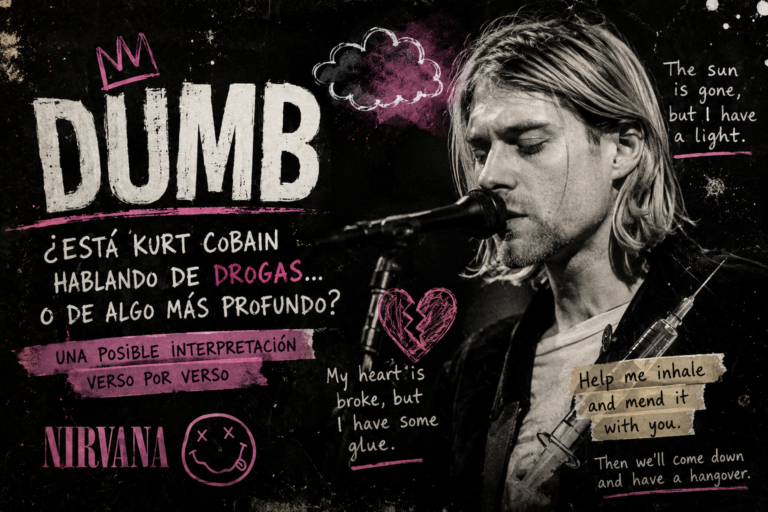
- Dumb → emotional numbness, false happiness, and glue as a metaphor.
Read the analysis - Something in the Way → consumption, addiction and moral permission.
Read the analysis - About a Girl → semantic ambiguity and the difficulty of defining a relationship.
Read the analysis



One Comment