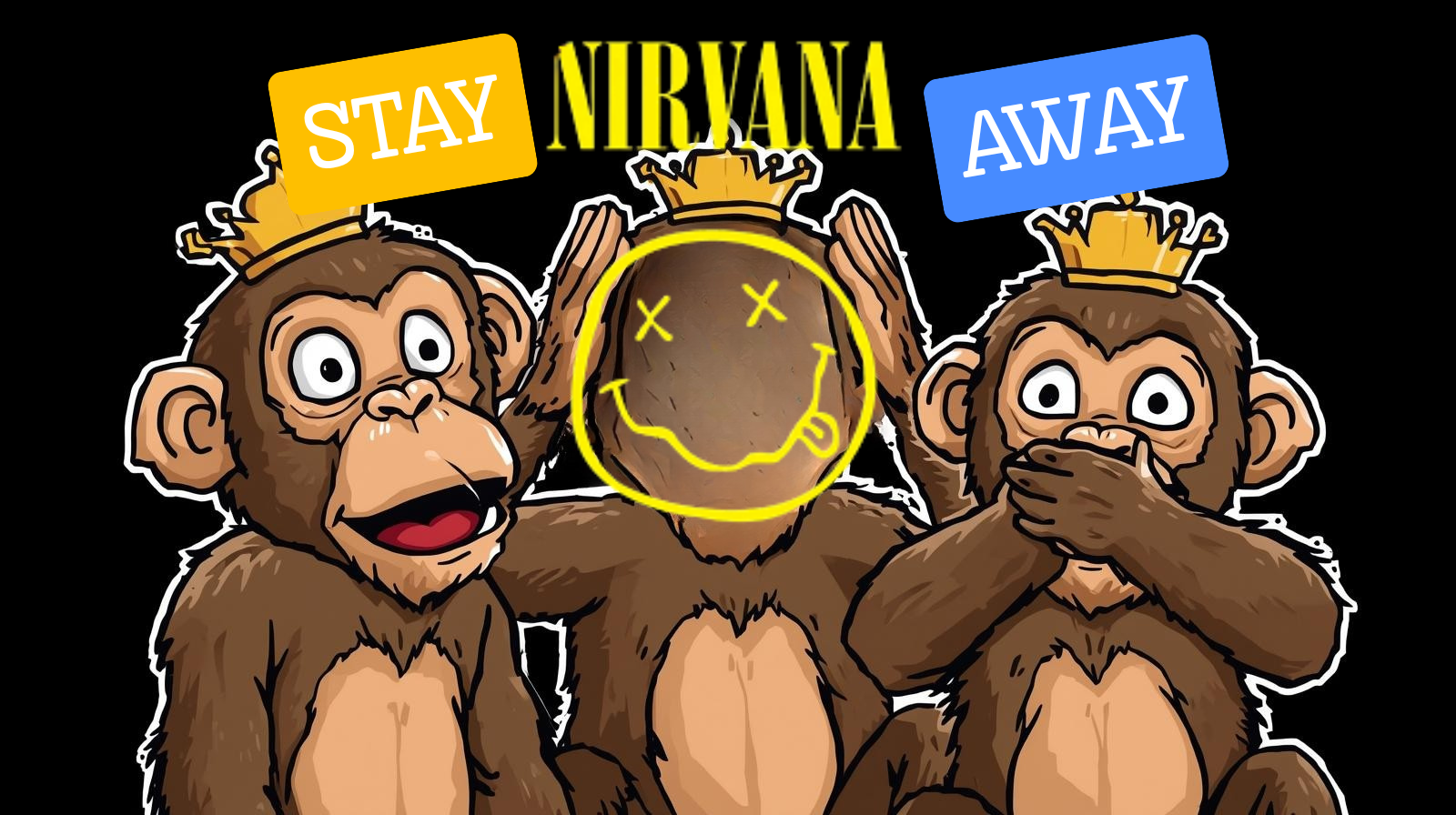
Nirvana and Identity Construction: A Political Analysis of “Stay Away”
“Monkey See, Monkey Do”: Nirvana’s Fierce Critique of Irreflexive Imitation
Introduction to “STAY AWAY”
Released in 1991 on the seminal album Nevermind, “STAY AWAY” by Nirvana stands as a powerful exploration of authenticity, conformity, and the visceral rejection of social pretense. Moreover, this song captures the essence of the burgeoning grunge movement, making it a key piece for understanding the broader cultural angst of Generation X.
Historical and Cultural Context
To fully grasp “Stay Away,” one must return to the musical landscape of 1991. In contrast to the polished, theatrical aesthetics of dominant hair metal and pop acts, the Seattle scene offered something raw and unfiltered. Nirvana’s sound channeled a widespread frustration that many young people felt but rarely saw reflected in mainstream media.
The track’s original title was “Pay to Play,” a direct and cynical jab at a music industry that demanded bands finance their own access to stages and visibility. Changing the title to “Stay Away” broadened its scope, transforming a specific industry critique into a universal anthem about setting boundaries and protecting one’s identity.
“Stay Away” is a prime example of saying much without becoming verbose. The track tackles a major pillar in the social construction of identity: imitation. From the perspective of Political Science and Linguistics, this work represents one of Kurt Cobain’s most direct and uncompromising critiques of conformity, over-adaptation, and consumerism.
The title itself, “Stay Away,” functions as a political imperative. It is not a suggestion, but a call to action: reflect on one’s own behavior instead of blindly following the herd (Corso, 2024, p. 18).
The Monkey Metaphor: Imitation Without Awareness
The song opens with a phrase that operates as the thesis of the entire track: Monkey see, monkey do. This old adage refers to imitation without reflection or awareness of consequences (Corso, 2024, p. 18). Cobain is not referring to primates; he is addressing the sociology of the masses—our tendency to replicate behaviors simply because others do.
Immediately after, he adds: (I don’t know why). This is the key moment. The imitating subject does not even know why they imitate; the act is passive, mechanical, and unexamined. Cobain invites the listener to abandon this mode of being.
Key Analysis: Deconstructing Social Critique
“Stay Away” is a collage of phrases aimed directly at social norms. The table below systematizes the most powerful lyrics that reveal Cobain’s critique of superficiality and inauthenticity:
| Original Lyrics | Analysis / Key Interpretation |
|---|---|
| Monkey see, monkey do | BLIND IMITATION: The central metaphor describing the construction of identity through unreflective emulation. It represents the human tendency to adopt behaviors without questioning their origin (Corso, 2024, p. 17). |
| Rather be dead than cool | REJECTION OF INDIFFERENCE: Here, “cool” carries a negative connotation of emotional detachment. It is an ethical declaration: choosing intensity and authenticity over calculated emotional distance (Corso, 2024, p. 18). |
| Less is more, love is blind | CRITIQUE OF CONSUMERISM: “Less is more” promotes minimalism in opposition to material excess. “Love is blind” reinforces the search for value beyond appearances (Corso, 2024, p. 18). |
| Fashion shits, fashion style / Throw it out and keep it in | ATTACK ON THE CULTURE INDUSTRY: These contradictory lines denounce planned obsolescence and the endless cycle of consumption and waste (Corso, 2024, p. 19). |
| Every line ends in rhyme | THE SYSTEM’S PARADOX: Even while rejecting conformity, Cobain acknowledges adherence to formal structures. This highlights the difficulty of fully escaping established systems (Corso, 2024, p. 19). |
Deep Exploration: Central Themes
The themes outlined above intertwine to produce a portrait of voluntary alienation. The song does not mourn loneliness; it demands it as a defense mechanism. The speaker does not seek belonging—he actively rejects “the club.”
The musical structure reinforces this stance. The verses are contained and almost sardonic, while the chorus erupts into chaotic violence. This dynamic mirrors the tension between detached observation and the eventual emotional explosion that culminates in the scream: “Stay Away!”
Conclusion: The Dilemma of Authenticity
“Stay Away” is more than noise and fury—it is a manifesto. It exposes how much of what we call “our” identity is, in reality, a reproduction of traits, ideas, and styles borrowed from others (Corso, 2024, p. 20). The song urges listeners to become conscious of this process.
Ultimately, Nirvana created a cultural artifact that captures a universal struggle: the fight to preserve personal integrity in a world that constantly demands conformity.
References
Corso, N. del V. (2024). Subjectivity in Kurt Cobain’s songs “Come as You Are,” “Stay Away,” “All Apologies”: The use of metaphors and metaphorical expressions alluding to the construction of identities .
Want to join the community?
Ideas, resources, and creative processes around language, music, and culture.
If you’d like to support the project or access exclusive materials:
If this analysis was helpful, consider supporting independent content creation: