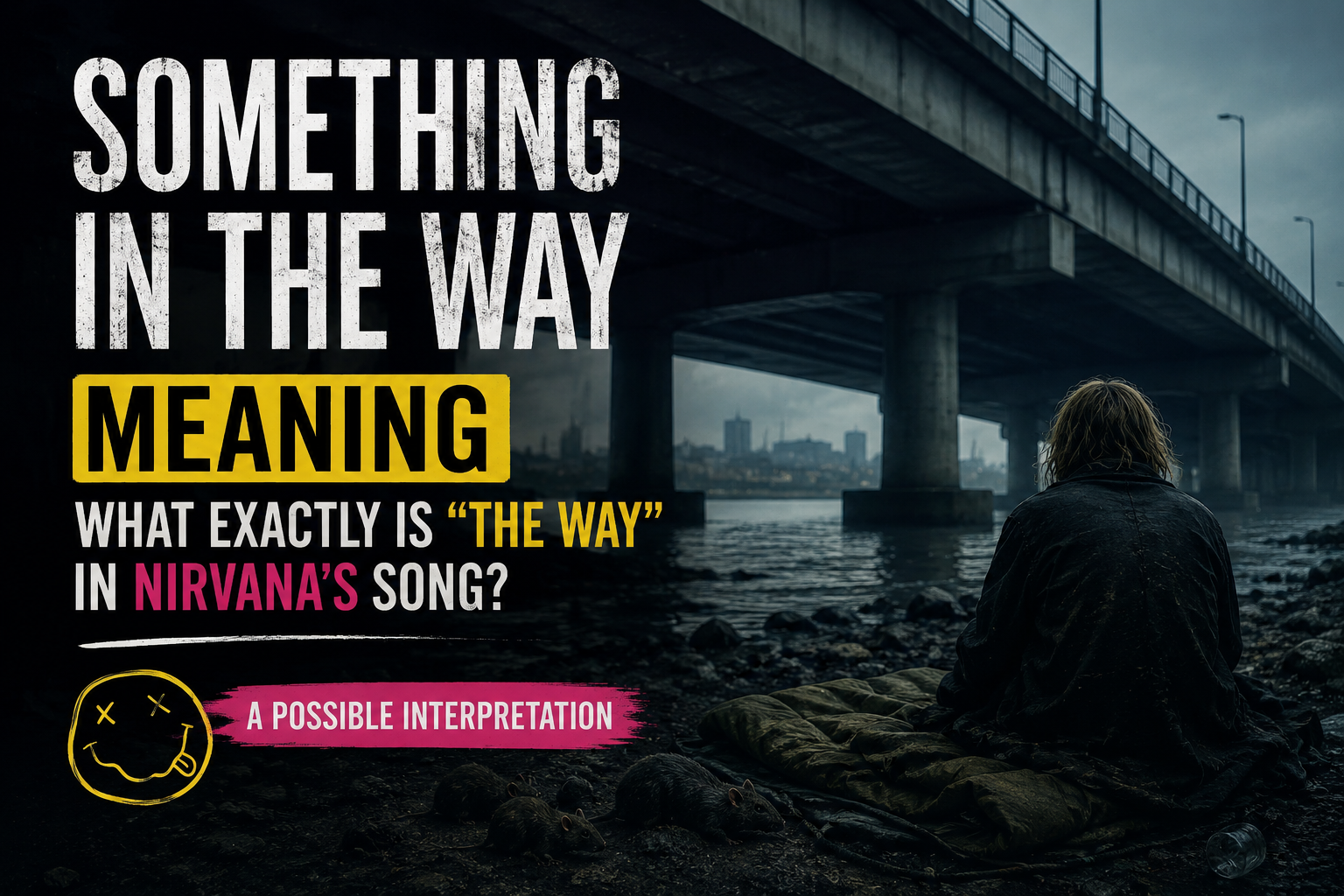

Category: 1. Lyrics Discourse Analysis

We apply discourse analysis to Global Hits to reveal how identity is constructed. We decode the friction between languages and the cultural codes.

  • Something in the Way: Nirvana, Consumption and Moral Permission

    Something in the Way: Nirvana, Consumption and Moral Permission

    POP Ideas POP Ideas · Music & Language

    Something in the Way: Nirvana, Consumption and Moral Permission

    A possible interpretation of Nirvana’s song through language, consumption, addiction, and moral permission.

    🔎 Metaphors and Ideas to Notice

    • Way → not only a road, but also a method, manner, condition, or way of life.
    • The bridge → a border between two sides: consumption and refusal, addiction and non-addiction, guilt and purity.
    • Under the bridge → the speaker is not crossing into another life; he remains in-between.
    • The leaking tarp → protection fails; something hidden begins to leak through.
    • The trapped animals → what could be consumed becomes too close or too familiar to consume.
    • Grass and dripping water → survival is reduced to almost nothing.
    • The fish line → one form of consumption is allowed because it seems less morally charged.
    • The unnamed obstacle → the blockage may be moral, bodily, emotional, and social at once.

    1. Three Ways to Understand “Way”

    The first thing that caught my attention was the word way. In English, way does not only mean a physical road. According to Merriam-Webster, it can also refer to a route, a course of action, a method, a manner, a mode, a system, or a habitual form of being.

    That means Something in the Way can be read on several levels at once.

    1. Something in the path

    There is an obstacle that does not let me move forward.

    2. Something in the manner

    There is something in the way I live, think, feel, consume, or behave that does not work.

    3. Something in the way things are

    There is an invisible structure, condition, or system that shapes what I can and cannot do.

    What exactly is “the way” that something keeps getting in?

    2. A Bridge Between Two Moral Worlds

    A bridge usually exists so people can cross from one side to another. But in the song, the speaker does not cross. He stays underneath.

    That detail matters. The bridge can be read as a border between two ways of living: consumption and refusal, addiction and non-addiction, guilt and purity.

    On one side, there is eating, using, needing, surviving. On the other side, there is not eating, not using, not harming, trying to remain clean or morally safe.

    But the speaker is not fully on either side. He is under the bridge, suspended between two worlds.

    3. When Consumption Becomes Too Intimate

    The animal image is central. At first, the animals seem connected to survival. In a survival story, captured animals would normally become food.

    But here, something changes: they become companions. That shift transforms their moral status. They are no longer only possible food. They are part of the speaker’s world.

    This does not mean that the animals have one fixed symbolic meaning. They can be read literally, but they also belong to Cobain’s wider field of food, body, drugs, pain, and moral judgment.

    The stronger idea is this: what could be consumed becomes too close to consume. Need is still there, but attachment interrupts the act.

    4. Fish as the Permitted Exception

    After the animals become companions, the speaker survives on almost nothing: grass and dripping water. Consumption becomes minimal, passive, and strange.

    Then the fish becomes the exception. The line sounds like a justification. The speaker does not simply eat. He explains why this form of eating is acceptable.

    This is where the song can echo the logic of addiction. Not because fish literally mean drugs, but because the structure is similar: some forms of consumption are condemned, others are tolerated, and others are explained as “not that bad.”

    The question becomes: what can I allow myself to consume without fully condemning myself?

    5. Food, Drugs, and Moral Permission in Cobain’s Writing

    This reading connects with Jessica L. Wood’s article on Kurt Cobain’s Journals. Wood observes that Cobain often links food, drugs, the body, sickness, and moral judgment.

    In the passage Wood analyzes, Cobain contrasts addicts and vegetarians through food and drug-related metaphors. Wood says that Cobain suggests addicts are sincere, while vegetarians are hypocritical. The point is not simply what people eat or refuse to eat. The point is that consumption becomes a moral language.

    That helps me return to Something in the Way. The animals, grass, dripping water, and fish do not have to be read only as survival details. They can also belong to a wider pattern: food and the body become ways of talking about moral permission.

    In that sense, the fish line is not simply about eating. It sounds like a small moral argument inside a damaged world.

    Final Synthesis: What Is in the Way?

    If I had to explain this interpretation in one idea, I would say this: the speaker has started to consume something that later becomes too close, too familiar, or too morally charged to consume.

    The trapped animals become companions. They cannot simply be eaten anymore. But survival does not disappear. The body still needs something, so another form of consumption has to be justified.

    That may be the “something” in the way: the impossibility of crossing into a clean, innocent, or fully justified way of living.

    The speaker does not cross the bridge. He remains below it, between consumption and refusal, between need and guilt, between survival and moral permission.

    Perhaps that is why the song remains so disturbing: it never tells us how to cross to the other side.

    More Nirvana Readings on POP Ideas

    Keep exploring other POP Ideas articles on ambiguity, identity, emotional distance, contradiction, and survival in Kurt Cobain’s writing.

    • Come as You Are → identity, contradiction, and the impossibility of being only one thing.
      Read the analysis
    • All Apologies → guilt, exposure, silence, and the desire to disappear.
      Read the analysis
    • Dumb → emotional numbness, false happiness, and glue as a metaphor.
      Read the analysis
    • About a Girl → semantic ambiguity and the difficulty of defining a relationship.
      Read the analysis
    • Stay Away → imitation, social pressure, belonging, and rejection.
      Read the analysis

    References

    Keep Exploring

    Keep exploring Nirvana, English, music, metaphor, and culture through POP Ideas.

    Read more POP Ideas articles
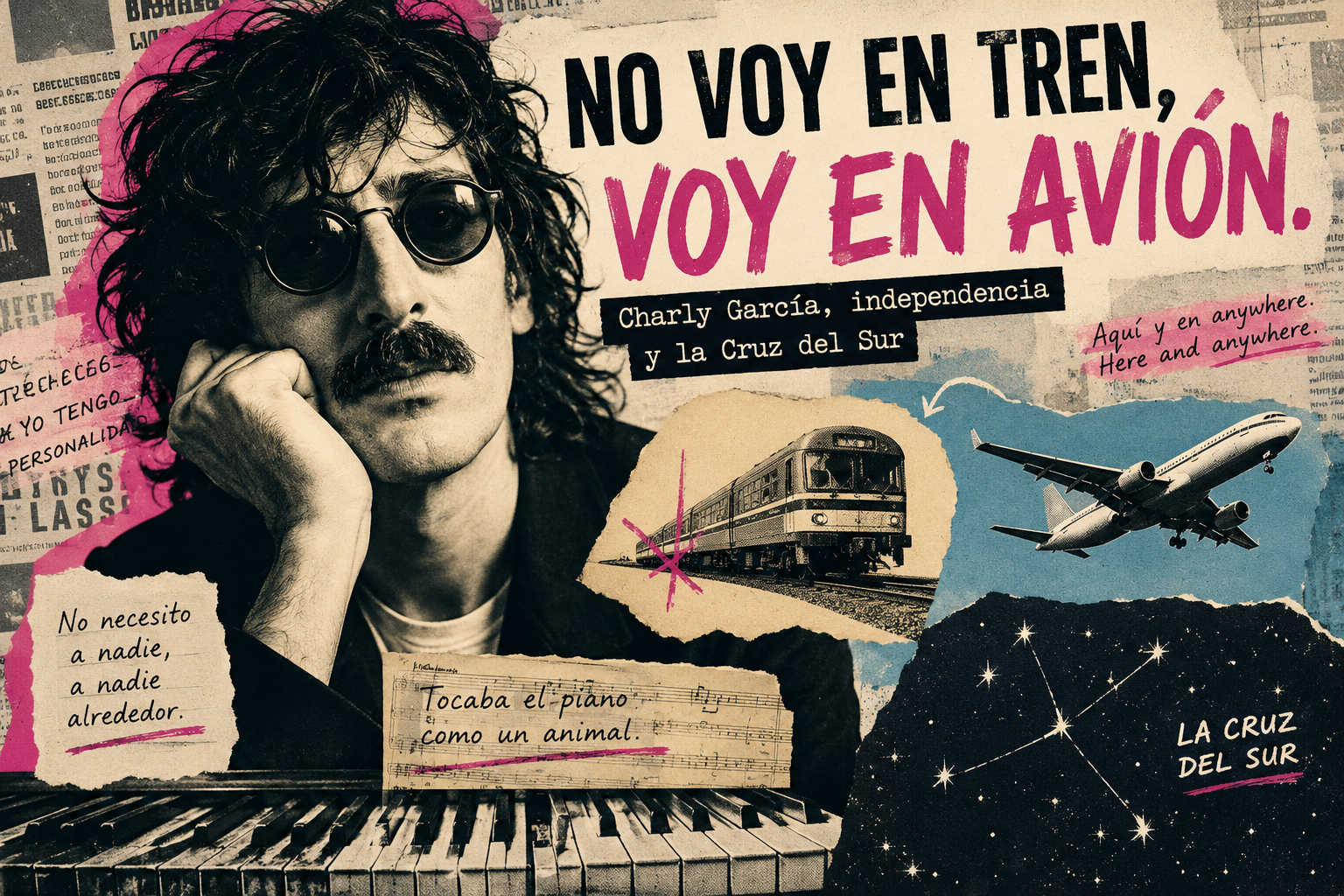
  • No Voy en Tren Meaning | Charly García, Independence and the Southern Cross

    No Voy en Tren Meaning | Charly García, Independence and the Southern Cross

    POP Ideas POP Ideas · Music & Language

    No Voy en Tren: Charly García, Independence and the Southern Cross

    A possible cultural and linguistic reading of a song about speed, isolation, media, personality and Southern identity

    No Voy en Tren can be read as more than a song about transportation — a declaration of independence, where the speaker refuses the marked path and claims his own way of existing in the world. In this reading, the train stands for the conventional route, while the plane suggests speed, freedom, and a different way of thinking.

    🔎 Metaphors and ideas to notice

    • Tren / train → the conventional, fixed, predictable path.
    • Avión / plane → speed, freedom, a different way of thinking.
    • “No necesito a nadie alrededor” → independence, distance, or isolation.
    • “Mi piel resista” → contact with others, exhaustion, or the difficulty of coexistence.
    • Televisión y revistas → media, consumer culture, prefabricated models of life.
    • “Tocaba el piano como un animal” → instinct, force, undomesticated creativity.
    • Mixto → someone difficult to classify.
    • La Cruz del Sur → orientation, Southern identity and belonging.
    • “El que apaga la luz” → ending a scene, remaining as the last witness.

    This is one possible interpretation. POP Ideas reads songs as case studies in how language creates meaning.

    The Train and the Plane

    No voy en tren, voy en avión.

    Why comparing a train to a plane?

    At first, this sounds like a simple comparison between two means of transportation. But another idea can be read into it: in Argentina, there’s an expression — “cuando vos salís y yo ya llegué” — a way of saying someone thinks faster, always one step ahead.

    A train follows rails already decided. A plane leaves the ground, rising above the fixed route. Perhaps Charly is not only saying how he travels, but how he thinks: “while you are still following the tracks, I am already somewhere else.”

    Of course, this is only one possible interpretation.

    I Don’t Need Anyone

    No necesito a nadie, a nadie alrededor.

    Freedom, or isolation?

    The line can be read in different ways — the next verse seems to give a clue. It may not be only about independence; there may also be tiredness, distance, or exhaustion toward other people.

    Skin and Other People

    Porque no hay nadie que mi piel resista.

    What does it mean that “my skin can stand”?

    At least two readings open up: I can’t stand people — exhaustion toward others — or the opposite, no one can stand me, the skin as a border between self and world. In both cases, the same idea appears: a difficulty in living with others.

    So when he says “I don’t need anyone around,” we can’t tell whether he’s defending his independence, or simply naming a distance that already exists.

    Television, Magazines and Consumption

    No veo televisión ni las revistas, no veo ya nada que no pueda hacer.

    Why does he reject the media?

    This likely isn’t just about not watching TV — it can be read as questioning what television and magazines represent. Media doesn’t only inform; it builds desire, telling us what to consume, what to want.

    The speaker doesn’t want to consume images of life. He wants to live for himself.

    Childhood and the Piano

    Cuando era niño nunca fui muy listo, tocaba el piano como un animal.

    Why does he return to childhood?

    Up to here, the song speaks from a strong identity. Then childhood appears — humanizing the speaker: there was once a child not considered “smart.”

    “Like an animal” can read as criticism or as praise — animals act by instinct, without calculation. Perhaps Charly is saying he played with natural force, without asking permission.

    Being “Mixto”

    Yo sé que algunos piensan que soy mixto, pero yo tengo personalidad.

    What does “mixto” mean?

    It may refer to someone hard to classify, who mixes styles or breaks categories. The speaker’s answer is clear: “I have personality.” Not a shapeless mixture, but an identity of his own.

    The Southern Cross

    Yo soy de la Cruz del Sur.

    Why does Charly mention the Southern Cross?

    The Southern Cross has long guided sailors to the South Celestial Pole — a navigation tool, not just a group of stars. Saying “I belong to the Southern Cross” may express a way of seeing the world: defining himself from the South rather than from Europe or North America.

    The constellation becomes both an identity and a compass.

    Closing and Turning Off the Light

    Soy el que cierra y el que apaga la luz.

    What does it mean to close and turn off the light?

    It may be the one who puts an end to something, who remains after everyone else has left, or who refuses to keep participating in a show that no longer interests him — someone who marks the end of a stage.

    Here and Anywhere

    Yo soy de la Cruz del Sur, aquí y en anywhere.

    Why mix Spanish and English?

    Charly could have said “aquí y en cualquier lugar,” but chooses anywhere. Argentine rock has always been in dialogue with the English-speaking world without becoming less local — the speaker belongs to the South, but isn’t trapped inside a border.

    Final Thought

    No Voy en Tren may not be a song about means of transportation. It can be read as a declaration of independence: the speaker rejects prefabricated paths, distances himself from others, questions media and consumer culture, accepts being difficult to classify, and finally presents himself as someone who belongs to the South while his voice can sound anywhere.

    That is why the plane is not only a plane — it can be read as a way of moving, thinking, and existing outside the marked tracks.

    This reading does not try to close the meaning of the song, but to open one possible way of thinking about it.

    POP Ideas · Translation, language and cultural analysis through songs, by Noelia Corso.

  • Dumb Meaning | Nirvana, Emotional Numbness and the Metaphor of Glue

    Dumb Meaning | Nirvana, Emotional Numbness and the Metaphor of Glue

    POP Ideas POP Ideas · Music & Language

    Dumb Meaning: Emotional Numbness, Glue and False Happiness in Nirvana

    A possible reading of Nirvana’s Dumb through metaphor, language and emotional escape.

    In this interpretation, Dumb is not simply about stupidity. It may be about emotional numbness: the strange state of feeling different, pretending to belong, and finding temporary ways to repair pain without truly healing it.

    The song moves through a chain of images: pretending, light, dumbness, happiness, a broken heart, glue, inhaling, floating, coming down and having a hangover. Read together, those images suggest a cycle of pain, escape and return.

    🔎 Metaphors and ideas to notice

    • “I’m not like them” → feeling different from other people.
    • “I can pretend” → social masking; acting like one belongs.
    • The sun → God, hope, purpose, certainty or an ideal.
    • The light → a smaller source of hope that still remains.
    • Dumb → not only “stupid,” but possibly silent, numb or disconnected.
    • Happy → not necessarily joy; perhaps emotional anesthesia.
    • The broken heart → emotional pain.
    • Glue → drugs, emotional escape or a temporary way to hold pain together.
    • Inhale → possibly consuming something, or taking in an escape.
    • Clouds → euphoria, fantasy or altered consciousness.
    • Come down → returning from that altered state.
    • Hangover → the physical and emotional cost after escape.

    This is one possible interpretation. POP Ideas reads songs as case studies in how language creates meaning.

    Not Like Them

    I’m not like them, but I can pretend.

    What does he mean by “I’m not like them”?

    The narrator immediately separates himself from everyone else — he feels different. Yet he also says he can pretend, which means he knows how to hide that difference. The first conflict in the song is not simply between him and the world: it is between who he really is and the role he performs for other people.

    The Sun and the Light

    The sun is gone, but I have a light.

    If the sun is gone, what is the light?

    The sun usually represents something greater than ourselves — it could symbolize God, hope, purpose, or the certainty that everything will eventually be alright. The narrator says the sun has disappeared, yet he still has a light. Perhaps it is weaker, perhaps artificial — but he is not completely in darkness.

    Fun After the Day Is Done

    The day is done, but I’m having fun.

    Why is he having fun if everything else sounds so sad?

    That is exactly what makes the line interesting: the surrounding images are not cheerful — the sun is gone, the day is over, and the narrator feels different from everyone else. So the “fun” may not be simple happiness. It may be distraction, escape, or simply the temporary feeling of not suffering as much.

    Dumb

    I think I’m dumb.

    What does “dumb” really mean here?

    Today, many people understand dumb as “stupid.” But according to Merriam-Webster, the word also carries older meanings related to silence, speechlessness and muteness — historically, it could describe someone unable to speak, someone silent, or someone left without words. That changes the possible meaning of the line: maybe the narrator is not only asking, “Am I stupid?” Maybe he is also asking whether he has become emotionally numb, stopped speaking, or disconnected from what he feels.

    Or Maybe Just Happy

    Or maybe just happy.

    Why does Cobain contrast “dumb” with “happy”?

    That contrast is fascinating, because the two words may not be opposites. Perhaps the narrator wonders whether his numbness feels like happiness — not because life has improved, but because he no longer feels the pain in the same way. In this reading, happiness does not sound like joy; it sounds more like anesthesia.

    The Broken Heart and the Glue

    My heart is broke, but I have some glue.

    If his heart is broken, why does he use glue?

    He does not say he has medicine, love, or time — he says he has glue. Glue fixes broken objects; it does not heal wounds. That image suggests a temporary repair rather than real recovery.

    Inhale

    Help me inhale and mend it with you.

    Why does Cobain choose the word “inhale”?

    That word feels unusually specific. He could have written “help me fix it” or “help me heal” — instead, he writes “help me inhale.” One possible interpretation is that the glue symbolizes drugs, or at least some form of emotional escape. The narrator is not truly healing his broken heart; he is temporarily holding it together.

    Clouds

    We’ll float around and hang out on clouds.

    What happens after inhaling the glue?

    Now the images begin to connect: they float, they drift through clouds, and the emotional pain disappears for a while. The clouds may represent euphoria, fantasy, or an altered state where the broken heart no longer feels as broken.

    Coming Down

    Then we’ll come down and have a hangover.

    But does the escape last?

    No. First they float. Then they come down. Finally, there is a hangover. Whether the glue represents drugs, emotional denial, or another kind of escape, the cycle remains the same: temporary relief followed by reality.

    More Nirvana Readings on POP Ideas

    Keep exploring other POP Ideas articles on ambiguity, identity, emotional distance and survival in Kurt Cobain’s writing.

    • Something in the Way → consumption, addiction and moral permission.
      Read the analysis
    • Come as You Are → identity, contradiction and the impossibility of being only one thing.
      Read the analysis
    • About a Girl → semantic ambiguity and the difficulty of defining a relationship.
      Read the analysis

    Final Thought

    One possible interpretation is that Dumb is not about stupidity at all — it may be about emotional numbness. The narrator feels different from everyone else. His heart is broken, and instead of healing it, he finds glue.

    He inhales, floats, and comes down — and then the cycle begins again.

    In this reading, happiness is not necessarily joy. It may be the temporary silence of pain.

  • Come As You Are Lyrics Meaning: A Deep Philosophical Analysis

    Come As You Are Lyrics Meaning: A Deep Philosophical Analysis

    “Come as you are, as you were, as I want you to be”: Kurt Cobain’s Philosophy of Identity

    When you listen to Nirvana’s “Come As You Are,” it’s easy to get swept away by its iconic, watery guitar riff and catchy chorus. However, as with much of Kurt Cobain’s work, the surface tells only half the story. As a Political Scientist and translator, I’ve always been fascinated by how Cobain used simple words to explore incredibly complex ideas. Today, we will deconstruct the ‘Come As You Are’ lyrics meaning, not just to understand the words, but to uncover the profound reflection on identity hidden within its verses.

    This is the first part of a three-part series where we will analyze how Nirvana addresses the construction of subjectivity. Drawing on concepts from philosophy and discourse theory from my academic thesis, we will reveal a layer of meaning you may have never noticed before.


    Time, Space, and “The Other”: The Dimensions of Being

    The song begins with an invitation that is, in reality, a statement of principles about how we exist in the world. Let’s analyze the opening line:

    Come as you are, as you were, as I want you to be.

    Cobain isn’t just saying “show up.” He’s establishing a complex framework. “As you are” places you in the present, in this exact moment. “As you were” immediately introduces history—the past that shaped you. Your identity is not just who you are now, but the sum of everything you have been (Corso, 2024, p. 12).

    But it is the final phrase, “as I want you to be,” that introduces the most crucial element: “The Other.” We do not construct ourselves in a vacuum. Our identity is molded in relation to the expectations, desires, and perceptions of others (Corso, 2024, p. 14). You are you, your past, and also the version of you that exists in my mind. This is a deeply discursive process; we exist through language and social interaction.

    The Core Analysis: Deconstructing the Deepest Verses

    To better understand these ideas, I have selected the song’s most potent phrases and analyzed them in this table. The goal here is not a literal translation, but an interpretation that reveals their philosophical weight, based on my research.

    Key Lyric (English) Deep Analysis / Key Interpretation
    Come as you are, as you were, as I want you to be THE EXISTENTIAL FRAMEWORK: This line establishes the three dimensions of identity: the present (“are”), the past (“were”), and the social influence of The Other (“want you to be”). It’s not a simple invitation, but a definition of the human condition (Corso, 2024, p. 12).
    As a friend, as an old enemy ANTAGONISTIC IDENTITY: Here, Cobain introduces the idea that we are defined by opposition. The theorist Chantal Mouffe argues that political identity is formed against an “adversary”—not an enemy to be destroyed, but an ‘other’ that allows us to be who we are (Corso, 2024, p. 14).
    Come doused in mud, soaked in bleach HUMAN DUALITY: “Doused in mud” represents our flaws, our imperfect humanity. “Soaked in bleach” is the societal desire to purify ourselves, to wash away that dirt to appear flawless. Cobain invites us to come with both parts—our darkness and our light (Corso, 2024, p. 16).
    And I swear that I don’t have a gun THE REJECTION OF ANNIHILATION: Connected to the idea of the “old enemy,” denying possession of a gun suggests that this ‘other’ is not something to be eliminated. We need the adversary to define ourselves; therefore, we do not come to destroy it (Corso, 2024, p. 15).

    Contradiction as the Human Essence

    Another layer of the ‘Come As You Are’ lyrics meaning is found in verses like Take your time, hurry up / Choice is yours, don't be late. Far from being a mistake, this contradiction is central to the message. Human beings are inherently contradictory, driven by both reason and passion. Cobain shows us that part of “being” involves navigating these tensions (Corso, 2024, p. 15).

    Identity is not a static photograph but a dynamic process of constant definition and deconstruction. This tension is not a flaw; it is the essence of our subjectivity.


    Conclusion

    Ultimately, “Come As You Are” serves as a masterclass in social analysis disguised as a rock anthem. It invites us to accept our identities as historical, contradictory, and perpetually under construction. The song’s enduring power lies not in providing answers, but in perfectly articulating the questions that define our existence.

    If you enjoyed this analysis, please share your thoughts on social media. Don’t miss the next installment of our series on subjectivity in Nirvana’s music.


    Academic Reference

    Corso, N. del V. (2024). 

  • Decoding Nirvana’s “All Apologies”: A Deep Dive into the Lyrics & Meaning?

    Decoding Nirvana’s “All Apologies”: A Deep Dive into the Lyrics & Meaning?

    Peace at Last: Resignation and Transcendence in ‘All Apologies’

    We have reached the third and final installment of our series on the construction of identity in Nirvana’s discography. Today, we conclude this journey with “All Apologies,” a song that serves as Kurt Cobain’s lyrical testament: a profound reflection on the suffocation of social expectations and the ultimate quest for universal peace. This analysis provides the necessary cultural and academic context before you dive into our technical pronunciation and translation guides.

    Due to my background in the fields of Political Science and Translation, I perceive this song not as a cry of rage, but as a whisper of resignation. It represents the finality of an individual’s struggle against the structures that limit them—a conflict I describe in my research as “the dilemma of accepting… the culturally fixed repertoire of roles” or risking total exclusion (Corso, 2024, p. 20). Consequently, every line reveals a deeper layer of this internal friction.


    The Plea for Being and the Apology for Existing

    The song opens with a series of questions that expose total vulnerability, setting an immediate tone of exhaustion. This opening is crucial because it frames the entire piece as a dialogue with an oppressive external force—be it society, fame, or internalized expectations. Cobain isn’t just singing; he is negotiating the terms of his existence.

    “What else should I be? / All apologies.”

    The question “What else should I be?”, through the use of the modal verb “should,” implies a request for permission or guidance from an external authority (Corso, 2024, p. 21). It is not a definitive “what will I be?” but rather a plea. It is as if he is asking society: “Will you allow me to be who I am?” The immediate follow-up, “All apologies,” functions as a preemptive apology for failing to meet those imposed expectations (Corso, 2024, p. 21).

    The Limits of Expression

    This concept of limitation is masterfully reinforced in the subsequent lines: “What else could I write? / I don’t have the right.” Here, Cobain isn’t merely discussing songwriting; he is acknowledging the boundaries that social discourse and structures place upon self-expression (Corso, 2024, p. 21). It is an admission that even his art—his purest form of being—is conditioned by rules he did not create. Therefore, he remains an impostor on his own stage.


    Lyric Analysis Table: From Suffocation to Universal Unity

    “All Apologies” is an emotional odyssey that moves from the cage of social convention to liberation under the sun. This table breaks down that path, identifying the central concepts that drive the narrative. Notice how each phrase builds upon the last, shifting from personal distress toward a universal resolution.

    Key Lyric (English) Direct Meaning Thematic Interpretation & Analysis
    What else should I be? / All apologies What is expected of me? / I am sorry. THE EXISTENTIAL PLEA: The song opens by asking society what role it expects the subject to fill, followed by an apology for being unable or unwilling to comply (Corso, 2024, p. 21).
    Married / Buried United in contract / Put into the ground. SOCIAL SUFFOCATION: This metaphor equates the institution of marriage (and social contracts) with being buried. It represents feeling stifled by “normal” social roles (Corso, 2024, p. 22).
    I wish I was like you / Easily amused Desiring simplicity / Envying lack of depth. ENVY OF IGNORANCE: Cobain expresses a longing for simplicity, envying those who do not struggle with existential questions and are satisfied with superficial entertainment (Corso, 2024, p. 22).
    In the sun, I feel as one Under the light, I feel whole. NATURAL UNITY: The sun serves as the counterpoint to social suffocation. It represents a state of nature and fundamental equality where the subject feels “as one,” free from artificial restrictions (Corso, 2024, p. 22).
    All in all is all we are In the end, this is our totality. UNIVERSAL RESOLUTION: Repeated as a mantra, this phrase transforms individual anguish into a declaration of universal belonging. We are all part of a larger whole (Corso, 2024, p. 23).

    Trilogy Conclusion: Identity as Struggle and Acceptance

    When we unite these three songs, Nirvana reveals a complete arc of identity. In “Come as You Are,” we are told that we are a complex construct. Then, in “Stay Away,” we are warned against the dangers of imitation. Finally, in “All Apologies,” Cobain expresses the pain of being restricted by society, only to find peace in the idea that “all in all is all we are.” It is an achingly beautiful, yet liberating conclusion.

    If you are interested in practicing the English pronunciation or seeing my artistic Spanish translation, stay tuned for the next part of this guide.

    References

    Corso, N. del V. (2024). Subjectivity in Kurt Cobain’s songs “Come as you are”, “Stay Away”, “All apologies”: The use of metaphors and metaphorical expressions alluding to the construction of identities

  • Come As You Are: How Nirvana’s Metaphors Reveal the Contradictions of Identity

    POP Ideas POP Ideas · Music & Language

    Come As You Are: How Nirvana’s Metaphors Reveal the Contradictions of Identity

    A philosophical reading of identity, antagonism and the “purity paradox” in Nirvana’s “Come As You Are.”

    Nirvana’s “Come As You Are” doesn’t build an identity — it uses metaphor to talk about how identity actually works. Drawing from my background in Political Science and Translation, I read this track not just as a grunge anthem, but as a demonstration of how metaphor can describe identity as contradictory and historical: shaped by the present, weighed down by the past, and never fully separate from what others expect it to be. In my recent research (Corso, 2024), I explored exactly this: how Cobain uses metaphor not to construct identity, but to expose how contradictory and historical it already is.

    The song functions as a philosophical inquiry into the nature of authenticity in a postmodern world. When we analyze the text, we see a recurring tension between the individual’s true self and the performative self required by society. This isn’t just teenage angst; it is a sophisticated critique of social expectations. Consequently, “Come As You Are” remains one of the most intellectually dense tracks in the grunge canon, offering a blueprint for understanding the “self” as a precarious construction.

    🔎 Metaphors and ideas to notice

    • “As you are, as you were, as I want you to be” → the three planes of subjectivity: present, historical, and the social gaze.
    • “As a friend, as an old enemy” → identity needs an “other” — even an enemy — to define its own boundaries.
    • Mud vs. bleach → the purity paradox: raw, flawed humanity vs. the forced sanitation demanded for social consumption.
    • “I swear that I don’t have a gun” → a plea for trust, a moment of extreme vulnerability inside a song built on antagonism.

    This is one possible interpretation. POP Ideas reads songs as case studies in how language creates meaning.

    The Tripartite Structure of Existence

    Come as you are, as you were, as I want you to be

    The opening lines present a brilliant linguistic and philosophical trap. Within these few words, Cobain addresses three distinct planes of existence that define our subjectivity: first, the Present (“as you are”), an invitation to immediate authenticity; second, the Historical (“as you were”), acknowledging the baggage of our past; finally, the Social Gaze (“as I want you to be”), which immediately complicates the invitation. In other words, we are the result of the present, the past, and other people’s expectations — society itself.

    This structure suggests that our identity is never truly our own. It is constantly being negotiated between our history and the projections of the “Other.” In political theory, this mirrors the concept of subjectivity — the social and discursive construction of identity as something acted upon by outside forces. Cobain’s genius lay in his ability to condense these heavy sociological themes into a few bars of a rock song, effectively inviting the listener to a party where the dress code is fundamentally impossible to meet.

    Key Lyrics and Analysis

    Key LyricDirect MeaningThematic Interpretation & Analysis
    “Come as you are, as you were, as I want you to be” An invitation to authenticity, immediately followed by the speaker’s desires. The conditional invitation: the final clause negates the first two, highlighting how social acceptance is always tied to expectation.
    “As a friend, as an old enemy” Acknowledging both kinship and historical conflict. The necessary antagonist: reflecting Chantal Mouffe’s theory of agonism, identity requires an “other” — even an enemy — to define the boundaries of the “self.”
    “Doused in mud, soaked in bleach” Being covered in filth and simultaneously sanitized. The purity paradox: “mud” represents raw, flawed humanity; “bleach” represents the forced purification required for social consumption.

    The Purity Paradox: Mud vs. Bleach

    One of the most striking metaphors in the song is the juxtaposition of “mud” and “bleach.” In the context of the album title, Bleach, this takes on an even deeper meaning. “Mud” represents the organic, messy, and real parts of our identity — our failures and our “dirty” truths. “Bleach,” on the other hand, is the toxic chemical used to sanitize and erase. By asking the subject to be both, Cobain is highlighting the hypocrisy of a society that demands “authentic” people but only if they are “clean.”

    Furthermore, this duality reflects the internal struggle Cobain faced with his own image. As an artist, he was doused in the “mud” of the underground scene, but the industry attempted to soak him in “bleach” for mainstream appeal. Therefore, the line is not just a poetic image; it is a technical description of the commodification of subculture. When we apply this to political science, we see the process of co-optation, where radical identities are “bleached” to make them safe for the status quo.

    A Plea for Trust in a World of Anxiety

    The song’s bridge, “And I swear that I don’t have a gun,” is perhaps its most misunderstood section. In the wake of Cobain’s death, many read this as dark foreshadowing. However, within the context of the song’s ideological framework, it serves as a desperate plea for trust. If identity is built on antagonism (friend vs. enemy), then the declaration “I don’t have a gun” is an attempt to de-escalate that conflict. It is a moment of extreme vulnerability.

    Ultimately, “Come As You Are” is a philosophical masterpiece in the sense that, through metaphor, it shows the precarious nature of the human subject. It reminds us that while we are invited to “come as we are,” that invitation is often conditional.