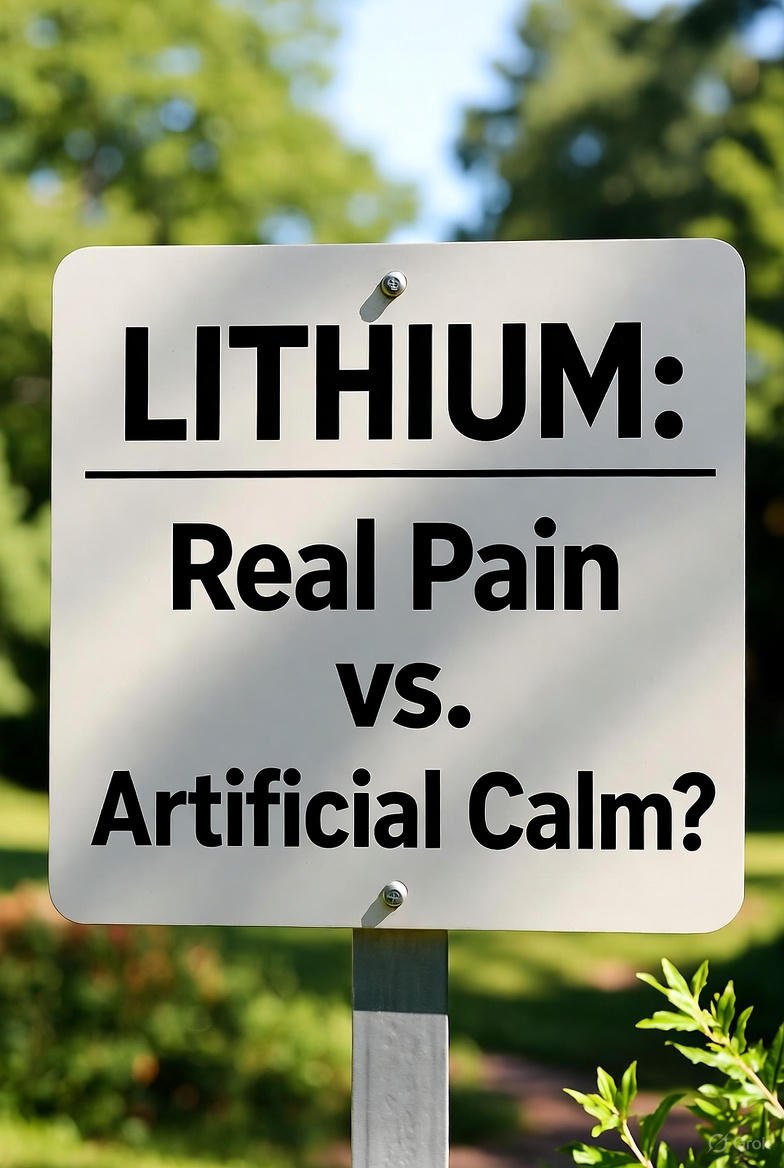
Decoding Authenticity vs. Numbness: A Personal Interpretation of “Lithium”?
As a Political Science graduate and translator, I’ve always been drawn to the song’s dense metaphors. But from a personal perspective—having navigated my own neurological challenges—the song takes on a new, profound meaning. It’s an exploration of the battle for authenticity (our true self) versus the fog of prescribed numbness (our anesthetized self).
This isn’t just an academic analysis. It is a personal interpretation of the song’s central conflict: the human desire to feel “well” without help, and the cost of that help.
The Central Conflict: Authenticity vs. Numbness
The title, “Lithium,” is our first and most important clue. Lithium is a potent mood stabilizer. From the very first line, Amy Lee personifies it: “Lithium, don’t wanna lock me up inside.”
This immediately frames the conflict. When you suffer from a neurological or mood disorder, the illness itself is a prison. Consequently, the medication designed to “free you” can quickly become a new prison. It is a prison of numbness, of feeling disconnected from your own life. You are “fine,” but you are locked “inside” this new, artificial state.
The Duality of the Cure
This duality is the heart of the song. The singer is trapped between two undesirable states: the chaos of her “sorrow” and the emptiness of her “cure.” She is agonizingly aware of this paradox when she wails, “Oh, but God I wanna let it go.” She wants to let go of the pain, but to do so means accepting the numbness, which feels like a different kind of loss.
“I Can’t Hold On To Me”: The Crisis of Dependency
This is, in my opinion, the most important line in the entire song. In my Spanish adaptation, I translated this as “No puedo confiarme de mi” (I can’t trust myself). Why? Because when you are on potent medication, you can no longer trust yourself.
Your sense of “wellness” is conditional. It depends on a pill. You know, deep down, that if you stop taking it, you will feel “very, very bad.” Therefore, your stability isn’t yours; it’s borrowed from a chemical. This creates a profound identity crisis. You cannot rely on your own mind. You are dependent.
Why “Stay in Love with My Sorrow”?
This interpretation gives new meaning to “I wanna stay in love with my sorrow.” This is not a death wish. It is a tragic but rational choice: she prefers her authentic pain (her “sorrow”) because, at the very least, it is hers. It is real. The alternative is an artificial wellness she cannot trust.
Decoding the Metaphors: Analysis Table
This theme of dependency and authenticity is woven into every line. Let’s analyze the key phrases through this specific lens.
| Original Lyrics (English) | Analysis: The Medication Metaphor | |
|---|---|---|
| Lithium, don’t wanna lock me up inside | THE MEDICATED PRISON: The singer’s direct plea to the medication. She feels it’s enclosing her in a new prison of numbness, walling her off from her true self. | |
| I wanna stay in love with my sorrow | CHOOSING REAL PAIN: A preference for authentic, familiar pain over artificial “wellness.” Her “sorrow” is real and *hers*. The medicated state is false. | |
| Oh, but God I wanna let it go | THE PARADOX: The agonizing duality. She hates the “sorrow” (the illness) and wants release, but she also hates the numbness (the cure). She is trapped with no good options. | |
| I can’t hold on to me | THE DEPENDENCY CRISIS: The central theme. “I can’t trust myself.” She feels her “self” isn’t stable without the pill’s help, a total loss of autonomy. | |
| Come to bed, don’t make me sleep alone | THE CODEPENDENT RELATIONSHIP: This is not a plea to a human lover. It’s a plea to the *medication* (or the illness itself). She is codependent, unable to be alone with her own mind. | |
| Always find my place among the ashes | DESIRE FOR AUTHENTIC REBIRTH: The “ashes” represent a total, natural collapse. It’s the hope that if she lets herself fall apart, she can be reborn from scratch—this time, without help. |
The “Lover” as a Codependent Metaphor
With this framework, the “love song” verses become even more tragic. “Come to bed, don’t make me sleep alone” is a portrait of profound loneliness. It is the emptiness of her condition.
Furthermore, the line “Just didn’t drink enough to say you love me” fits perfectly. It’s the idea of needing another substance (alcohol) to force an emotional connection, to break through the very numbness the Lithium itself causes. She is in a codependent, abusive relationship with her own brain chemistry and the substances she uses to manage it.
Conclusion: The Plea for a Real Self
This song is a masterpiece. It captures an incredibly difficult feeling to articulate: the sense that the “cure” feels just as bad as the “disease.”
Ultimately, “Lithium” is an exploration of identity. It is the voice of someone who has lost the ability to trust her own mind. She is faced with a terrible choice: the chaotic, painful “sorrow” that is authentic, or the stable, numb “wellness” that is artificial. As I’ve come to understand through my own experience, there is no sensation more desirable than feeling well, in a natural way. That desperate search for an authentic, unassisted self is the tragic and powerful message at the heart of “Lithium.”