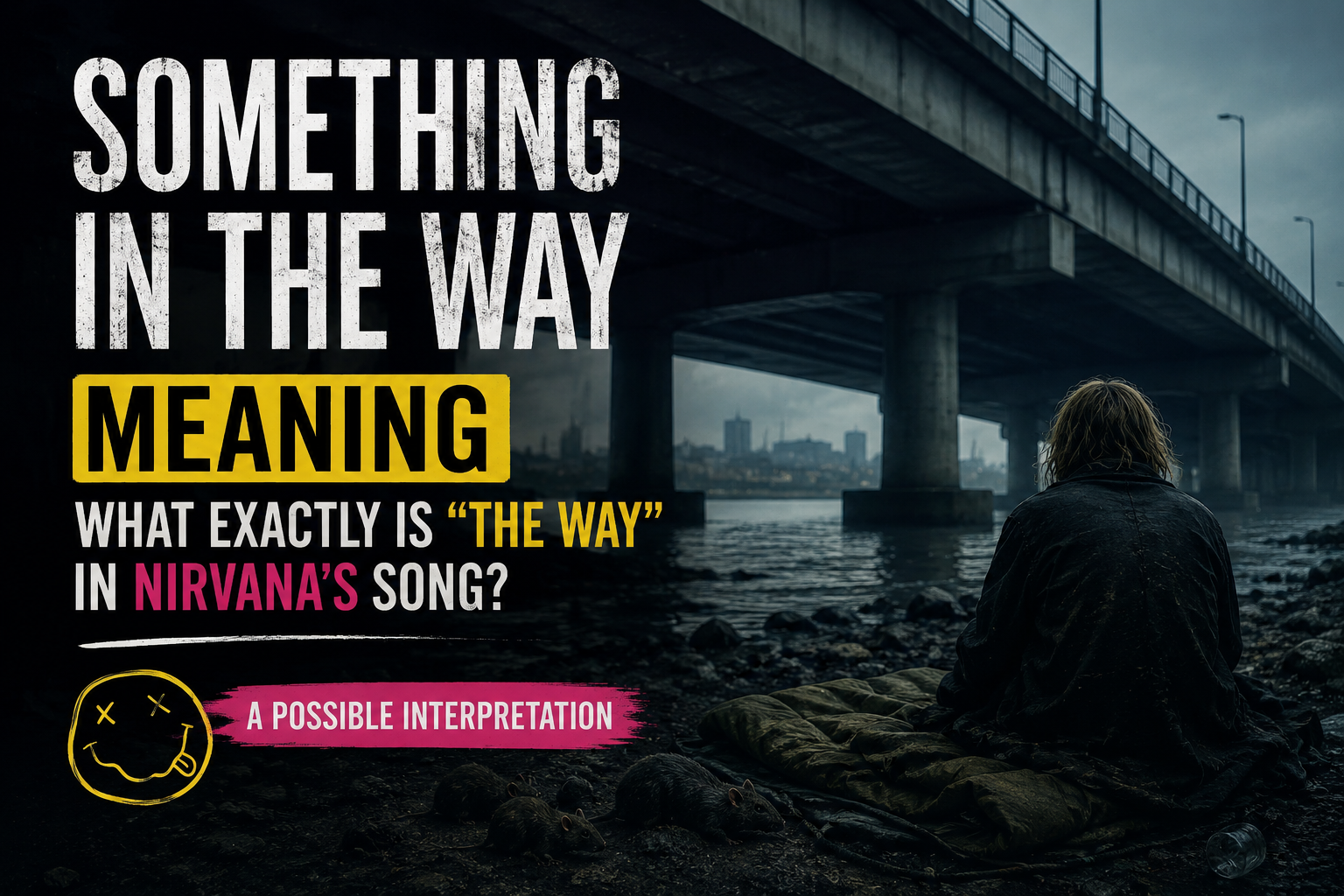
Tag: Something in the way

  • “Underneath the Bridge, Tarp Has Sprung a Leak”: Meaning of the Metaphor in Nirvana

    “Underneath the Bridge, Tarp Has Sprung a Leak”: Meaning of the Metaphor in Nirvana

    POP Ideas POP Ideas · Música, Lenguaje y Cultura

    “Underneath the Bridge, Tarp Has Sprung a Leak”: significado de la metáfora en Nirvana

    Una posible lectura desde la teoría de la metáfora conceptual de Lakoff y Turner.

    La frase de inicio de “Something in the Way”, “Underneath the bridge, tarp has sprung a leak”, es un cúmulo de metáforas en sí misma. La teoría de la metáfora conceptual, desarrollada por George Lakoff y Mark Turner en More Than Cool Reason: A Field Guide to Poetic Metaphor, puede ayudarnos a entenderla. Según los autores, el lenguaje poético no inventa sensaciones de la nada, sino que toma nuestro conocimiento cotidiano del mundo físico y lo proyecta sobre estados emocionales abstractos.

    Underneath the bridge, tarp has sprung a leak

    “Debajo del puente, la lona empezó a tener una gotera”

    🔎 Las metáforas en juego

    • Estar debajo del puente → el control está arriba, ser controlado es estar abajo.
    • La lona (tarp) → un espacio delimitado, un límite entre lo protegido y lo hostil.
    • La gotera (sprung a leak) → la vida como un fluido que se escapa del cuerpo.

    Esta es una posible lectura, apoyada en la teoría de la metáfora conceptual de Lakoff y Turner. No pretende cerrar el significado de la canción, sino mostrar cómo funcionan sus imágenes.

    Estar abajo, no tener el control

    Lakoff y Turner explican que entendemos situaciones abstractas a través de “esquemas de imagen” (image-schemas): orientaciones humanas básicas como arriba-abajo, centro-periferia, delante-detrás. Una de las metáforas estructurales más básicas de nuestro sistema conceptual es EL CONTROL ESTÁ ARRIBA, SER CONTROLADO ES ESTAR ABAJO. A eso se suma otra: LOS ESTADOS SON UBICACIONES.

    Al situar al sujeto “debajo” de un puente, la letra transmite de inmediato un estado de subordinación, marginalidad o abatimiento. No está en la cima de nada ni tiene el control: está aplastado por el peso y la estructura de lo que lo rodea.

    La lona como límite

    Comprendemos el mundo también a través de “espacios delimitados” (bounded spaces): un adentro y un afuera, como una casa, un garaje o el propio cuerpo. La lona (tarp) funciona como esa barrera física — un límite pensado para proteger un interior de la hostilidad del exterior, el frío, la lluvia. Ese límite físico se proyecta sobre un límite psicológico: la última capa de protección de la mente o de la vida de alguien.

    La fuga: cuando la vida se escapa

    Esta es, quizás, la imagen más poderosa, y se apoya en otra metáfora fundamental que analizan los autores: LA VIDA ES UN FLUIDO EN EL CUERPO, donde perder ese fluido equivale a perder vitalidad — o a la muerte.

    Lakoff y Turner analizan un verso muy similar de W. H. Auden: “And the crack in the tea-cup opens / A lane to the land of the dead” (“Y la grieta en la taza de té abre / un camino a la tierra de los muertos”). Igual que la taza rota deja escapar el líquido, una lona con una gotera representa el fracaso de esa barrera protectora. El espacio interior ya no es seguro: la vitalidad se drena, o los elementos hostiles del afuera empiezan a filtrarse hacia adentro.

    Cuando algo deja de funcionar, además, solemos decir metafóricamente que está “apagado” o “fuera de servicio”. La lona goteando es exactamente eso: un mecanismo de defensa que dejó de funcionar, dejando a la persona expuesta.

    Síntesis

    La fuerza poética de este verso está en cómo toma una escena física dolorosamente ordinaria — estar debajo de un puente, tratando de cubrirse con una lona rota — y activa metáforas conceptuales que ya llevamos incorporadas sin darnos cuenta. A través de la orientación espacial (estar abajo, sometido) y la ruptura de un contenedor (perder la protección, perder vitalidad), la letra hace sentir, de manera inmediata y visceral, un estado abstracto de abandono y vulnerabilidad extrema.

    Esta lectura no pretende cerrar el significado de la canción, sino abrir una posible forma de pensarla.

    Más lecturas

    Este análisis se enfoca en un solo verso. Si querés la lectura completa de la canción — consumo, permiso moral y el resto de la letra:

  • Something in the Way: Nirvana, Consumption and Moral Permission

    Something in the Way: Nirvana, Consumption and Moral Permission

    POP Ideas POP Ideas · Music & Language

    Something in the Way: Nirvana, Consumption and Moral Permission

    A possible interpretation of Nirvana’s song through language, consumption, addiction, and moral permission.

    🔎 Metaphors and Ideas to Notice

    • Way → not only a road, but also a method, manner, condition, or way of life.
    • The bridge → a border between two sides: consumption and refusal, addiction and non-addiction, guilt and purity.
    • Under the bridge → the speaker is not crossing into another life; he remains in-between.
    • The leaking tarp → protection fails; something hidden begins to leak through.
    • The trapped animals → what could be consumed becomes too close or too familiar to consume.
    • Grass and dripping water → survival is reduced to almost nothing.
    • The fish line → one form of consumption is allowed because it seems less morally charged.
    • The unnamed obstacle → the blockage may be moral, bodily, emotional, and social at once.

    1. Three Ways to Understand “Way”

    The first thing that caught my attention was the word way. In English, way does not only mean a physical road. According to Merriam-Webster, it can also refer to a route, a course of action, a method, a manner, a mode, a system, or a habitual form of being.

    That means Something in the Way can be read on several levels at once.

    1. Something in the path

    There is an obstacle that does not let me move forward.

    2. Something in the manner

    There is something in the way I live, think, feel, consume, or behave that does not work.

    3. Something in the way things are

    There is an invisible structure, condition, or system that shapes what I can and cannot do.

    What exactly is “the way” that something keeps getting in?

    2. A Bridge Between Two Moral Worlds

    A bridge usually exists so people can cross from one side to another. But in the song, the speaker does not cross. He stays underneath.

    That detail matters. The bridge can be read as a border between two ways of living: consumption and refusal, addiction and non-addiction, guilt and purity.

    On one side, there is eating, using, needing, surviving. On the other side, there is not eating, not using, not harming, trying to remain clean or morally safe.

    But the speaker is not fully on either side. He is under the bridge, suspended between two worlds.

    3. When Consumption Becomes Too Intimate

    The animal image is central. At first, the animals seem connected to survival. In a survival story, captured animals would normally become food.

    But here, something changes: they become companions. That shift transforms their moral status. They are no longer only possible food. They are part of the speaker’s world.

    This does not mean that the animals have one fixed symbolic meaning. They can be read literally, but they also belong to Cobain’s wider field of food, body, drugs, pain, and moral judgment.

    The stronger idea is this: what could be consumed becomes too close to consume. Need is still there, but attachment interrupts the act.

    4. Fish as the Permitted Exception

    After the animals become companions, the speaker survives on almost nothing: grass and dripping water. Consumption becomes minimal, passive, and strange.

    Then the fish becomes the exception. The line sounds like a justification. The speaker does not simply eat. He explains why this form of eating is acceptable.

    This is where the song can echo the logic of addiction. Not because fish literally mean drugs, but because the structure is similar: some forms of consumption are condemned, others are tolerated, and others are explained as “not that bad.”

    The question becomes: what can I allow myself to consume without fully condemning myself?

    5. Food, Drugs, and Moral Permission in Cobain’s Writing

    This reading connects with Jessica L. Wood’s article on Kurt Cobain’s Journals. Wood observes that Cobain often links food, drugs, the body, sickness, and moral judgment.

    In the passage Wood analyzes, Cobain contrasts addicts and vegetarians through food and drug-related metaphors. Wood says that Cobain suggests addicts are sincere, while vegetarians are hypocritical. The point is not simply what people eat or refuse to eat. The point is that consumption becomes a moral language.

    That helps me return to Something in the Way. The animals, grass, dripping water, and fish do not have to be read only as survival details. They can also belong to a wider pattern: food and the body become ways of talking about moral permission.

    In that sense, the fish line is not simply about eating. It sounds like a small moral argument inside a damaged world.

    Final Synthesis: What Is in the Way?

    If I had to explain this interpretation in one idea, I would say this: the speaker has started to consume something that later becomes too close, too familiar, or too morally charged to consume.

    The trapped animals become companions. They cannot simply be eaten anymore. But survival does not disappear. The body still needs something, so another form of consumption has to be justified.

    That may be the “something” in the way: the impossibility of crossing into a clean, innocent, or fully justified way of living.

    The speaker does not cross the bridge. He remains below it, between consumption and refusal, between need and guilt, between survival and moral permission.

    Perhaps that is why the song remains so disturbing: it never tells us how to cross to the other side.

    More Nirvana Readings on POP Ideas

    Keep exploring other POP Ideas articles on ambiguity, identity, emotional distance, contradiction, and survival in Kurt Cobain’s writing.

    • Come as You Are → identity, contradiction, and the impossibility of being only one thing.
      Read the analysis
    • All Apologies → guilt, exposure, silence, and the desire to disappear.
      Read the analysis
    • Dumb → emotional numbness, false happiness, and glue as a metaphor.
      Read the analysis
    • About a Girl → semantic ambiguity and the difficulty of defining a relationship.
      Read the analysis
    • Stay Away → imitation, social pressure, belonging, and rejection.
      Read the analysis

    References

    Keep Exploring

    Keep exploring Nirvana, English, music, metaphor, and culture through POP Ideas.

    Read more POP Ideas articles