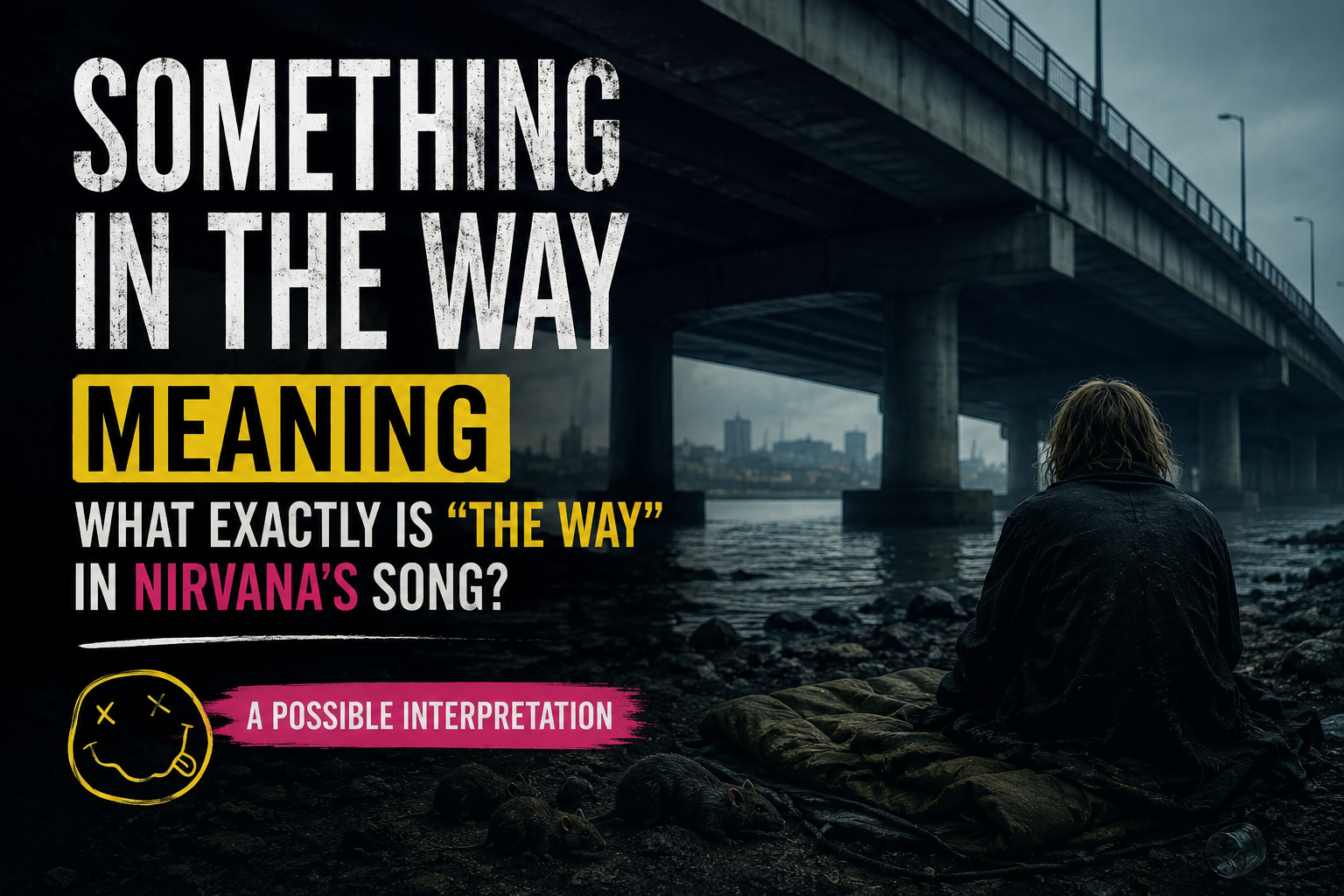
Something in the Way: Nirvana, Consumption and Moral Permission
 POP Ideas · Music & Language
Something in the Way: Nirvana, Consumption and Moral Permission
A possible interpretation of Nirvana’s song through language, consumption, addiction, and moral permission.
🔎 Metaphors and Ideas to Notice
1. Three Ways to Understand “Way”
The first thing that caught my attention was the word way. In English, way does not only mean a physical road. According to Merriam-Webster, it can also refer to a route, a course of action, a method, a manner, a mode, a system, or a habitual form of being.
That means Something in the Way can be read on several levels at once.
1. Something in the path
There is an obstacle that does not let me move forward.
2. Something in the manner
There is something in the way I live, think, feel, consume, or behave that does not work.
3. Something in the way things are
There is an invisible structure, condition, or system that shapes what I can and cannot do.
What exactly is “the way” that something keeps getting in?
2. A Bridge Between Two Moral Worlds
A bridge usually exists so people can cross from one side to another. But in the song, the speaker does not cross. He stays underneath.
That detail matters. The bridge can be read as a border between two ways of living: consumption and refusal, addiction and non-addiction, guilt and purity.
On one side, there is eating, using, needing, surviving. On the other side, there is not eating, not using, not harming, trying to remain clean or morally safe.
But the speaker is not fully on either side. He is under the bridge, suspended between two worlds.
3. When Consumption Becomes Too Intimate
The animal image is central. At first, the animals seem connected to survival. In a survival story, captured animals would normally become food.
But here, something changes: they become companions. That shift transforms their moral status. They are no longer only possible food. They are part of the speaker’s world.
This does not mean that the animals have one fixed symbolic meaning. They can be read literally, but they also belong to Cobain’s wider field of food, body, drugs, pain, and moral judgment.
The stronger idea is this: what could be consumed becomes too close to consume. Need is still there, but attachment interrupts the act.
4. Fish as the Permitted Exception
After the animals become companions, the speaker survives on almost nothing: grass and dripping water. Consumption becomes minimal, passive, and strange.
Then the fish becomes the exception. The line sounds like a justification. The speaker does not simply eat. He explains why this form of eating is acceptable.
This is where the song can echo the logic of addiction. Not because fish literally mean drugs, but because the structure is similar: some forms of consumption are condemned, others are tolerated, and others are explained as “not that bad.”
The question becomes: what can I allow myself to consume without fully condemning myself?
5. Food, Drugs, and Moral Permission in Cobain’s Writing
This reading connects with Jessica L. Wood’s article on Kurt Cobain’s Journals. Wood observes that Cobain often links food, drugs, the body, sickness, and moral judgment.
In the passage Wood analyzes, Cobain contrasts addicts and vegetarians through food and drug-related metaphors. Wood says that Cobain suggests addicts are sincere, while vegetarians are hypocritical. The point is not simply what people eat or refuse to eat. The point is that consumption becomes a moral language.
That helps me return to Something in the Way. The animals, grass, dripping water, and fish do not have to be read only as survival details. They can also belong to a wider pattern: food and the body become ways of talking about moral permission.
In that sense, the fish line is not simply about eating. It sounds like a small moral argument inside a damaged world.
Final Synthesis: What Is in the Way?
If I had to explain this interpretation in one idea, I would say this: the speaker has started to consume something that later becomes too close, too familiar, or too morally charged to consume.
The trapped animals become companions. They cannot simply be eaten anymore. But survival does not disappear. The body still needs something, so another form of consumption has to be justified.
That may be the “something” in the way: the impossibility of crossing into a clean, innocent, or fully justified way of living.
The speaker does not cross the bridge. He remains below it, between consumption and refusal, between need and guilt, between survival and moral permission.
Perhaps that is why the song remains so disturbing: it never tells us how to cross to the other side.
More Nirvana Readings on POP Ideas
Keep exploring other POP Ideas articles on ambiguity, identity, emotional distance, contradiction, and survival in Kurt Cobain’s writing.
- Come as You Are → identity, contradiction, and the impossibility of being only one thing.
Read the analysis - All Apologies → guilt, exposure, silence, and the desire to disappear.
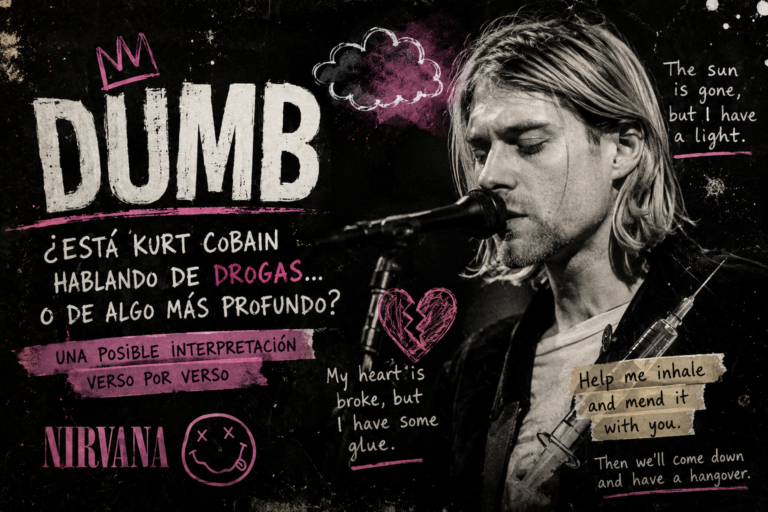
Read the analysis - Dumb → emotional numbness, false happiness, and glue as a metaphor.
Read the analysis - About a Girl → semantic ambiguity and the difficulty of defining a relationship.
Read the analysis - Stay Away → imitation, social pressure, belonging, and rejection.
Read the analysis
References
- Merriam-Webster. “Way” – Definition.
- Merriam-Webster Thesaurus. “Way” – Synonyms and Related Meanings.
- Wood, Jessica L. “Pained Expression: Metaphors of Sickness and Signs of ‘Authenticity’ in Kurt Cobain’s Journals”. Popular Music, 30(3), 2011, pp. 331–349.
Keep Exploring
Keep exploring Nirvana, English, music, metaphor, and culture through POP Ideas.
Read more POP Ideas articles

5 Comments