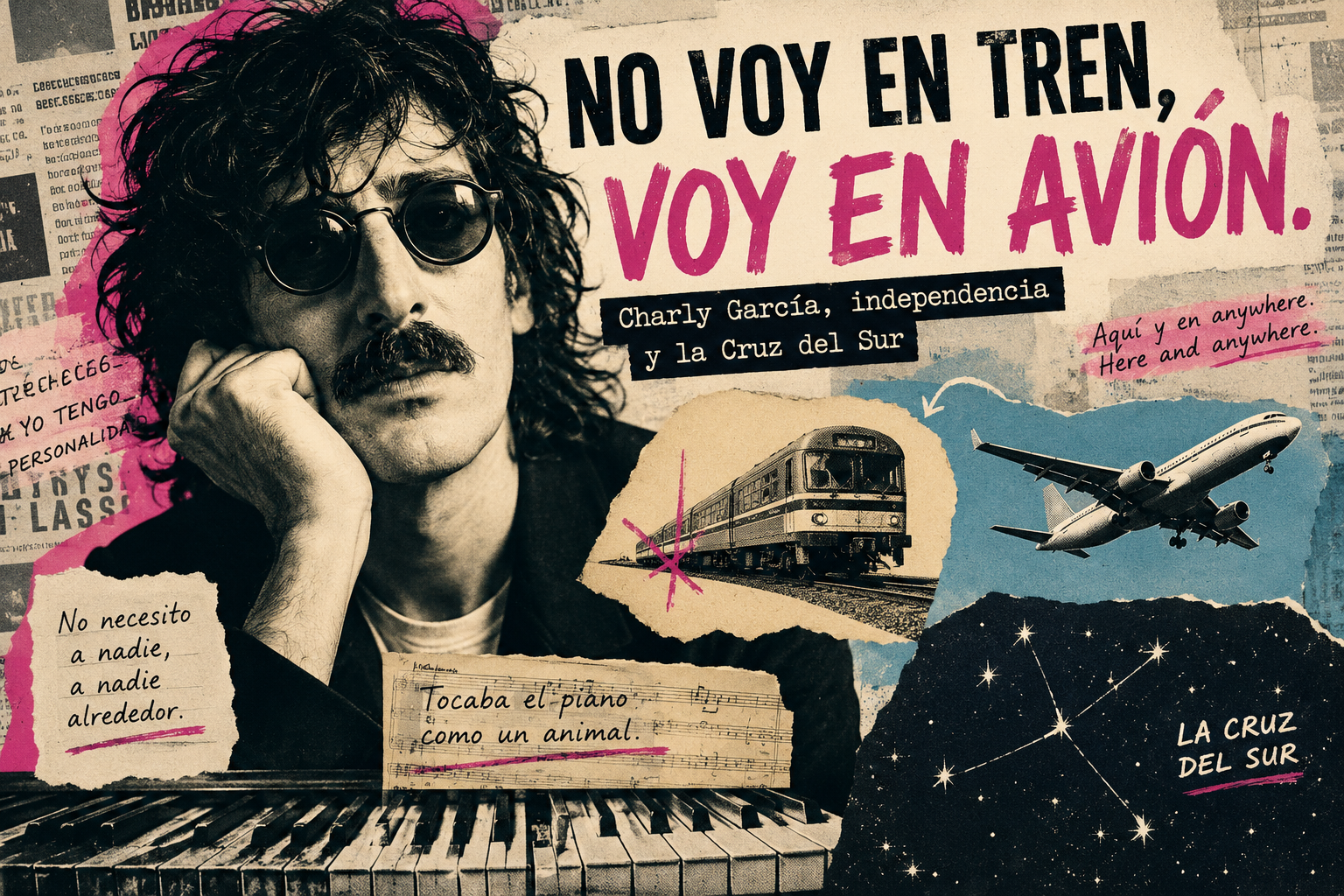
No Voy en Tren Meaning | Charly García, Independence and the Southern Cross
No Voy en Tren Meaning:
Charly García, Independence
and the Southern Cross
A possible cultural and linguistic reading of a song about speed, isolation, media, personality and Southern identity.
No Voy en Tren does not seem to be only a song about transportation. It can be read as a declaration of independence: the speaker refuses the marked path, distances himself from others, and claims his own way of existing in the world.
In this interpretation, the train represents the conventional route, while the plane suggests speed, freedom and a different way of thinking.
🔎 Metaphors and Ideas to Notice
This is one possible interpretation. POP Ideas reads songs as case studies in how language creates meaning.
The Train and the Plane
No voy en tren, voy en avión.
Why comparing a train to a plane?
At first, this sounds like a simple comparison between two means of transportation.
But while listening to the song, another idea cames to my mind.
In Argentina, we have an expression:
“Cuando vos salís y yo ya llegué.”
Literally: “When you are about to leave (to go to a certain place), and I have already arrived, meaning I am smarter than you, I realise things faster and easier than you.”
Of course, nobody is actually talking about traveling.
It is a humorous way of saying that someone thinks faster, reacts faster, or is always one step ahead of everyone else.
That made me wonder whether Charly García is using transportation as a metaphor for thought.
A train follows rails. Its path has already been decided.
A plane leaves the ground. It rises above the fixed route.
Perhaps Charly is not only saying how he travels. Perhaps he is saying how he thinks.
Maybe he is saying: “While you are still following the tracks, the rules, I am already somewhere else.”
Of course, this is only one possible interpretation, but it is the one that came to my mind while listening to the song.
I Don’t Need Anyone
No necesito a nadie,
a nadie alrededor.
Is he talking about freedom or isolation?
This line can be interpreted in different ways.
However, the next line seems to give us a clue.
It may not be only about independence. There may also be tiredness, distance or exhaustion toward other people.
Skin and Other People
Porque no hay nadie que mi piel resista.
What does it mean that “my skin can stand”?
I see at least two possibilities.
The first one is: I can’t stand people.
There is exhaustion or weariness toward others.
But it could also mean the opposite: no one can stand me.
The skin becomes the border between the self and the rest of the world.
In both cases, the same idea appears: a difficulty in living with others.
So when he previously says, “I don’t need anyone around,” we do not know whether he is defending his independence or simply describing a distance that already exists between him and everyone else.
Television, Magazines and Consumption
No veo televisión ni las revistas,
no veo ya nada que no pueda hacer.
Why does he reject the media?
I do not think Charly is simply saying that he does not watch television.
I think he is questioning what television and magazines represent.
Media do not only inform. They also build desire.
They tell us what to consume, how to dress, what to think, what to admire and what kind of life we should want.
So when he says he no longer “sees anything he cannot do” no veo nada que no pueda hacer, he seems to reject that logic.
Why watch magazines that sell consumer models? Why watch television if it only reproduces someone else’s version of life?
The speaker does not want to consume images of life. He wants to live for himself.
Childhood and the Piano
Cuando era niño nunca fui muy listo,
tocaba el piano como un animal.
Why does he return to childhood?
Up to this point, the song speaks from a strong identity: someone who does not go by train, who does not need anyone, who does not consume television or magazines.
But suddenly childhood appears.
That humanizes the speaker.
He was not born as a fully confident figure. There was once a child who perhaps was not considered “smart.”
Then comes a powerful image: playing the piano like an animal.
In Argentina, saying someone is an “animal” can be a way of expressing criticism (brutal=unrational), but it may also be used as a praise (a genious). Animals do not calculate. They do not rationalize. They act by instinct.
Perhaps Charly is saying that he played with natural force, without asking permission and without worrying about the rules.
Being “Mixed”
Yo sé que algunos piensan que soy mixto,
pero yo tengo personalidad.
What does “mixto” mean?
This word opens several possible readings.
It may refer to someone who is difficult to classify.
Someone who mixes styles.
Someone who breaks categories.
But the speaker’s answer is clear: “I have personality.”
As if he were saying: I am not a shapeless mixture. I am not an empty contradiction. I am different because I have an identity of my own.
The Southern Cross
Yo soy de la Cruz del Sur.
Why does Charly mention the Southern Cross?
The Southern Cross, or Crux, is one of the best-known constellations visible from the Southern Hemisphere.
For centuries, sailors used it to find the approximate location of the South Celestial Pole, making it an important navigation guide before modern GPS.
That makes this image particularly interesting.
The Southern Cross is not simply a group of stars.
It is a guide.
When Charly says, “I belong to the Southern Cross,” he may be doing more than stating where he comes from.
He may be expressing a way of seeing the world.
Instead of defining himself through Europe or North America, he defines himself from the South.
The constellation becomes both an identity and a compass.
It tells us where he belongs and how he chooses to navigate the world.
📚 Want to explore further?
EarthSky — Crux: The Southern Cross
https://earthsky.org/constellations/crux-the-southern-cross-jewel-box/
European Southern Observatory — Navigating by the Stars
https://www.eso.org/public/blog/navigating-the-stars/
Closing and Turning Off the Light
Soy el que cierra
y el que apaga la luz.
What does it mean to close and turn off the light?
This image can be read in several ways.
It may refer to the person who puts an end to something.
The one who remains after everyone else has left.
The one who observes the end of a scene.
Or even someone who refuses to keep participating in a show that no longer interests him.
If the Southern Cross is a guide, this line may also suggest someone who marks the end of a stage and decides when the performance is over.
Here and Anywhere
Yo soy de la Cruz del Sur,
aquí y en anywhere.
Why mix Spanish and English?
Charly could have simply said “aquí y en cualquier lugar.”
But he chooses anywhere.
That small change says a lot.
Argentine rock has always been in dialogue with the English-speaking world, but that does not make it less local.
The speaker belongs to the South, but he is not trapped inside a border.
He is from the Southern Cross here, and anywhere.
Final Thought
I do not think No Voy en Tren is a song about means of transportation.
I think it can be read as a declaration of independence.
The speaker rejects prefabricated paths.
He distances himself from others.
He questions the media and consumer culture.
He accepts being difficult to classify.
And finally, he presents himself as someone who belongs to the South, but whose voice can sound anywhere.
That is why the plane is not only a plane. It is a way of moving, thinking and existing outside the marked tracks.